Bao Min, Ma Rongji
School of Public Health, Southeast University, Nanjing, Jiangsu, China.
Department of Medical Affairs, The Second Affiliated Hospital of Soochow University, Suzhou, Jiangsu, China.
BMC Psychiatry. 2024 Dec 24;24(1):947. doi: 10.1186/s12888-024-06312-y.
This study explored the relationship between Adverse Childhood Experiences (ACE), physical pain, and depressive symptoms, and examined the mediating role of pain in the correlation between ACE and depressive symptoms among middle-aged and elderly Chinese (over the age of 45).
Cox proportional hazards regression models were used to analysis the association between ACE, physical pain, and depressive symptoms. To assess the mediating role of physical pain in the relationship between ACE and depressive symptoms, mediation analysis was conducted. Indirect, direct, and total effects were estimated by combining mediation and outcome models, adjusting for relevant covariates. Bayesian network models were used to visually demonstrate the interrelations between factors influencing depressive symptoms, further verifying the association between ACE, physical pain, and depressive symptoms.
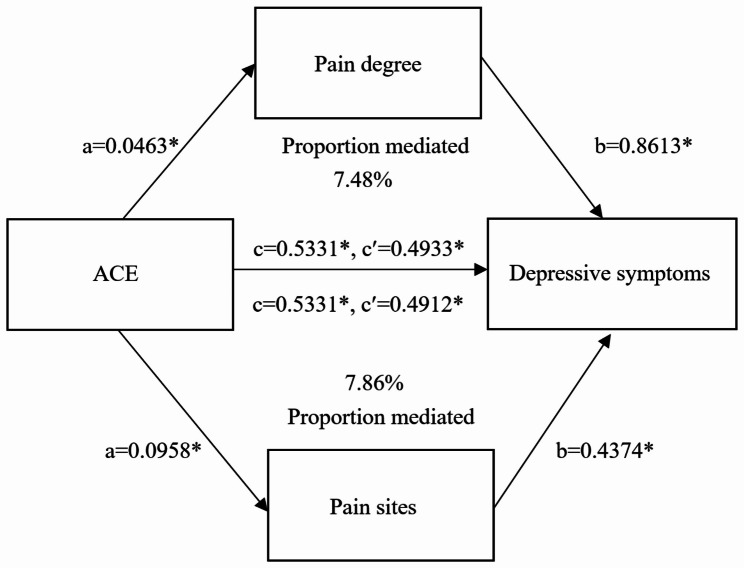
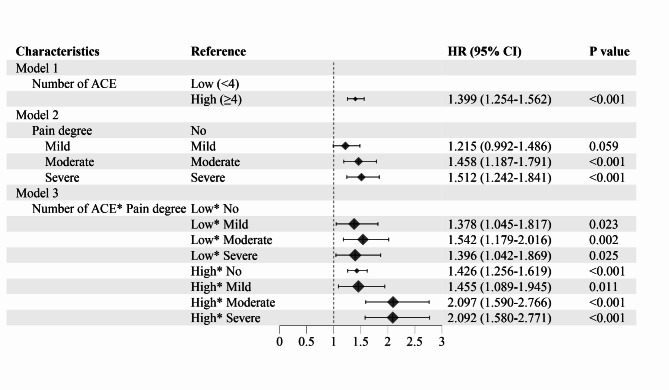
In the fully adjusted model, middle-aged and elderly individuals reporting ACE had a higher risk of developing depressive symptoms (hazard ratios [HR] and 95% confidence intervals [95% CI], 1.379 [1.266-1.503]). Compared to those without physical pain, individuals reporting severe physical pain were at an increased risk of depressive symptoms (HR [95% CI], 1.438 [1.235-1.673]). The risk was even higher for those with both ACE and severe physical pain compared to those with neither (HR [95% CI], 2.020 [1.630-2.505]). The intensity of pain explained 7.48% of the association between ACE and depressive symptoms, while the number of pain sites accounted for 7.86%.
Physical pain partially mediated the association between ACE and depressive symptoms. The study findings highlighted the importance of early screening and intervention for physical pain in middle-aged and older adults with ACE.
Not applicable.
本研究探讨了童年不良经历(ACE)、身体疼痛与抑郁症状之间的关系,并检验了疼痛在45岁以上中国中老年人ACE与抑郁症状相关性中的中介作用。
采用Cox比例风险回归模型分析ACE、身体疼痛与抑郁症状之间的关联。为评估身体疼痛在ACE与抑郁症状关系中的中介作用,进行了中介分析。通过结合中介模型和结果模型估计间接、直接和总效应,并对相关协变量进行调整。使用贝叶斯网络模型直观展示影响抑郁症状的因素之间的相互关系,进一步验证ACE、身体疼痛与抑郁症状之间的关联。
在完全调整模型中,报告有ACE的中老年人出现抑郁症状的风险更高(风险比[HR]和95%置信区间[95%CI],1.379[1.266 - 1.503])。与无身体疼痛的人相比,报告有严重身体疼痛的人出现抑郁症状的风险增加(HR[95%CI],1.438[1.235 - 1.673])。与两者都没有的人相比,同时有ACE和严重身体疼痛的人的风险更高(HR[95%CI],2.020[1.630 - 2.505])。疼痛强度解释了ACE与抑郁症状之间关联的7.48%,而疼痛部位数量占7.86%。
身体疼痛部分介导了ACE与抑郁症状之间的关联。研究结果强调了对有ACE的中老年成年人身体疼痛进行早期筛查和干预的重要性。
不适用。