Luo Xiaolin, Li Zhenbiao, Tang Shengping, Zheng Xinda, Yang Xiujiang, Cai Yangjie, Liao Shijie, Ding Xiaofei
The First Affiliated Hospital of Guangxi Medical University, 6 Shuangyong Road, Nanning, Guangxi, China.
J Orthop Surg Res. 2024 Dec 24;19(1):873. doi: 10.1186/s13018-024-05393-5.
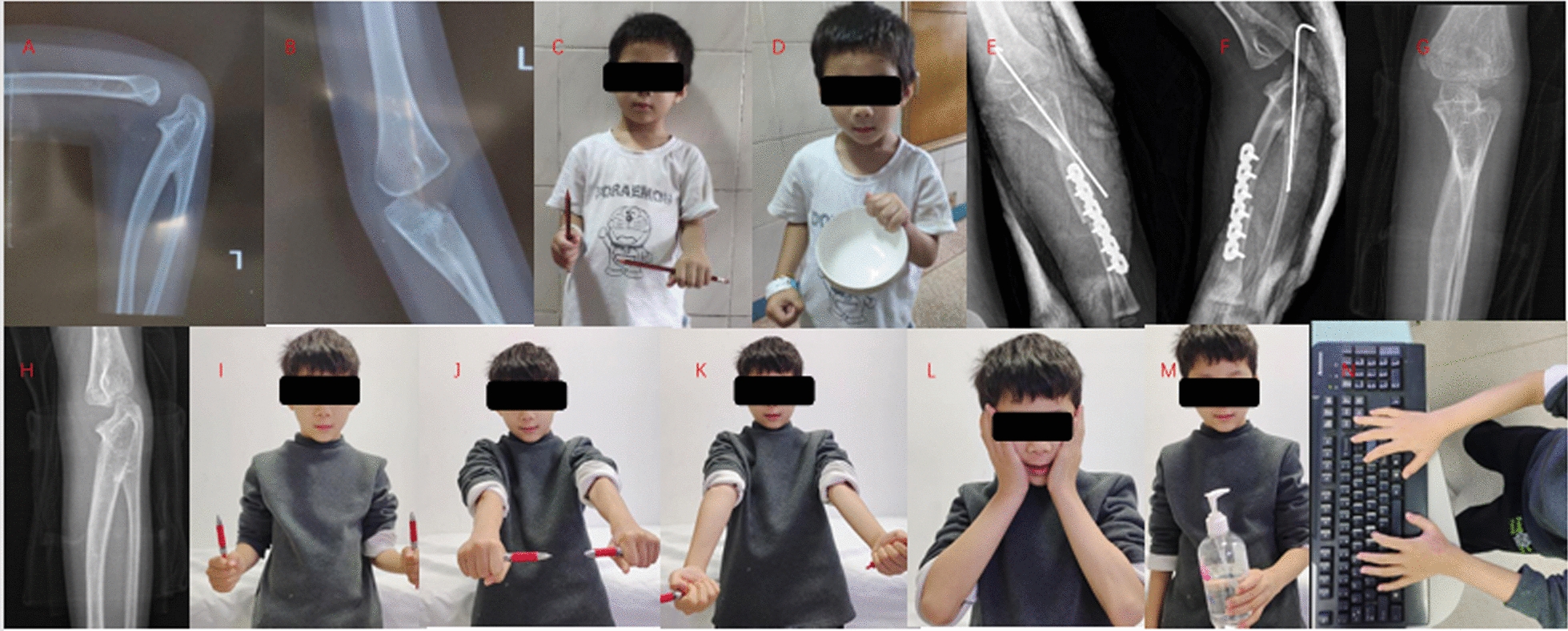
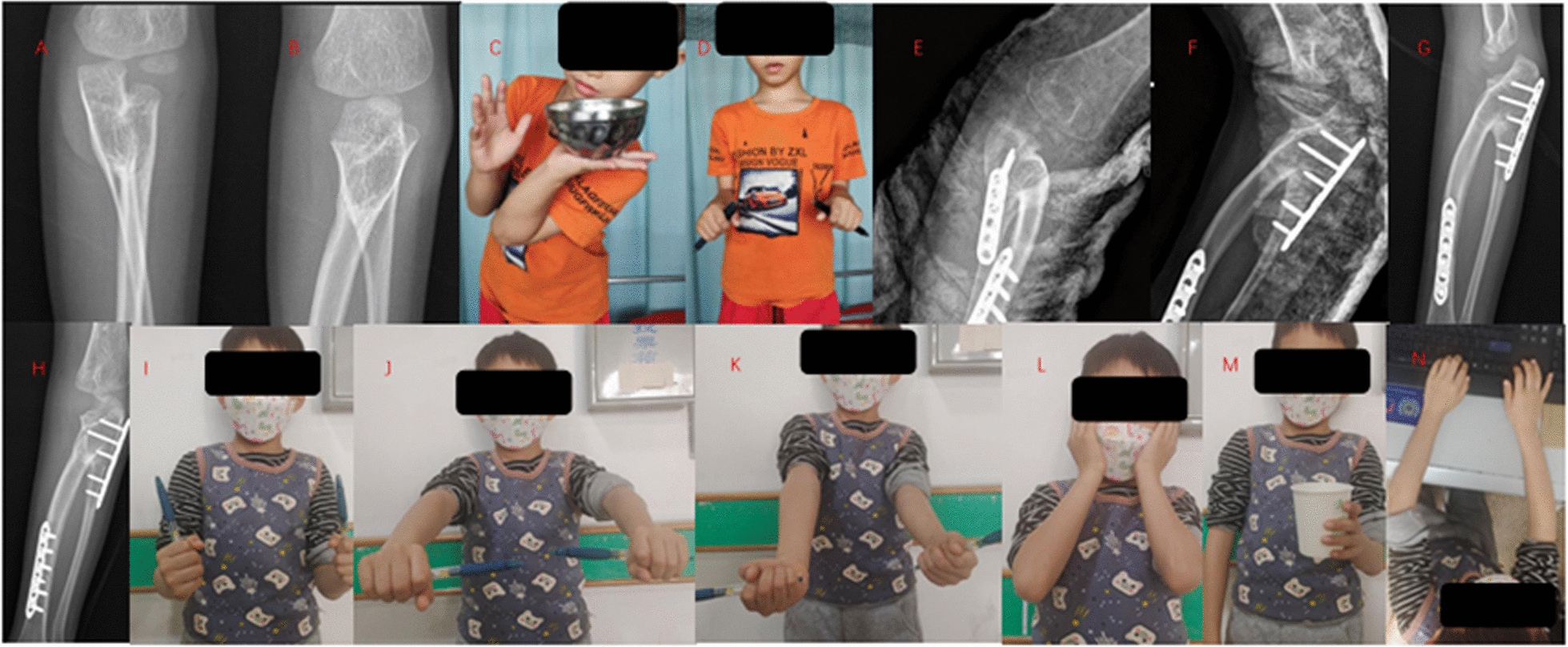
Congenital radioulnar synostosis (CRUS) is a rare upper limb deformity characterized by impaired rotational movement of the forearm. Rotational osteotomy is a commonly employed surgical procedure for treatment. This study aimed to analyze its surgical efficacy in treating CRUS in children.
22 children (24 limbs) with CRUS from January 2010 to December 2023 were retrospectively collected. Rotational osteotomy of proximal ulna and distal radius was performed. Forearm function was evaluated using Failla scores and hygiene and self-care scores in Activities of daily Living score (ADL score). In addition, patients were further grouped and compared according to type of ulnar internal fixation and age at surgery.
22 patients (14 males, 8 females), with an average age of 6.0 years and an average follow-up time of 56 months. The mean pronation angle before surgery was 75.0 ± 11.3°, the mean postoperative pronation angle was 3.8 ± 7.1°, and the mean correction degree was 78.8 ± 12.9°. The average Failla scores were 5.6 ± 2.1 points before operation and 14.0 ± 1.0 points after operation. The average scores of hygiene and self-care scores were 19.0 ± 5.1 points before surgery and 36.0 ± 3.9 points after surgery. No child developed complications such as osteofascial compartment syndrome or infection. The correction angle in the plate fixation group was 86.8 ± 10.6°, while in the K-wires group was 72.0 ± 10.7°. The postoperative Failla scores in the older age group were 13.0 ± 1.1 points, and in the younger age group were 14.3 ± 0.8 points.
Rotational osteotomy of forearm bones is safe and effective in the treatment of CRUS in children. Ulnar plate fixation has better correction than K-wires. Furthermore, younger children have better surgical outcomes than older ones.
先天性桡尺骨融合(CRUS)是一种罕见的上肢畸形,其特征为前臂旋转运动受损。旋转截骨术是常用的治疗手术。本研究旨在分析其治疗儿童CRUS的手术疗效。
回顾性收集2010年1月至2023年12月期间22例患有CRUS的儿童(24条肢体)。进行尺骨近端和桡骨远端的旋转截骨术。使用法伊拉评分以及日常生活活动评分(ADL评分)中的卫生和自我护理评分来评估前臂功能。此外,根据尺骨内固定类型和手术年龄对患者进行进一步分组和比较。
22例患者(14例男性,8例女性),平均年龄6.0岁,平均随访时间56个月。术前平均旋前角度为75.0±11.3°,术后平均旋前角度为3.8±7.1°,平均矫正度数为78.8±12.9°。术前平均法伊拉评分为5.6±2.1分,术后为14.0±1.0分。术前卫生和自我护理评分平均为19.0±5.1分,术后为36.0±3.9分。没有儿童发生骨筋膜室综合征或感染等并发症。钢板固定组的矫正角度为86.8±10.6°,而克氏针组为72.0±10.7°。年龄较大组术后法伊拉评分为13.0±1.1分,年龄较小组为14.3±0.8分。
前臂骨旋转截骨术治疗儿童CRUS安全有效。尺骨钢板固定比克氏针矫正效果更好。此外,年龄较小的儿童手术效果优于年龄较大的儿童。