Varlibas Figen Bakici, Domac Fusun Mayda, Yuksel Gulbun, Akhan Ozkan, Ercin Elif
Department of Neurology, Erenkoy Mental Health and Neurological Diseases Training and Research Hospital, University of Health Sciences, Istanbul, Turkey.
Department of Neurology, Haydarpasa Numune Training and Research Hospital, University of Health Sciences, Istanbul, Turkey.
J Epilepsy Res. 2024 Dec 10;14(2):66-72. doi: 10.14581/jer.24012. eCollection 2024 Dec.
Alzheimer's disease (AD) and epileptic seizure are among the most common health problems in the elderly population. This study aimed to estimate the prevalence rate and predictors of seizures in sporadic AD patients.
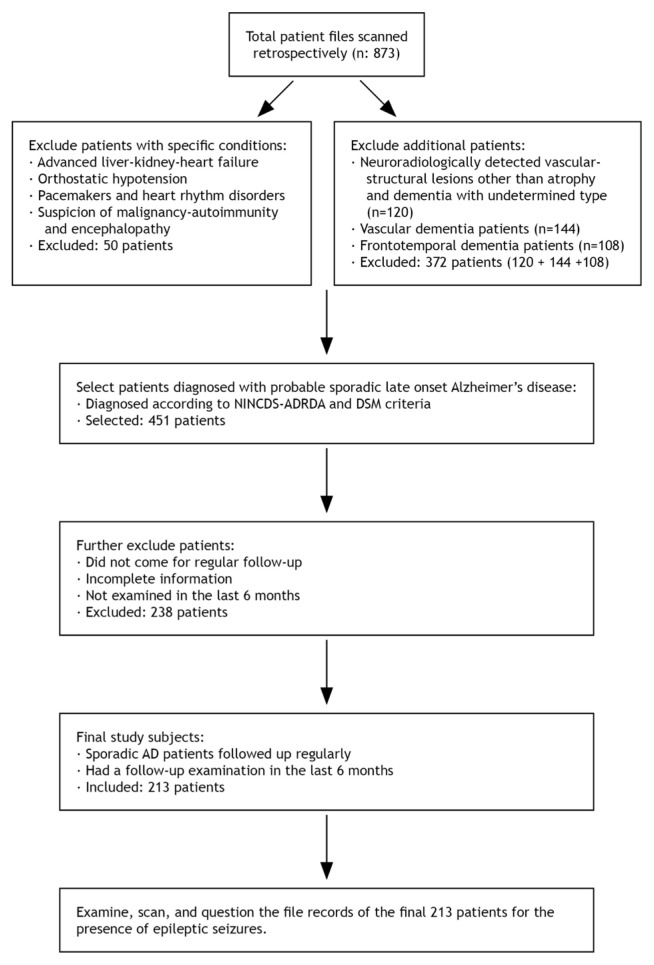
The study was conducted by retrospectively for a period of 10 years examining the file records. Patients were selected among the patients diagnosed with probable sporadic late onset AD according to the National Institute of Neurological Communicative Disorders and Stroke AD and related disorders association criteria and the diagnostic and statistical manual of mental disorders (n=451). In our 213 sporadic AD patients who were followed up regularly and had a follow up examination in the last 6 months, the file records were examined, scanned and questioned for the presence of epileptic seizures.
The prevalence of non provoked generalized tonic clonic seizures in sporadic AD was found to be 6.57% (n=14). Neuroleptic use, presence of diabetes mellitus (DM) and/or treatment, presence of ischemic heart disease (IHD) and/or treatment were found to be 2.99 times, 1.91 times and 3.09 times higher in our patients who had seizures, respectively. When the factors that can affect seizures were examined, the use of neuroleptics and the presence of IHD and/or treatment were found to be statistically significant in terms of the risk of seizure in AD.
The use of neuroleptics, the presence of IHD and DM and/or their medications could facilitate the development of unprovoked generalized tonic clonic seizures in sporadic AD. It is doubtful whether the seizures are primary or secondary generalized.
阿尔茨海默病(AD)和癫痫发作是老年人群中最常见的健康问题。本研究旨在估计散发性AD患者癫痫发作的患病率及预测因素。
本研究通过回顾性研究10年期间的病历记录进行。根据美国国立神经疾病与中风研究所AD及相关疾病协会标准和《精神疾病诊断与统计手册》,从诊断为可能散发性晚发型AD的患者中选取患者(n = 451)。在我们定期随访且在过去6个月内进行了随访检查的213例散发性AD患者中,检查、扫描病历记录并询问是否存在癫痫发作。
散发性AD中非诱发性全面性强直阵挛发作的患病率为6.57%(n = 14)。在有癫痫发作的患者中,使用抗精神病药物、存在糖尿病(DM)和/或接受治疗、存在缺血性心脏病(IHD)和/或接受治疗的比例分别高出2.99倍、1.91倍和3.09倍。当检查可能影响癫痫发作的因素时,发现使用抗精神病药物以及存在IHD和/或接受治疗在AD癫痫发作风险方面具有统计学意义。
使用抗精神病药物、存在IHD和DM以及/或其药物治疗可能促使散发性AD患者发生非诱发性全面性强直阵挛发作。这些癫痫发作是原发性还是继发性全面性发作尚不确定。