Zhang Wendi, Chen Zhaohui
College of Acupuncture and Massage (Rehabilitation Medical College), Anhui University of Chinese Medicine, Hefei, People's Republic of China.
Department of Tendon Injury, The First Affiliated Hospital of Anhui University of Chinese Medicine, Hefei, People's Republic of China.
J Pain Res. 2024 Dec 19;17:4433-4445. doi: 10.2147/JPR.S488988. eCollection 2024.
The aim of the research was to observe the variations in brain activity between young cervical spondylosis patients with chronic neck pain (CNP) and healthy volunteers in the resting state and to investigate the central remodeling mechanisms in the patients.
Our study recruited 31 patients with chronic neck pain from cervical spondylosis and 30 healthy volunteers. Eventually, 29 patients (CNP group) and 29 healthy volunteers (HC group) completed the acquisition of clinical data and resting-state functional magnetic resonance ( BOLD-fMRI) amplitude of low-frequency fluctuations (ALFF) data; in addition, we assessed the relationship between differentially active brain regions and clinical indicators.
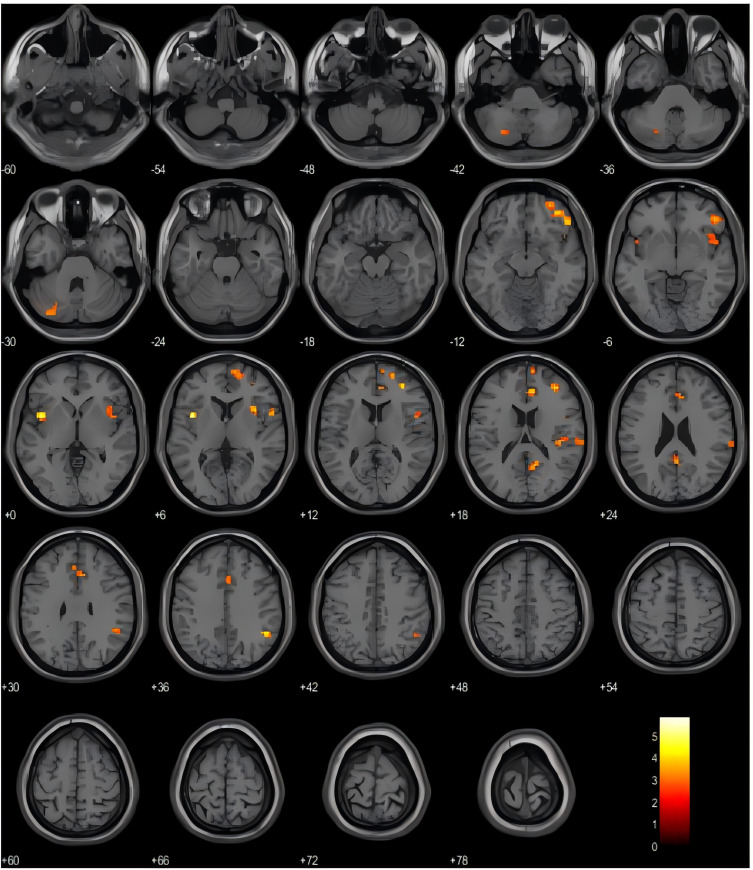
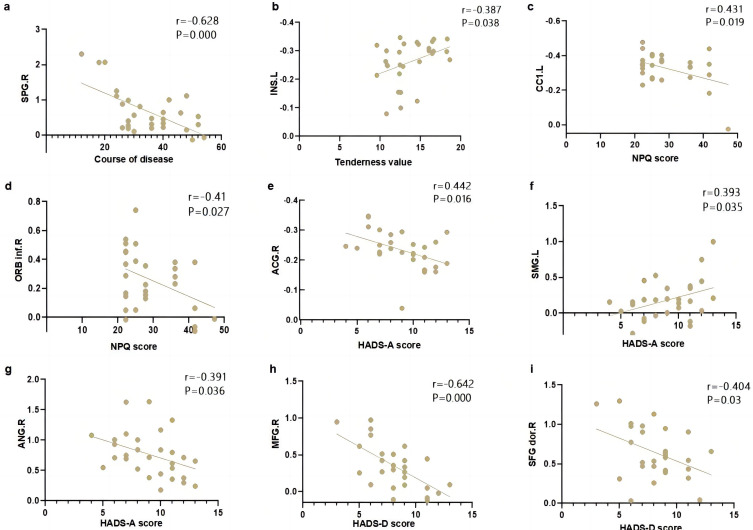
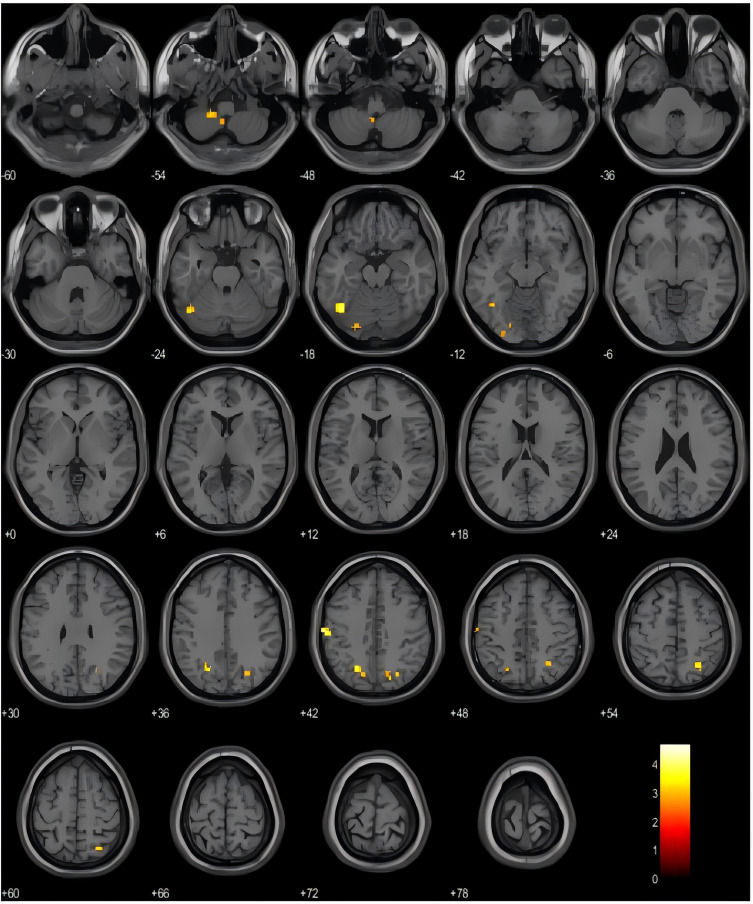
The CNP group found greater ALFF values in the insula, cingulate gyrus, prefrontal lobe, and other brain regions. The occipital, parietal, and other brain regions had lower ALFF values. In addition, there was a negative connection between the duration of the sickness in the CNP group and the ALFF value of the right superior parietal gyrus (SPG.R). The level of tenderness threshold exhibited a negative correlation with the ALFF value of the left insula (INS.L). In addition, the NPQ score showed a negative association with the ALFF value of the ORBinf.R and a positive correlation with the ALFF value of the CC1.L. Finally, the HADS-A score exhibited a positive correlation with the ALFF value of the right anterior cingulate and paracingulate gyrus (ACG.R).
Young patients with chronic neck pain show extensive central remodeling, with altered functional activity in pain-emotion brain areas (such as the cingulate gyrus and insula), pain-cognition brain areas (such as the prefrontal lobe), and other special sensory brain areas (such as the parietal and occipital lobes). These changes are linked to clinical tenderness, functional disability, and negative emotion indicators.
本研究旨在观察慢性颈部疼痛(CNP)的年轻颈椎病患者与健康志愿者在静息状态下脑活动的差异,并探讨患者的中枢重塑机制。
本研究招募了31例颈椎病慢性颈部疼痛患者和30名健康志愿者。最终,29例患者(CNP组)和29名健康志愿者(HC组)完成了临床数据采集及静息态功能磁共振(BOLD-fMRI)低频振幅(ALFF)数据采集;此外,我们评估了差异激活脑区与临床指标之间的关系。
CNP组在岛叶、扣带回、前额叶等脑区发现较高的ALFF值。枕叶、顶叶等脑区的ALFF值较低。此外,CNP组病程与右上顶叶(SPG.R)的ALFF值呈负相关。压痛阈值水平与左侧岛叶(INS.L)的ALFF值呈负相关。此外,NPQ评分与右侧眶额下回(ORBinf.R)的ALFF值呈负相关,与左侧扣带中部(CC1.L)的ALFF值呈正相关。最后,HADS-A评分与右侧前扣带回及旁扣带回(ACG.R)的ALFF值呈正相关。
慢性颈部疼痛的年轻患者表现出广泛的中枢重塑,疼痛-情感脑区(如扣带回和岛叶)、疼痛-认知脑区(如前额叶)以及其他特殊感觉脑区(如顶叶和枕叶)的功能活动发生改变。这些变化与临床压痛感、功能障碍及负性情绪指标相关。