Popescu Dominique Lynn, Abramson Jessica, Keins Sophia, Mallick Akashleena, Kourkoulis Christina, Anderson Christopher D, Rosand Jonathan, Biffi Alessandro, Yechoor Nirupama
Henry and Allison McCance Center for Brain Health, Massachusetts General Hospital, Boston, Massachusetts, USA.
Department of Psychiatry, Center for Health Outcomes and Interdisciplinary Research, Massachusetts General Hospital, Boston, Massachusetts, USA.
BMJ Neurol Open. 2024 Dec 18;6(2):e000728. doi: 10.1136/bmjno-2024-000728. eCollection 2024.
Survivors of intracerebral haemorrhage (ICH) are at high risk of incident depression, which is modified by social determinants of health (SDOH) and associated with worse functional outcomes. We sought to determine the role of prestroke SDOH in depression incidence after ICH to better characterise post-ICH outcomes.
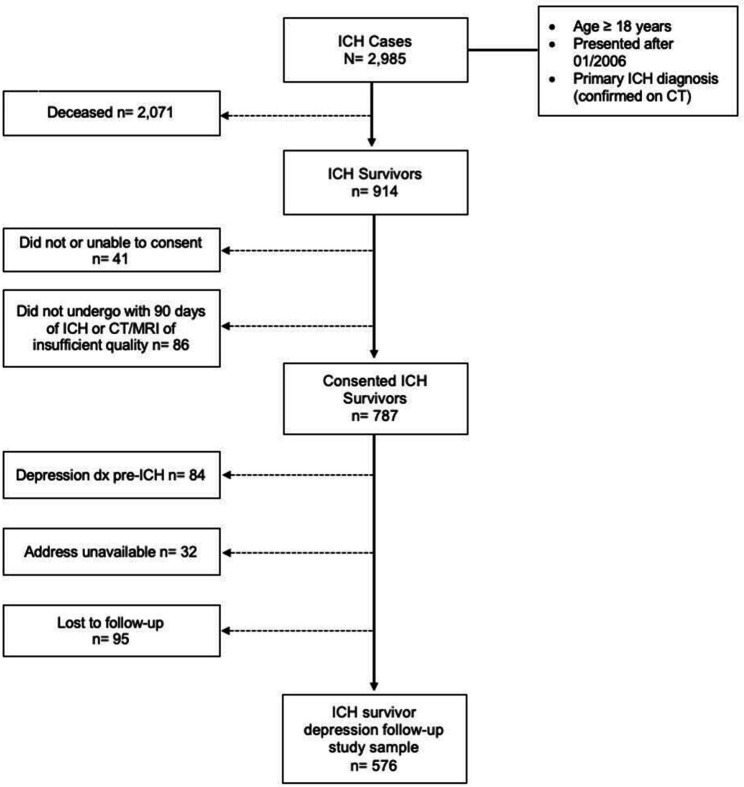
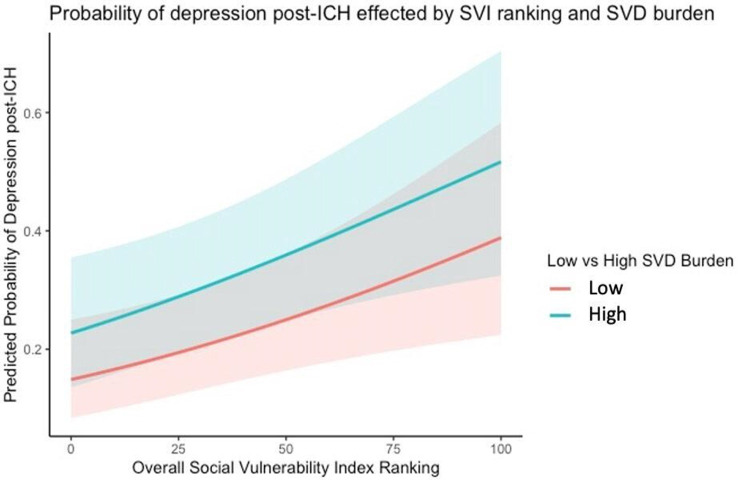
We analysed data from a cohort study of ICH survivors without prestroke depression, presenting at Massachusetts General Hospital between 2006 and 2017. We collected information from electronic health records (EHR), follow-up interviews and CT/MRI. The relationship between social vulnerability, air quality and post-ICH depression incidence within 12 months of acute haemorrhage was investigated using logistic regression models that also included EHR and CT/MRI information as predictors.
Participants were 576 survivors, median age of 72 (IQR=61-81), 317 (55%) self-reported as male and 482 (84%) as white. 204 (35%) were diagnosed with depression within 12 months of ICH. Hospital admission longer than 1 week (OR 1.80, 95% CI 1.08 to 3.00), cerebral amyloid angiopathy (CAA) burden (OR 1.45, 95% CI 1.25 to 1.68) and social vulnerability (OR 3.03, 95% CI 1.49 to 6.19) were associated with depression incidence post-ICH.
In addition to CAA burden and patient location 1-week post-ICH, social vulnerability was independently associated with depression among ICH survivors. Our findings suggest that social vulnerability influences ICH outcomes. Future studies should investigate how poststroke clinical care interventions can address SDOH effects to reduce incident depression and improve outcomes among ICH survivors.
脑出血(ICH)幸存者发生抑郁症的风险很高,健康的社会决定因素(SDOH)会对其产生影响,且抑郁症与较差的功能结局相关。我们试图确定卒中前SDOH在ICH后抑郁症发生率中的作用,以更好地描述ICH后的结局。
我们分析了一项队列研究的数据,该研究对象为2006年至2017年间在马萨诸塞州总医院就诊的无卒中前抑郁症的ICH幸存者。我们从电子健康记录(EHR)、随访访谈和CT/MRI中收集信息。使用逻辑回归模型研究了社会脆弱性、空气质量与急性出血后12个月内ICH后抑郁症发生率之间的关系,该模型还将EHR和CT/MRI信息作为预测因素。
参与者为576名幸存者,中位年龄72岁(IQR=61-81),317名(55%)自我报告为男性,482名(84%)为白人。204名(35%)在ICH后12个月内被诊断为抑郁症。住院时间超过1周(OR 1.80,95%CI 1.08至3.00)、脑淀粉样血管病(CAA)负担(OR 1.45,95%CI 1.25至1.68)和社会脆弱性(OR 3.03,95%CI 1.49至6.19)与ICH后抑郁症发生率相关。
除了CAA负担和ICH后1周的患者位置外,社会脆弱性与ICH幸存者的抑郁症独立相关。我们的研究结果表明,社会脆弱性会影响ICH结局。未来的研究应调查卒中后临床护理干预如何应对SDOH的影响,以减少抑郁症的发生并改善ICH幸存者的结局。