Fu Yu, Zhao Dan-Rong, Gao Li-Bing, Zhang Hai-Jun, Feng Jia, Min Yu-Na, Qi Guang-Hai, Wang Jing
Key Laboratory of Feed Biotechnology, Ministry of Agriculture and Rural Affairs, Institute of Feed Research, Chinese Academy of Agricultural Sciences, Beijing 100081, PR China.
Key Laboratory of Feed Biotechnology, Ministry of Agriculture and Rural Affairs, Institute of Feed Research, Chinese Academy of Agricultural Sciences, Beijing 100081, PR China; College of Animal Science and Technology, Northwest A&F University, Yangling 712100, Shaanxi, PR China.
Poult Sci. 2025 Feb;104(2):104661. doi: 10.1016/j.psj.2024.104661. Epub 2024 Dec 14.
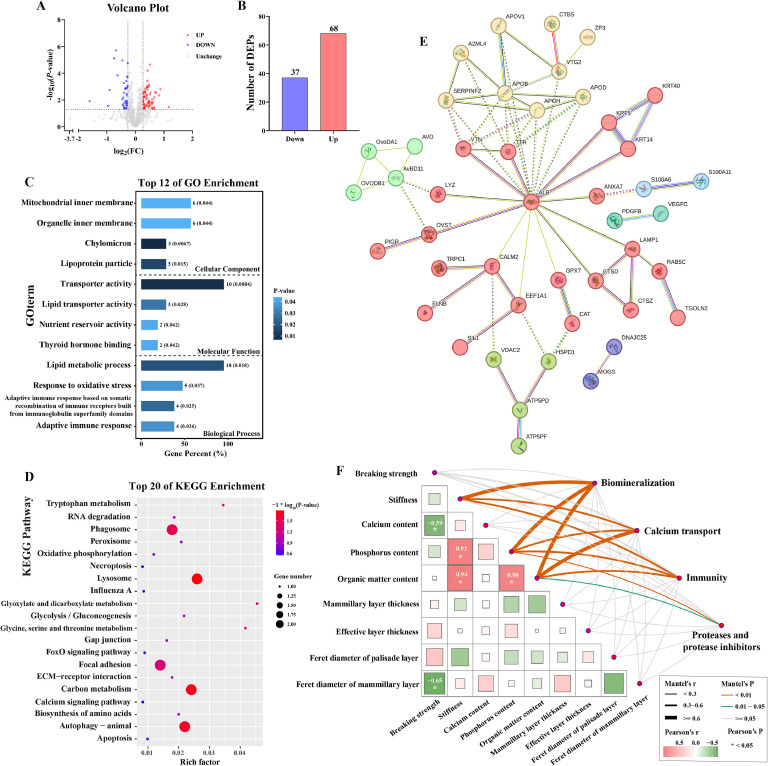
The decline in eggshell quality with increasing hen age may be related to changes in ultrastructure and chemical composition, with matrix proteins playing key roles in these changes. However, research on blue-shelled eggs remains limited. This study investigated the effects of hen age (35, 55, 75, and 85 weeks) on the physical, mechanical, and chemical properties of eggshells in the Xinyang blue-shelled laying hens, as well as their ultrastructural and nanostructural characteristics. Subsequently, a comparative proteomic analysis was performed to elucidate the differential protein profiles in eggshells from hens at 35 and 85 weeks of age. Results showed that egg weight, eggshell weight, and eggshell surface area increased with hen age, whereas eggshell stiffness decreased (p < 0.05). As the age advanced, the eggshell organic matter content declined (p < 0.05). The effective layer ratio, mammillae density, as well as the porosity and total pore area in the mammillary layer also decreased with age, whereas the ratio of the mammillary layer increased (p < 0.05). Compared to eggshells collected from 35-week-old hens, those from 85-week-old hens showed increases in egg weight, eggshell weight, surface area, and both the ratio and thickness of the mammillary layer (p < 0.05). However, significant decreases were observed in eggshell stiffness, organic matter content, phosphorus content, effective layer ratio, mammillae density, as well as the porosity and total pore area in the mammillary layer (p < 0.05). Additionally, eggshell stiffness, phosphorus content, and organic matter content were significantly correlated with each other (p < 0.05). Proteomic analysis identified 37 downregulated and 68 upregulated differentially expressed proteins (DEPs, FC > 1.2 or < 0.83, with a p-value < 0.05) in eggshells from 85-week-old hens compared to those from 35-week-old hens. These DEPs are associated with functions such as biomineralization, calcium transport, immunity, and proteases and protease inhibitors. Mantel and Pearson correlations suggest that these functions may be involved in regulating eggshell stiffness, phosphorus content, and organic matter content. Overall, the eggshell stiffness decreased from 35 to 85 weeks of age, which may be attributed to the reductions in eggshell organic matter and phosphorus contents, as well as the deteriorations in eggshell ultrastructure. The proteins associated with biomineralization, calcium transport, immunity, and proteases and protease inhibitors may contribute to these changes.
随着母鸡年龄增长,蛋壳质量下降可能与超微结构和化学成分的变化有关,其中基质蛋白在这些变化中起关键作用。然而,关于蓝壳蛋的研究仍然有限。本研究调查了母鸡年龄(35、55、75和85周)对信阳蓝壳蛋鸡所产鸡蛋蛋壳的物理、机械和化学性质,以及其超微结构和纳米结构特征的影响。随后,进行了比较蛋白质组学分析,以阐明35周龄和85周龄母鸡所产鸡蛋蛋壳中差异蛋白质谱。结果表明,蛋重、蛋壳重和蛋壳表面积随母鸡年龄增加而增加,而蛋壳硬度下降(p<0.05)。随着年龄增长,蛋壳有机质含量下降(p<0.05)。有效层比例、乳突密度以及乳突层中的孔隙率和总孔隙面积也随年龄下降,而乳突层比例增加(p<0.05)。与35周龄母鸡所产蛋壳相比,85周龄母鸡所产蛋壳的蛋重、蛋壳重、表面积以及乳突层比例和厚度均增加(p<0.05)。然而,观察到蛋壳硬度、有机质含量、磷含量、有效层比例、乳突密度以及乳突层中的孔隙率和总孔隙面积显著下降(p<0.05)。此外,蛋壳硬度、磷含量和有机质含量之间存在显著相关性(p<0.05)。蛋白质组学分析鉴定出,与35周龄母鸡所产蛋壳相比,85周龄母鸡所产蛋壳中有37种下调和68种上调的差异表达蛋白(DEPs,FC>1.2或<0.83,p值<0.05)。这些DEPs与生物矿化、钙转运、免疫以及蛋白酶和蛋白酶抑制剂等功能相关。Mantel和Pearson相关性表明,这些功能可能参与调节蛋壳硬度、磷含量和有机质含量。总体而言,蛋壳硬度在35至85周龄之间下降,这可能归因于蛋壳有机质和磷含量的降低以及蛋壳超微结构的恶化。与生物矿化、钙转运、免疫以及蛋白酶和蛋白酶抑制剂相关的蛋白质可能导致了这些变化。