Chowdhry Bhabesh K, Gupta Prakriti, Giridhar M F, Chaudhary Neha, Kumar Chandramohan, Dalai Richie
Department of Neonatology, All India Institute of Medical Sciences, Patna, Bihar, India.
Department of Pediatrics, All India Institute of Medical Sciences, Patna, Bihar, India.
J Family Med Prim Care. 2024 Nov;13(11):5244-5248. doi: 10.4103/jfmpc.jfmpc_809_24. Epub 2024 Nov 18.
The cut-off for referral to a higher center and further investigations for the delayed passage of first urine and meconium by a neonate have been traditionally kept after 48 hours of birth. There are very few studies regarding this in Indian neonates, and previous studies have relied primarily on the mother's recall of the event which may have led to recall bias. Therefore, through this study, we wanted to use hospital intake/output records to identify the risk factors that affect the timing of passage of first urine and stool in neonates delivered at our center and to find out if the cut-off of 48 hours to call it a delay is justifiable.
This was a single-center, prospective observational study conducted in Eastern India. After obtaining ethics committee approval, the eligible neonates delivered at the center were prospectively enrolled between June 2020 to December 2022. The timing of passage of first urine and meconium was noted using 3 hourly collected information from the input/output charts maintained by the nursing staff in the postnatal wards. The median time of passage of first urine and meconium was compared across gender, gestation, and birth weight. To find the factors associated independently with delayed passage of meconium, multivariable logistic regression was used.
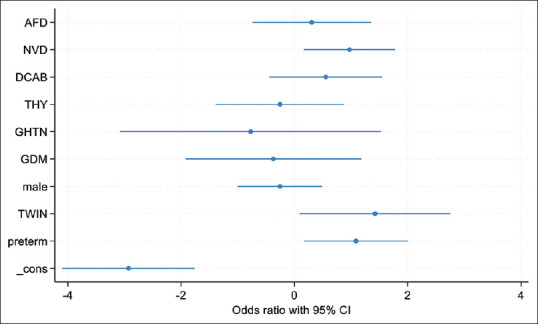
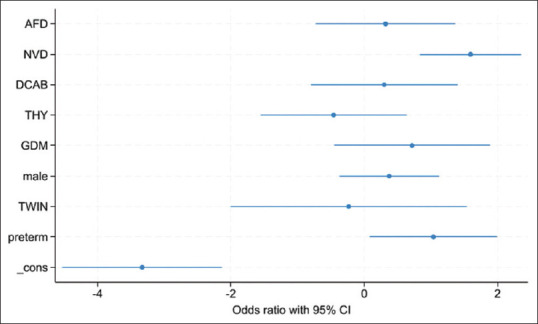
A total of 330 neonates were enrolled prospectively in the study. Approximately two-thirds of them passed first urine (69.7%) and meconium (62.7%) within 6 hours after delivery. The median and interquartile range (IQR) of the time of passage of the first urine was 4 (1-7) hours of life. This did not vary significantly for gender, gestation, and birthweight categories. The median (IQR) of time of passage of meconium was 4 (1-8) hours of life, which was significantly higher for male [5 (2-8.5), ( = 0.029)] and preterm neonates [6.3 (2.5-12), ( = 0.001)], but did not vary significantly for birthweight categories. On multivariable logistic regression, twin gestation [OR 4.15 (95% CI 1.09-15.76); = 0.036] and preterm birth [OR 2.97 (95% CI 1.18-7.43); = 0.02] increased the odds of passage of meconium beyond 12 hours' postnatal age. 99.39% and 98.77% of the neonates passed urine and meconium respectively within 24 hours.
The median time of passage of first urine was not influenced by gender, gestation at birth, and birthweight categories. The median time of passage of meconium was significantly higher for male and preterm neonates. Also, with early initiation of direct breastfeeding and good feeding support most neonates pass their first urine and stool by 24 hours of life. So, maybe it's time to revise the cut-off for referrals or investigations from 48 hours to 24 hours of life. However, further studies with larger sample sizes will be required to confirm this cut-off.
传统上,对于新生儿首次排尿和胎粪排出延迟转诊至上级中心并进行进一步检查的时间节点设定在出生后48小时。关于印度新生儿这方面的研究非常少,而且以往研究主要依赖母亲对该事件的回忆,这可能导致回忆偏差。因此,通过本研究,我们希望利用医院的出入院记录来确定影响在我们中心分娩的新生儿首次排尿和排便时间的危险因素,并探究将48小时作为延迟判定标准是否合理。
这是一项在印度东部进行的单中心前瞻性观察研究。获得伦理委员会批准后,2020年6月至2022年12月期间在该中心分娩的符合条件的新生儿被前瞻性纳入研究。通过产后病房护理人员维护的出入量图表每3小时收集一次信息,记录首次排尿和胎粪排出的时间。比较首次排尿和胎粪排出的中位时间在性别、孕周和出生体重方面的差异。为了找出与胎粪排出延迟独立相关的因素,采用多变量逻辑回归分析。
共有330名新生儿前瞻性纳入本研究。其中约三分之二的新生儿在出生后6小时内排出了首次尿液(69.7%)和胎粪(62.7%)。首次排尿时间的中位数和四分位间距(IQR)为出生后4(1 - 7)小时。在性别、孕周和出生体重类别方面,这一情况没有显著差异。胎粪排出时间的中位数(IQR)为出生后4(1 - 8)小时,男性[5(2 - 8.5),P = 0.029]和早产儿[6.3(2.5 - 12),P = 0.001]的这一数值显著更高,但在出生体重类别方面没有显著差异。多变量逻辑回归分析显示,双胎妊娠[比值比(OR)4.15(95%置信区间1.09 - 15.76);P = 0.036]和早产[OR 2.97(95%置信区间1.18 - 7.43);P = 0.02]会增加出生后12小时后胎粪排出的几率。分别有99.39%和98.77%的新生儿在24小时内排出了尿液和胎粪。
首次排尿的中位时间不受性别、出生孕周和出生体重类别的影响。男性和早产儿胎粪排出的中位时间显著更长。此外,随着早期直接母乳喂养的开始以及良好的喂养支持,大多数新生儿在出生后24小时内排出了首次尿液和粪便。所以,也许是时候将转诊或检查的时间节点从48小时修订为24小时了。然而,需要更大样本量的进一步研究来证实这一时间节点。