Papaleo Stella, Nodari Riccardo, Sterzi Lodovico, D'Auria Enza, Cattaneo Camilla, Bettoni Giorgia, Bonaiti Clara, Pagliarini Ella, Zuccotti Gianvincenzo, Panelli Simona, Comandatore Francesco
Pediatric Clinical Research Center "Invernizzi", Department of Biomedical and Clinical Sciences, University of Milan, Milan, Italy.
Department of Pediatrics, Buzzi Children's Hospital, University of Milan, Milan, Italy.
PLoS One. 2024 Dec 26;19(12):e0310675. doi: 10.1371/journal.pone.0310675. eCollection 2024.
Candidate Phyla Radiation (CPR) is a large monophyletic group encompassing about 25% of bacterial diversity. Among CPR, "Candidatus Saccharibacteria" is one of the most clinically relevant phyla. Indeed, it is enriched in the oral microbiota of subjects suffering from immune-mediated disorders and it has been found to have immunomodulatory activities. For these reasons, it is crucial to have reliable methods to detect and quantify this bacterial lineage in human samples, including saliva.
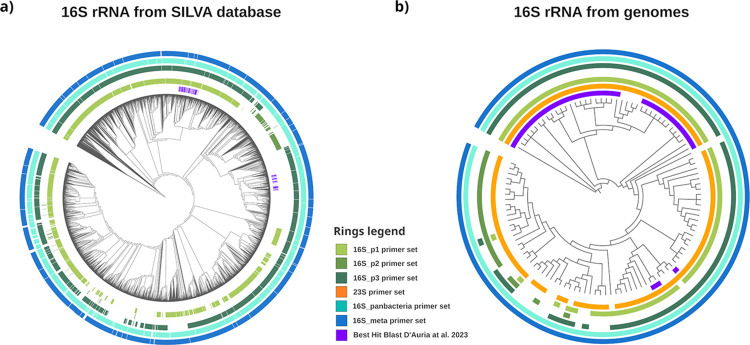
Four qPCR protocols for quantifying "Ca. Saccharibacteria" (one targeting the 23S rRNA gene and three the 16S) were tested and compared. The efficiency and coverage of these four protocols were evaluated in silico on large genomic datasets, and in vitro on salivary DNA samples, already characterized by amplicon sequencing on the V3-V4 regions of the 16S rRNA. In silico PCR analyses showed that all qPCR primers lose part of the "Ca. Saccharibacteria" genetic variability, even if the 23S qPCR primers matched more lineages than the 16S qPCR primers. In vitro qPCR experiments confirmed that all 16S-based protocols strongly underestimated "Ca. Saccharibacteria" in salivary DNA, while the 23S qPCR protocol gave quantifications more comparable to 16S amplicon sequencing.
Overall, our results show that the 23S-based qPCR protocol is more precise than the 16S-based ones in quantifying "Ca. Saccharibacteria", although all protocols probably underestimate specific lineages. These results underline the current limits in quantifying "Ca. Saccharibacteria", highlighting the needs for novel experimental strategies or methods. Indeed, the underestimation of "Ca. Saccharibacteria" in clinical samples could hide its role in human health and in the development of immune-mediated diseases.
候选门辐射类群(CPR)是一个大型单系类群,包含约25%的细菌多样性。在CPR中,“候选糖菌门”是与临床最相关的门类之一。事实上,它在患有免疫介导疾病的个体口腔微生物群中富集,并且已发现其具有免疫调节活性。基于这些原因,拥有可靠的方法来检测和定量人类样本(包括唾液)中的这种细菌谱系至关重要。
测试并比较了四种用于定量“候选糖菌门”的qPCR方案(一种靶向23S rRNA基因,三种靶向16S)。在大型基因组数据集上进行了计算机模拟评估这四种方案的效率和覆盖范围,并在唾液DNA样本上进行了体外评估,这些样本已经通过16S rRNA的V3 - V4区域的扩增子测序进行了表征。计算机模拟PCR分析表明,所有qPCR引物都丢失了部分“候选糖菌门”的遗传变异性,尽管23S qPCR引物比16S qPCR引物匹配更多的谱系。体外qPCR实验证实,所有基于16S的方案都严重低估了唾液DNA中的“候选糖菌门”,而基于23S的qPCR方案给出的定量结果与16S扩增子测序更具可比性。
总体而言,我们的结果表明,在定量“候选糖菌门”时,基于23S的qPCR方案比基于16S的方案更精确,尽管所有方案可能都低估了特定谱系。这些结果强调了当前在定量“候选糖菌门”方面的局限性,突出了对新的实验策略或方法的需求。事实上,临床样本中“候选糖菌门”的低估可能掩盖其在人类健康和免疫介导疾病发展中的作用。