Sato Miki Takenaka, Araki Takuya, Yashima Hideaki, Ishikawa Yuya, Morita Jun, Maeda Yoshiko, Ohbayashi Masayuki, Kohyama Noriko, Ogawa Yoshio, Fukagai Takashi, Yamamoto Koujirou, Kogo Mari
Division of Pharmacotherapeutics, Department of Clinical Pharmacy, School of Pharmacy, Showa University, 1-5-8 Hatanodai, Shinagawa-ku, Tokyo, 142-8555, Japan.
Department of Clinical Pharmacology and Therapeutics, Gunma University Graduate School of Medicine, Maebashi, Japan.
Cancer Chemother Pharmacol. 2024 Dec 26;95(1):14. doi: 10.1007/s00280-024-04741-w.
The blood concentrations of some tyrosine kinase inhibitors are known to decrease with long-term administration. We evaluated the variability in the serum concentrations of sunitinib and its metabolites in patients receiving long-term sunitinib treatment.
This study prospectively recruited patients who received sunitinib for metastatic renal cell carcinoma at the Showa University Hospital between March 2020 and January 2022. Bivariate correlations between the serum concentration/dose (C/D) ratios of sunitinib and its metabolites (i.e., N-desethyl sunitinib and sunitinib N-oxide) and treatment duration were evaluated using Pearson's correlation coefficient.
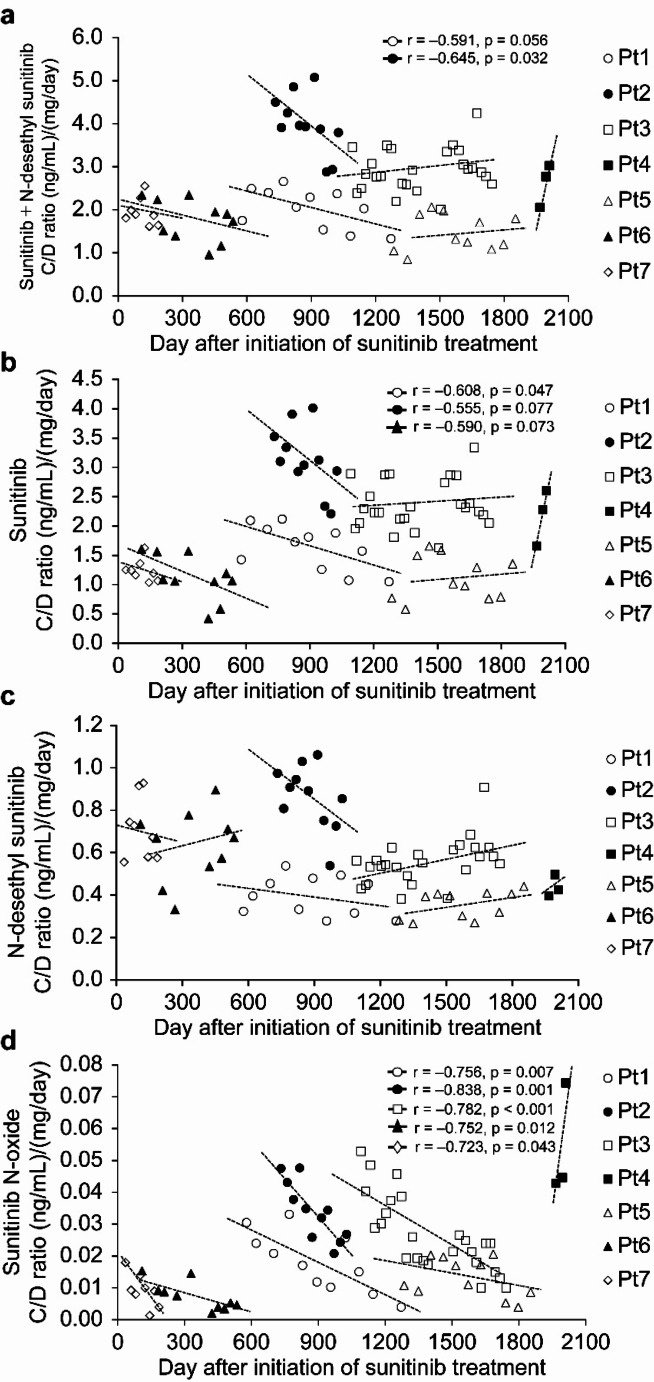
Seven patients were enrolled, and 79 blood samples were collected. Among six patients who received sunitinib for > 1 year, three showed a decreasing trend in the C/D ratio of sunitinib (Pt1: r = -0.608, p = 0.047; Pt2: r = -0.555, p = 0.077; Pt6: r = -0.590, p = 0.073). In these patients, the median annual decrease in the C/D ratio of sunitinib was 55.8% (26.5-63.2%). Additionally, two of the three patients also showed a decrease in the C/D ratio of N-desethyl sunitinib. The ratio of N-desethyl sunitinib/sunitinib concentration at baseline and the end of follow-up was similar between the C/D-decreased and C/D-non-decreased groups.
This study showed that the C/D ratio of sunitinib decreased by half over time in half of the patients who received long-term sunitinib treatment despite continuing the same dose. Therefore, serum concentrations of sunitinib and its metabolites should be monitored periodically in patients receiving long-term treatment to prevent decrease in serum sunitinib concentrations.
已知某些酪氨酸激酶抑制剂的血药浓度会随着长期给药而降低。我们评估了长期接受舒尼替尼治疗的患者中舒尼替尼及其代谢物血清浓度的变异性。
本研究前瞻性招募了2020年3月至2022年1月在昭和大学医院接受舒尼替尼治疗转移性肾细胞癌的患者。使用Pearson相关系数评估舒尼替尼及其代谢物(即N-去乙基舒尼替尼和舒尼替尼N-氧化物)的血清浓度/剂量(C/D)比值与治疗持续时间之间的双变量相关性。
共纳入7例患者,采集了79份血样。在6例接受舒尼替尼治疗超过1年的患者中,3例舒尼替尼的C/D比值呈下降趋势(患者1:r = -0.608,p = 0.047;患者2:r = -0.555,p = 0.077;患者6:r = -0.590,p = 0.073)。在这些患者中,舒尼替尼C/D比值的年中位数下降率为55.8%(26.5 - 63.2%)。此外,3例患者中有2例N-去乙基舒尼替尼的C/D比值也下降。C/D比值下降组和C/D比值未下降组在基线和随访结束时N-去乙基舒尼替尼/舒尼替尼浓度的比值相似。
本研究表明,在长期接受舒尼替尼治疗且剂量不变的患者中,半数患者的舒尼替尼C/D比值随时间下降了一半。因此,对于接受长期治疗的患者,应定期监测舒尼替尼及其代谢物的血清浓度,以防止血清舒尼替尼浓度降低。