Marrero-Gonzalez Alejandro R, Salvador Craig D, Nguyen Shaun A, Meyer Ted A, Ford Dee W, Rinn Andrea M, Lal Chitra, Swanson Melissa, Abdelwahab Mohamed
Sleep Surgery Division, Department of Otolaryngology-Head and Neck Surgery, Medical University of South Carolina, 135 Rutledge Avenue, MSC550, Charleston, SC, 29425, USA.
School of Medicine, University of Puerto Rico, San Juan, Puerto Rico.
Sleep Breath. 2024 Dec 27;29(1):64. doi: 10.1007/s11325-024-03235-6.
To evaluate the effect of CPAP and surgical alternatives for OSA on depression and compare the results of surgery to CPAP. METHODS: COCHRANE Library, CINAHL, PubMed, and Scopus databases were searched for English-language articles. Meta-analysis of continuous measures (mean), proportions (%), and mean difference (Δ) with 95% confidence interval was conducted for objective and subjective outcomes before and after treatment with CPAP or surgical interventions.
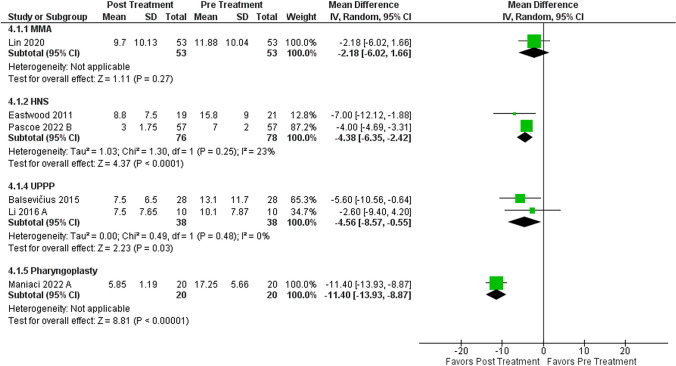
We identified 2018 abstracts, 14 studies (N = 3,488) were included in the meta-analysis. Both treatments witnessed significant improvement in Apnea-hypopnea Index (AHI), with similar improvement with CPAP (Δ-48.8 [-51.2, -46.4]) and surgical interventions (Δ -20.22 [-31.3, -9.17]). An improvement in Epworth Sleepiness Scale (ESS) was noted between groups with (Δ -3.9 [-6.2, -1.6]) for the CPAP group and (Δ -4.3 [-6.0, -2.5]) for surgical interventions. The improvement of BDI II depression scores pre- and post-treatment was comparable between treatments with (Δ -4.1 [-5.8, -2.4]) for the CPAP group and (Δ- 5.6 [-9.2, -2.0]) for surgical interventions.
Our findings suggest a reduction in AHI is seen in both CPAP and surgical interventions for OSA, with no difference in AHI reduction between groups. Both treatments also lead to a similar improvement in depression scores providing strong evidence regards impact of surgery on OSA-associated mood disorders. While percent reduction in depression is higher in the surgical group, the difference did not reach statistical significance when compared to CPAP. When stratified by surgical intervention, most interventions suggest an improvement in depression scores.
评估持续气道正压通气(CPAP)及阻塞性睡眠呼吸暂停(OSA)的手术替代方案对抑郁症的影响,并比较手术与CPAP的治疗结果。方法:检索Cochrane图书馆、CINAHL、PubMed和Scopus数据库中的英文文章。对CPAP或手术干预治疗前后的客观和主观结果进行连续测量(均值)、比例(%)和平均差(Δ)的荟萃分析,并给出95%置信区间。结果:我们共筛选出2018篇摘要,14项研究(N = 3488)纳入荟萃分析。两种治疗方法均使呼吸暂停低通气指数(AHI)显著改善,CPAP(Δ -48.8 [-51.2, -46.4])和手术干预(Δ -20.22 [-31.3, -9.17])的改善效果相似。两组Epworth嗜睡量表(ESS)均有改善,CPAP组为(Δ -3.9 [-6.2, -1.6]),手术干预组为(Δ -4.3 [-6.0, -2.5])。治疗前后贝克抑郁量表第二版(BDI II)抑郁评分的改善情况在两种治疗方法中相当,CPAP组为(Δ -4.1 [-5.8, -2.4]),手术干预组为(Δ -5.6 [-9.2, -2.0])。结论:我们的研究结果表明,CPAP和手术干预治疗OSA均能降低AHI,两组间AHI降低幅度无差异。两种治疗方法在抑郁评分方面也有相似改善,有力证明了手术对OSA相关情绪障碍的影响。虽然手术组抑郁降低百分比更高,但与CPAP相比差异未达到统计学意义。按手术干预分层时,大多数干预措施显示抑郁评分有所改善。