Cheng Bangjun, Jiang Xiping, Zhang Xiaofeng, Guo Shixin, Chen Qi, Du Shengchao, Luo Yi, He Yaohua
Department of Orthopedic Surgery, Shanghai Sixth People's Hospital, Shanghai Jiao Tong University School of Medicine, Jinshan Branch, Jinshan District Central Hospital, Shanghai, 201500, China.
Department of Orthopedic Surgery, Shanghai Sixth People's Hospital, Shanghai Jiao Tong University School of Medicine, Shanghai, 200233, China.
BMC Musculoskelet Disord. 2024 Dec 26;25(1):1066. doi: 10.1186/s12891-024-08216-0.
The lateral locking plate for the proximal humerus is currently the most commonly used surgical procedure for the treatment of elderly proximal humeral comminuted fractures. Previous studies have found that the rate of postoperative complications in patients of proximal humerus fractures with medial column involvement is relatively high. Through biomechanical methods, this study aims to investigate the effectiveness of the conventional lateral locking plate fixation along with the addition of the metacarpal supporting plate on the medial column in the treatment for proximal humeral fractures involving the medial column. The goal is to reduce the rate of postoperative internal fixation failure in patients with medial column injury.
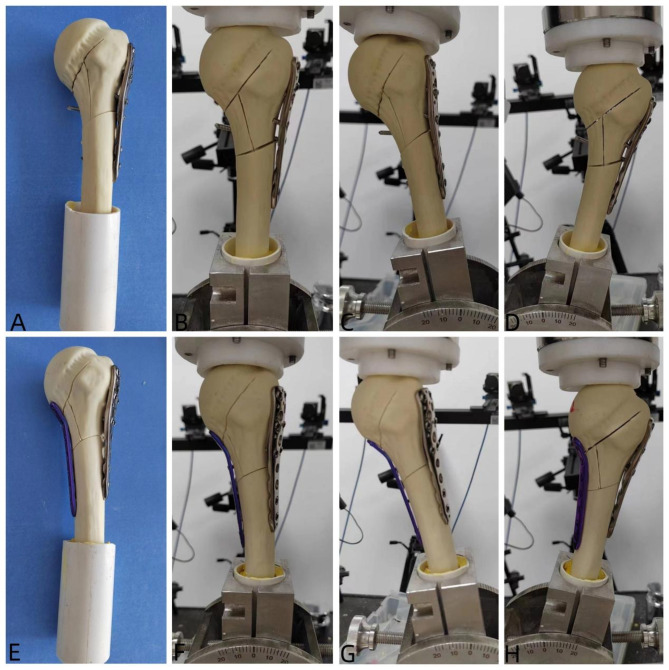
Thirty artificial synthetic humerus models are used as experimental samples. A proximal humerus fracture model with medial column injury was created, and then divided into two groups. Group A was fixed with a proximal humerus lateral locking plate (single-plate group). Group B was fixed with a proximal humerus lateral locking plate and a metacarpal supporting plate on the medial column (double-plate group). The failure displacement, stiffness, and strength of the repaired proximal humerus fractures with two different methods were tested under compression at posterior extension of 15°, forward flexion of 15°, and vertical direction.
There was no statistical significance in the comparison of the failure displacement of repaired proximal humeral fractures between the two groups under compression at posterior extension of 15° and forward flexion of 15° (P > 0.05). However, the failure displacement of the fracture was longer in single-plate group than in double-plate group under compression at vertical direction (P < 0.05). The double-plate group was better in terms of biomechanical stiffness and strength compared to the single-plate group at all three testing angles (P < 0.05).
For patients whose proximal humeral fractures involve the medial column, the addition of a support plate on the medial side of the humerus is recommended along with the lateral locking plate. The double-plate strategy can increase the stability of the medial column of the proximal humerus, and enhance the overall biomechanical property of the repaired proximal humerus.
肱骨近端外侧锁定钢板是目前治疗老年肱骨近端粉碎性骨折最常用的手术方法。既往研究发现,内侧柱受累的肱骨近端骨折患者术后并发症发生率相对较高。本研究旨在通过生物力学方法,探讨传统外侧锁定钢板固定联合在内侧柱加用掌骨支撑钢板治疗累及内侧柱的肱骨近端骨折的有效性。目的是降低内侧柱损伤患者术后内固定失败率。
采用30个人工合成肱骨模型作为实验样本。建立内侧柱损伤的肱骨近端骨折模型,然后分为两组。A组采用肱骨近端外侧锁定钢板固定(单钢板组)。B组采用肱骨近端外侧锁定钢板并在内侧柱加用掌骨支撑钢板固定(双钢板组)。在15°后伸、15°前屈和垂直方向压缩下,测试两种不同方法修复的肱骨近端骨折的失效位移、刚度和强度。
在15°后伸和15°前屈压缩时,两组修复的肱骨近端骨折失效位移比较无统计学意义(P>0.05)。然而,在垂直方向压缩时,单钢板组骨折失效位移比双钢板组长(P<0.05)。在所有三个测试角度下,双钢板组在生物力学刚度和强度方面均优于单钢板组(P<0.05)。
对于肱骨近端骨折累及内侧柱的患者,建议在外侧锁定钢板的基础上,在内侧加用支撑钢板。双钢板策略可增加肱骨近端内侧柱的稳定性,提高修复后肱骨近端的整体生物力学性能。