Ahmed Zahra, Zargaran Alexander, Zargaran David, Sousi Sara, Hakimnia Keiron, Panagiota Glynou Sevasti, Davies Julie, Hamilton Stephen, Mosahebi Afshin
From the Division of Surgery and Interventional Science, University College London, London, United Kingdom.
Department of Plastic and Reconstructive Surgery, Royal Free NHS Foundation Trust, London, United Kingdom.
Plast Reconstr Surg Glob Open. 2024 Dec 26;12(12):e6374. doi: 10.1097/GOX.0000000000006374. eCollection 2024 Dec.
The deep inferior epigastric perforator (DIEP) flap provides an effective and popular means for autologous breast reconstruction. However, with the complexity of the pathway, the environmental impact of the pathway has yet to be evaluated.
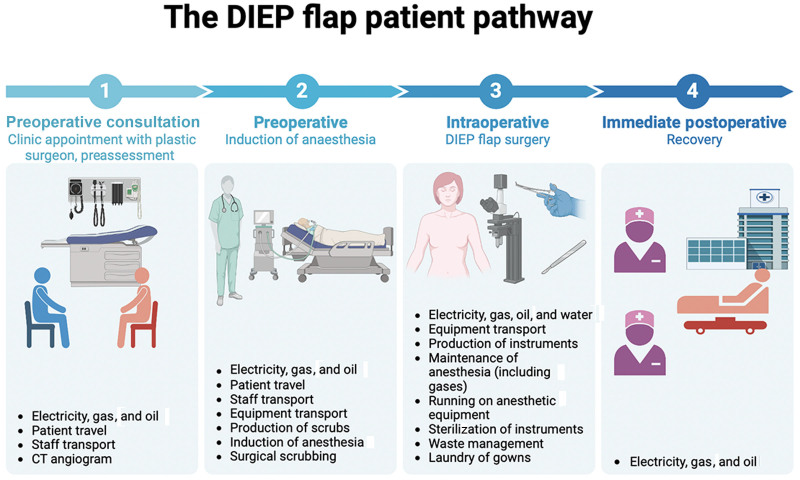
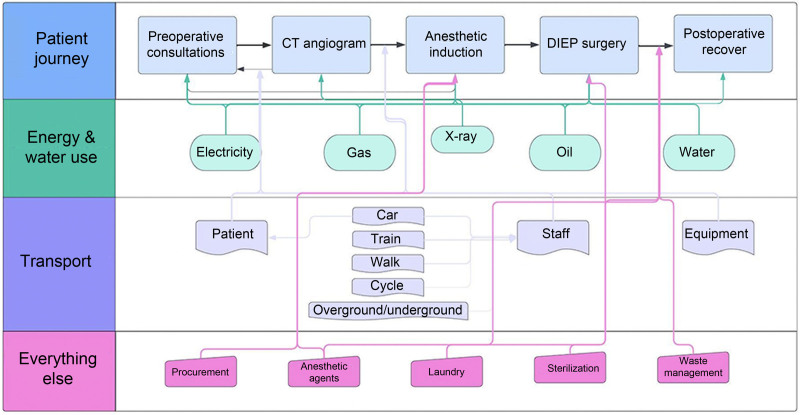
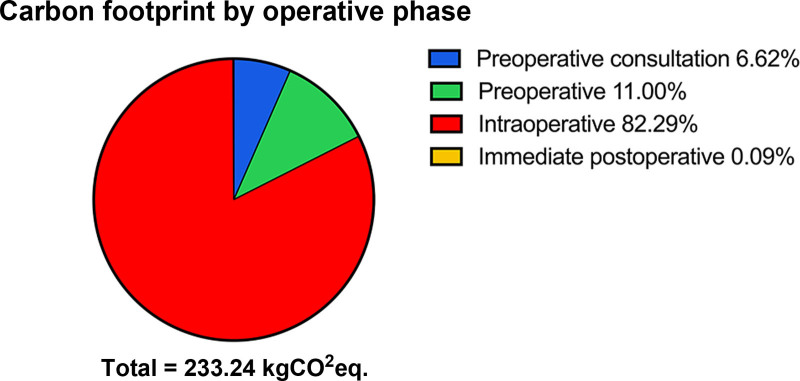
A retrospective analysis of 42 unilateral DIEPs at a single reconstructive center was performed. Process mapping and life-cycle analyses were performed for equipment, staff, patients, and land. A bottom-up approach was adopted to calculate carbon dioxide equivalent estimates for the initial consultation, preoperative, intraoperative, and immediate postoperative periods.
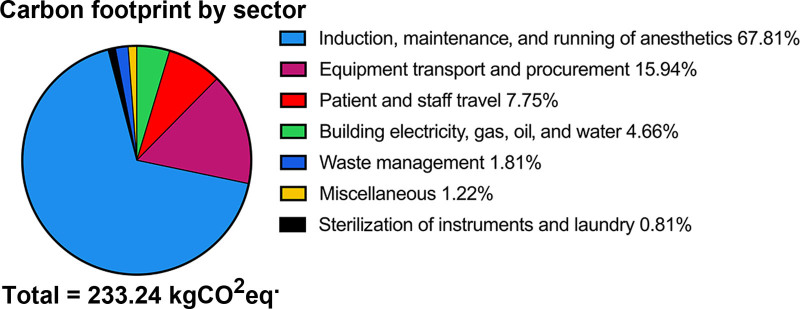
This study estimated the carbon footprint of a patient undergoing DIEP flap surgery to be approximately 233.96 kg COeq. Induction, maintenance, and running of anesthesia had the highest overall contribution to the carbon footprint (158.17 kg COeq, 67.60% overall). Patient and staff travel contributed more than 15% overall carbon emissions in this study. The impact of sterilization was less than half of that from waste management (0.81 versus 1.81 kg COeq, respectively). Waste management alone contributed 4.21 kg COeq of the overall carbon emissions, the majority of which was accountable to the incineration of 14.75 kg of noninfectious offensive waste.
This study estimates the carbon footprint of the DIEP pathway. Strategies to mitigate the impact of carbon emissions including usage of reusable vs single-use equipment, virtual consultations, standardization of equipment packs, and optimizing waste disposal were suggested areas for improvement. Data from manufacturers on life-cycle assessments were limited, and further work is needed to fully understand and optimize the impact of DIEP surgery on the environment.
腹壁下深动脉穿支(DIEP)皮瓣为自体乳房重建提供了一种有效且常用的方法。然而,鉴于该流程的复杂性,其对环境的影响尚未得到评估。
对某单一重建中心的42例单侧DIEP手术进行回顾性分析。对设备、工作人员、患者和土地进行了流程映射和生命周期分析。采用自下而上的方法计算初次咨询、术前、术中和术后即刻阶段的二氧化碳当量估算值。
本研究估计接受DIEP皮瓣手术患者的碳足迹约为233.96千克二氧化碳当量。麻醉诱导、维持和运行对碳足迹的总体贡献最大(158.17千克二氧化碳当量,占总体的67.60%)。在本研究中,患者和工作人员的交通产生的碳排放占总排放量的15%以上。消毒的影响不到废物管理影响的一半(分别为0.81千克二氧化碳当量和1.81千克二氧化碳当量)。仅废物管理就产生了4.21千克二氧化碳当量的总排放量,其中大部分是14.75千克非感染性有害废物焚烧造成的。
本研究估算了DIEP流程的碳足迹。减少碳排放影响的策略,包括使用可重复使用与一次性设备、虚拟咨询、设备包标准化以及优化废物处理,是建议改进的方面。来自制造商的生命周期评估数据有限,需要进一步开展工作以全面了解并优化DIEP手术对环境的影响。