Draganova Rossitza, Hartanto Genisius, Pawlik Robert Jan, Aulenkamp Jana Luisa, Elsenbruch Sigrid
Department of Neurology, Center for Translational Neuro-and Behavioral Sciences (C-TNBS), University Hospital Essen, University of Duisburg-Essen, Essen, Germany.
Department of Medical Psychology and Medical Sociology, Ruhr University Bochum, Bochum, Germany.
Front Neurosci. 2024 Dec 11;18:1502752. doi: 10.3389/fnins.2024.1502752. eCollection 2024.
This study explored the potential of electrogastrography (EGG) and heart rate variability (HRV) as psychophysiological markers in experimental pain research related to the gut-brain axis. We investigated responses to the experience of pain from the visceral (rectal distension) and somatic (cutaneous heat) pain modalities, with a focus on elucidating sex differences in EGG and HRV responses.
In a sample of healthy volunteers (29 males, 43 females), EGG and ECG data were collected during a baseline and a pain phase. Data were analyzed for changes in gastric myoelectrical activity and cardiac autonomic regulation, with special attention to sex-specific patterns and correlations with perceptual responses to visceral and somatic pain stimuli, assessed by visual analogue scale ratings.
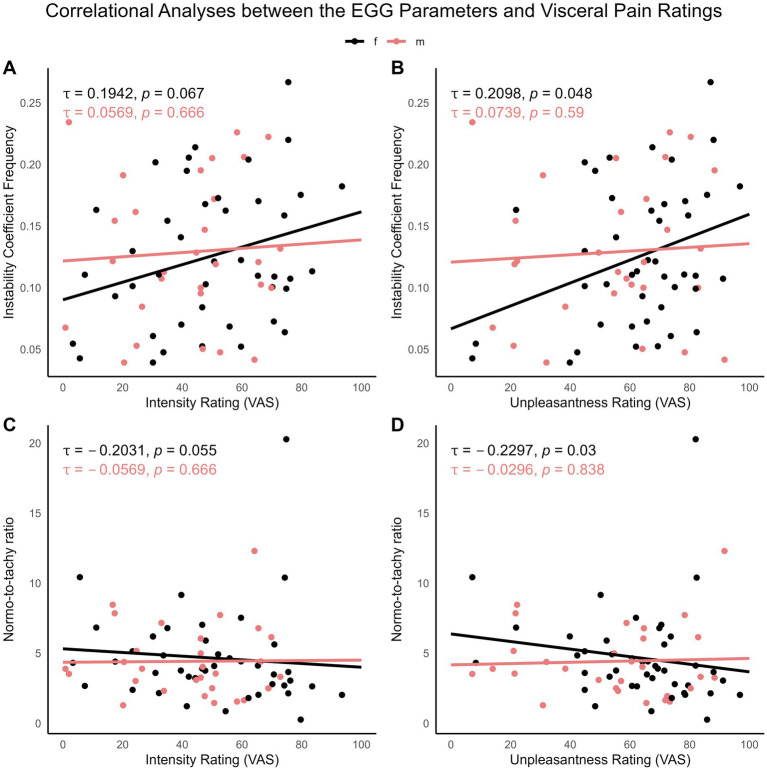
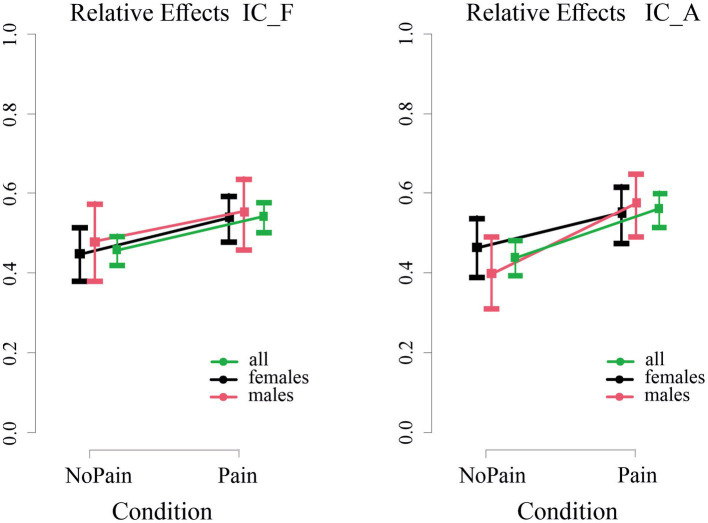
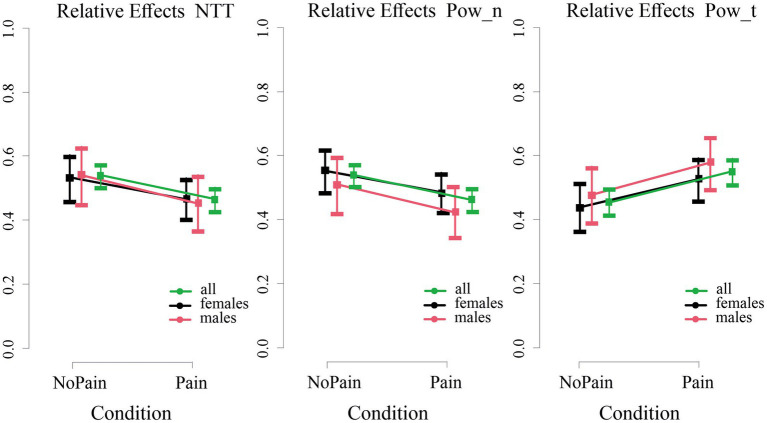
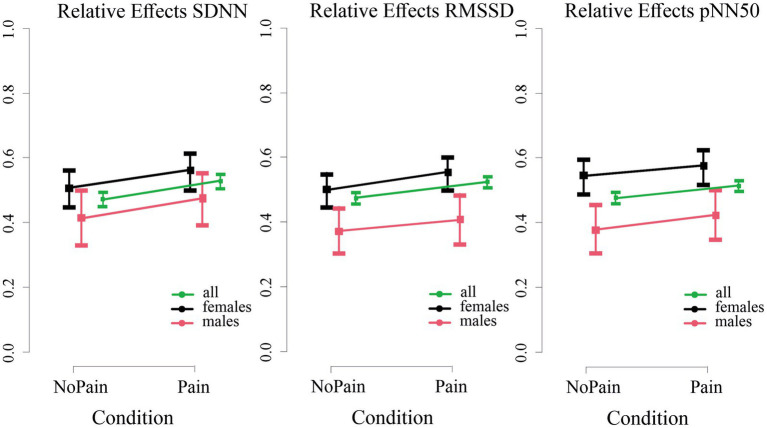
Acute pain induced significant instability in EGG slow-wave frequency and amplitude, increased tachygastria, and decreased normogastric spectral power, without evidence of sex differences. HRV analyses revealed increases in SDNN, RMSSD, and pNN50 during pain, indicating sympathovagal regulation changes. While there were no significant sex differences in EGG responses, only female participants exhibited significant correlations between visceral pain unpleasantness and EGG alterations. HRV measures, particularly time-domain parameters, showed sex differences, independent of pain-induced autonomic reactivity.
The experience of pain in the lower abdominal region may induce impaired gastric motility. EGG and HRV are sensitive to acute pain and offer insight into pain mechanisms along the gut-brain axis. While EGG responses were consistent across sexes, HRV revealed sex-specific differences, suggesting that autonomic regulation and gastric motility may be modulated differently by pain and psychosocial factors. Further research in patients with chronic visceral pain is warranted.
本研究探讨了胃电图(EGG)和心率变异性(HRV)作为与肠-脑轴相关的实验性疼痛研究中的心理生理标志物的潜力。我们研究了内脏(直肠扩张)和躯体(皮肤热)疼痛模式下对疼痛体验的反应,重点是阐明EGG和HRV反应中的性别差异。
在一组健康志愿者(29名男性,43名女性)样本中,在基线期和疼痛期收集EGG和心电图数据。分析数据以了解胃肌电活动和心脏自主调节的变化,特别关注性别特异性模式以及与通过视觉模拟量表评分评估的对内脏和躯体疼痛刺激的感知反应的相关性。
急性疼痛导致EGG慢波频率和幅度出现显著不稳定,胃过速增加,正常胃频谱功率降低,且无性别差异证据。HRV分析显示疼痛期间SDNN、RMSSD和pNN50增加,表明交感迷走神经调节发生变化。虽然EGG反应没有显著的性别差异,但只有女性参与者在内脏疼痛不愉快感与EGG改变之间表现出显著相关性。HRV测量,特别是时域参数,显示出性别差异,与疼痛引起的自主反应无关。
下腹部疼痛体验可能导致胃动力受损。EGG和HRV对急性疼痛敏感,并能深入了解肠-脑轴上的疼痛机制。虽然EGG反应在性别上是一致的,但HRV显示出性别特异性差异,表明自主调节和胃动力可能受到疼痛和心理社会因素的不同调节。有必要对慢性内脏疼痛患者进行进一步研究。