
帕金森病与相关疾病之间血液和脑脊液的差异
Differences in Blood and Cerebrospinal Fluid Between Parkinson's Disease and Related Diseases.
作者信息
Ma Jie, Tang Zhijian, Wu Yaqi, Zhang Jun, Wu Zitao, Huang Lulu, Liu Shengwen, Wang Yu
机构信息
Department of Neurosurgery, Tongji Hospital, Tongji Medical College, Huazhong University of Science and Technology, Wuhan, China.
Department of Electrical and Computer Engineering, University of Illinois Urbana Champaign, Champaign, IL, USA.
出版信息
Cell Mol Neurobiol. 2024 Dec 27;45(1):9. doi: 10.1007/s10571-024-01523-z.
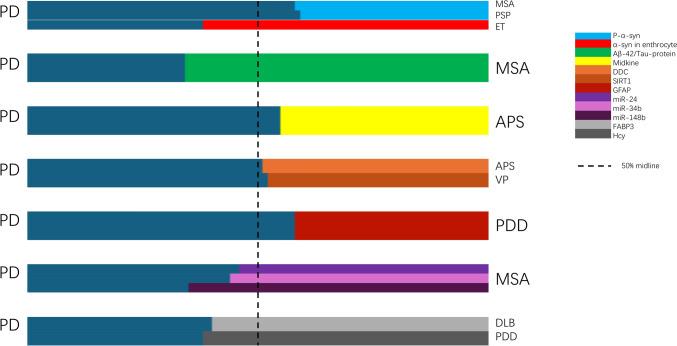
It is difficult to distinguish Parkinson's disease (PD) in the early stage from those of various disorders including atypical Parkinson's syndrome (APS), vascular parkinsonism (VP), and even essential tremor (ET), because of the overlap of symptoms. Other, more challenging problems will arise when Parkinson's disease develops into Parkinson's disease dementia (PDD) in the middle and late stages. At this time, the differential diagnosis of PDD and DLB becomes thorny. These complicate the diagnostic process for PD, which traditionally heavily relies on symptomatic assessment and treatment response. Recent advances have identified several biomarkers in the blood and cerebrospinal fluid (CSF), including α-synuclein, lysosomal enzymes, fatty acid-binding proteins, and neurofilament light chain, whose concentration differs in PD and the related diseases. However, not all these molecules can effectively discriminate PD from related disorders. This review advocates for a paradigm shift toward biomarker-based diagnosis to effectively distinguish between PD and similar conditions. These biomarkers may reflect the diversity that exist among different diseases and provide an effective way to accurately understand their mechanisms. This review focused on blood and CSF biomarkers of PD that may have differential diagnostic value and the related molecular measurement methods with high diagnostic performance due to emerging technologies.
由于症状重叠,帕金森病(PD)早期很难与包括非典型帕金森综合征(APS)、血管性帕金森病(VP)甚至特发性震颤(ET)在内的各种疾病相区分。当帕金森病发展到中晚期出现帕金森病痴呆(PDD)时,还会出现其他更具挑战性的问题。此时,PDD与路易体痴呆(DLB)的鉴别诊断变得棘手。这些都使PD的诊断过程变得复杂,传统上PD的诊断严重依赖症状评估和治疗反应。最近的进展已在血液和脑脊液(CSF)中鉴定出几种生物标志物,包括α-突触核蛋白、溶酶体酶、脂肪酸结合蛋白和神经丝轻链,它们在PD及相关疾病中的浓度有所不同。然而,并非所有这些分子都能有效区分PD与相关疾病。本综述主张向基于生物标志物的诊断模式转变,以有效区分PD与类似病症。这些生物标志物可能反映不同疾病之间存在的差异,并提供准确理解其机制的有效方法。本综述重点关注可能具有鉴别诊断价值的PD血液和脑脊液生物标志物,以及由于新技术而具有高诊断性能的相关分子测量方法。


 Zotero 插件