Li Yimeng, Chen Yao, Ma Bosheng, Chen Jyu-Lin, Zhong Jie, Jiang Yan, Luo Jing, Guo Jia
Xiangya School of Nursing, Central South University, Changsha, Hunan, PR China.
Department of Ophthalmology, The Second Xiangya Hospital, Central South University, Changsha, Hunan, PR China.
PLoS One. 2024 Dec 27;19(12):e0315218. doi: 10.1371/journal.pone.0315218. eCollection 2024.
Improving the efficiency of ophthalmology service is a global challenge to fight vision impairment, yet there is little concrete evidence of the current efficiency status. This study aimed to examine the efficiency of ophthalmology departments in the Hunan Province, China, and determine the associating factors of low-efficiency and high-efficiency ophthalmology departments.
This cross-sectional study included a province-level survey of ophthalmology departments of public hospitals. All the ophthalmology departments of public hospitals in Hunan Province were invited to complete an online survey on ophthalmic competence resources. Bootstrap Data Envelopment Analysis was conducted to describe the service efficiency status of the ophthalmology departments using Maxdea (version 8.0) software. Then, we employed Fuzzy Set-Qualitative Comparative Analysis to explore the recipes of low-efficiency and high-efficiency ophthalmology departments using Fs-QCA (version 3.0) software.
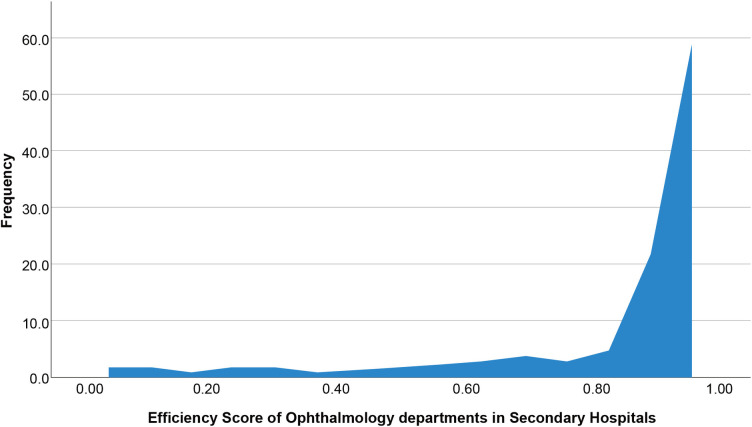
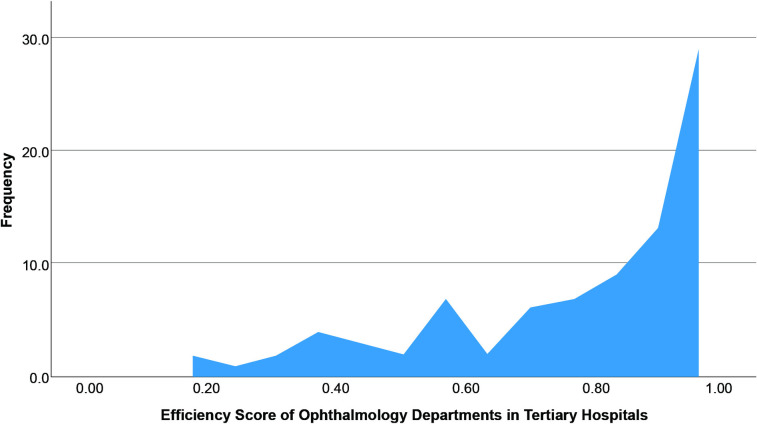
One hundred and ninety-five ophthalmology departments (87 in tertiary and 108 in secondary public hospitals) completed the survey. The mean efficiency score was 0.78 for ophthalmology departments in tertiary hospitals and 0.82 for secondary hospitals. The number of ophthalmologists and equipment positively contributed to the efficiency of ophthalmology departments in tertiary and secondary hospitals. While increasing the bed capacity was not always beneficial to improving the efficiency of ophthalmology departments in secondary hospitals. For ophthalmology departments in tertiary hospitals, simply increasing the number of nurses did not universally increase efficiency unless there were enough ophthalmologists and equipment to support the nurses' work. This study also revealed 2 configurations for ophthalmology departments in secondary hospitals and 5 configurations for those in tertiary hospitals that could guide their efficiency improvement efforts.
Moderate efficiency levels in ophthalmology departments at both tertiary and secondary hospitals were found. Prioritizing the number of ophthalmologists and equipment was recommended to achieve high efficiency for ophthalmology departments in tertiary and secondary hospitals. We also proposed that blindly increasing the number of beds and nurses was meaningless, and ophthalmology departments should flex the bed capacity and number of nurses after premising having high numbers of ophthalmologists and equipment.
提高眼科服务效率是应对视力损害的一项全球性挑战,但目前关于效率现状的具体证据很少。本研究旨在调查中国湖南省眼科科室的效率,并确定低效和高效眼科科室的相关因素。
这项横断面研究包括对省级公立医院眼科科室的调查。邀请湖南省所有公立医院的眼科科室完成一项关于眼科能力资源的在线调查。使用Maxdea(8.0版)软件进行Bootstrap数据包络分析,以描述眼科科室的服务效率状况。然后,我们使用Fs-QCA(3.0版)软件,采用模糊集定性比较分析来探究低效和高效眼科科室的成因。
195个眼科科室(三级公立医院87个,二级公立医院108个)完成了调查。三级医院眼科科室的平均效率得分为0.78,二级医院为0.82。眼科医生数量和设备对三级和二级医院眼科科室的效率有积极贡献。而增加床位容量并不总是有利于提高二级医院眼科科室的效率。对于三级医院的眼科科室,单纯增加护士数量并不一定会普遍提高效率,除非有足够的眼科医生和设备来支持护士的工作。本研究还揭示了二级医院眼科科室的2种配置模式和三级医院眼科科室的5种配置模式,这些模式可指导它们提高效率的工作。
发现三级和二级医院的眼科科室效率处于中等水平。建议优先考虑眼科医生数量和设备,以实现三级和二级医院眼科科室的高效运作。我们还提出,盲目增加床位和护士数量毫无意义,眼科科室应在拥有大量眼科医生和设备的前提下灵活调整床位容量和护士数量。