Twichell Sarah, Hunt Elizabeth A K, Ciurea Rodica, Somers Michael J G
Department of Pediatrics, The University of Vermont Robert Larner, M.D. College of Medicine and University of Vermont Children's Hospital, Burlington, Vermont, USA.
EMMES Corporation, Rockville, Maryland, USA.
Pediatr Transplant. 2025 Feb;29(1):e70005. doi: 10.1111/petr.70005.
Given the risks of cardiovascular disease among pediatric kidney transplant recipients, we evaluated whether there was an association between rapid weight gain (RWG) following kidney transplantation and the development of obesity and hypertension among children enrolled in the North American Pediatric Renal Trials and Collaborative Studies (NAPRTCS) registry.
This retrospective analysis of the NAPRTCS transplant cohort assessed for RWG in the first year post-transplant and evaluated for obesity and hypertension in children with and without RWG up to 5 years post-transplant. We evaluated three separate eras (1986-1999, 2000-2009, and 2010-2021). We performed chi-square and logistic regression analyses to assess cardiometabolic risk at three time points (1, 3, and 5 years post-transplant).
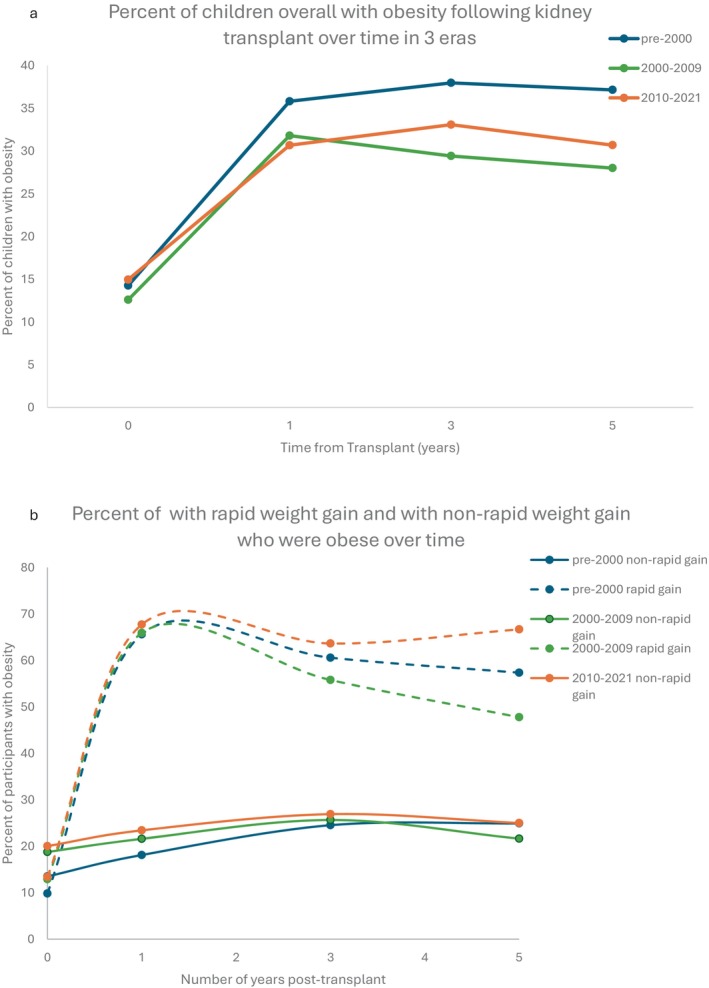
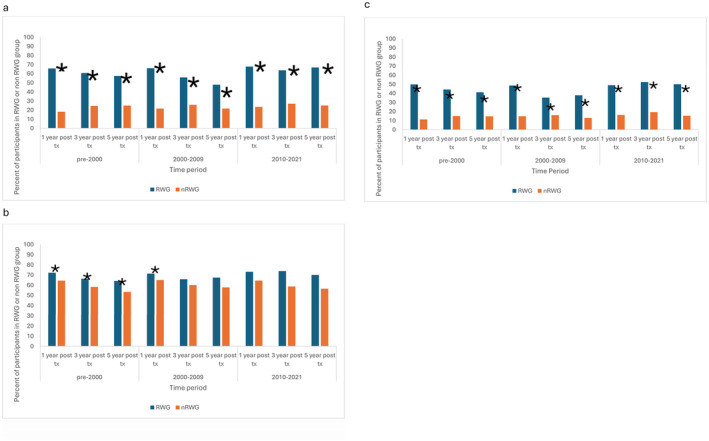
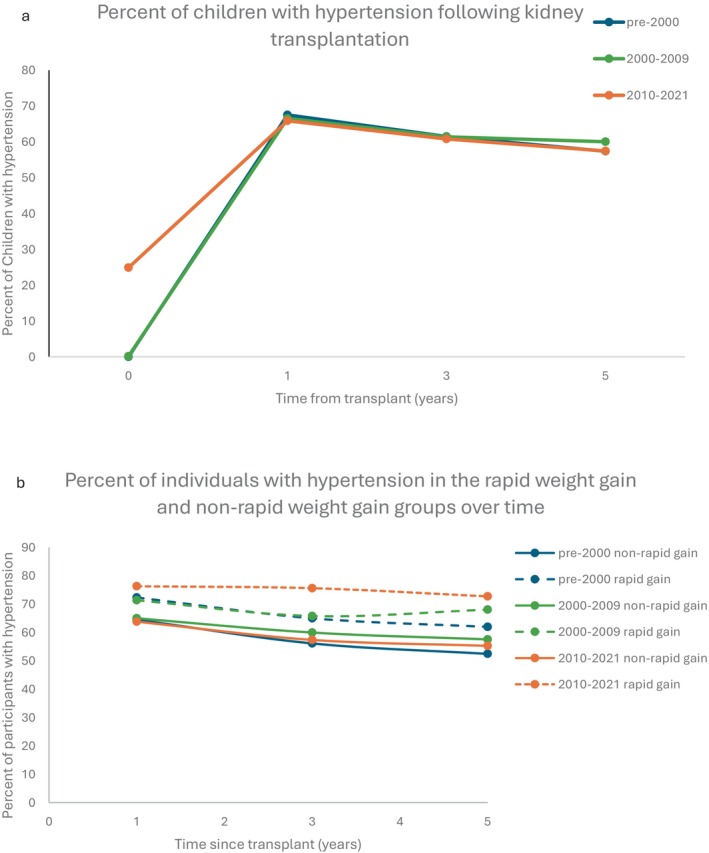
The percent of children with RWG decreased across the three eras (1986-1999 37.3%, 2000-2009 23.0%, and 2010-2021 16.4%). Obesity was significantly more common among children with a history of RWG following transplant, with 48%-67% with RWG having obesity 5 years following transplant compared with 22%-25% without RWG. Hypertension was significantly more common in the RWG group than the non-RWG group at all but two time points. In logistic regression models, the odds of obesity in the RWG group compared with non-RWG was 2.55 (2.29-2.83), and the odds of hypertension were 1.00 (0.94-1.08). Steroid minimization protocols were associated with significantly less RWG.
RWG was significantly associated with obesity but not hypertension among pediatric kidney transplant recipients enrolled in NAPRTCS. Interventions targeting RWG following kidney transplant should be evaluated as a potential way to modify obesity rates following transplantation.
鉴于小儿肾移植受者存在心血管疾病风险,我们评估了北美小儿肾移植试验与协作研究(NAPRTCS)登记处登记的儿童肾移植后体重快速增加(RWG)与肥胖症和高血压发生之间是否存在关联。
对NAPRTCS移植队列进行的这项回顾性分析评估了移植后第一年的RWG情况,并对移植后5年内有和没有RWG的儿童的肥胖症和高血压情况进行了评估。我们评估了三个不同时期(1986 - 1999年、2000 - 2009年和2010 - 2021年)。我们进行了卡方检验和逻辑回归分析,以评估移植后三个时间点(1年、3年和5年)的心脏代谢风险。
三个时期内有RWG的儿童百分比呈下降趋势(1986 - 1999年为37.3%,2000 - 2009年为23.0%,2010 - 2021年为16.4%)。移植后有RWG病史的儿童肥胖症明显更常见,移植后5年有RWG的儿童中48% - 67%患有肥胖症,而没有RWG的儿童中这一比例为22% - 25%。除两个时间点外,RWG组高血压在所有时间点都明显比非RWG组更常见。在逻辑回归模型中,RWG组与非RWG组相比,肥胖症的比值比为2.55(2.29 - 2.83),高血压的比值比为1.00(0.94 - 1.08)。类固醇最小化方案与明显更少的RWG相关。
在NAPRTCS登记的小儿肾移植受者中,RWG与肥胖症显著相关,但与高血压无关。应评估针对肾移植后RWG的干预措施,作为改变移植后肥胖率的一种潜在方法。