Angelomenos Vasileios, Sandberg Olof, Shareghi Bita, Ullman Michael
Department of Orthopedics, Institute of Clinical Sciences, Sahlgrenska Academy, University of Gothenburg, Gothenburg, Sweden.
Department of Hand Surgery, Sahlgrenska University Hospital, Gothenburg, Sweden.
J Orthop Res. 2025 Mar;43(3):660-670. doi: 10.1002/jor.26031. Epub 2024 Dec 27.
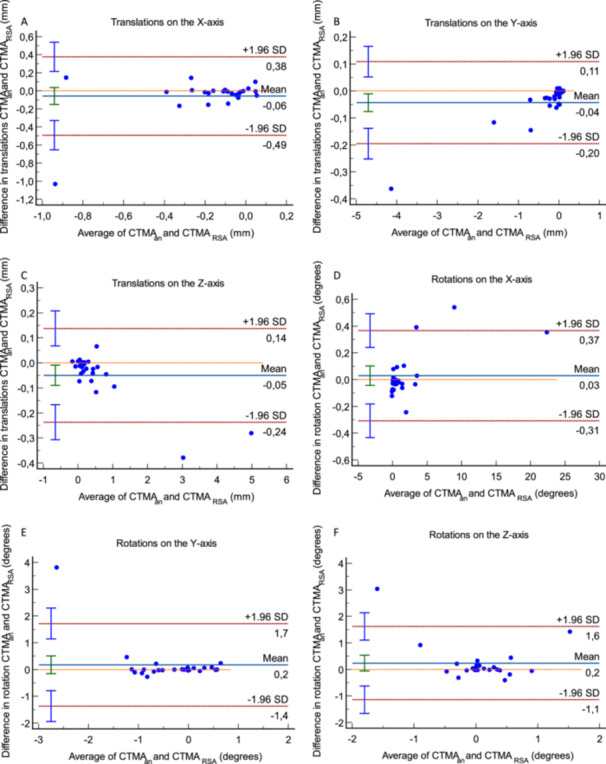
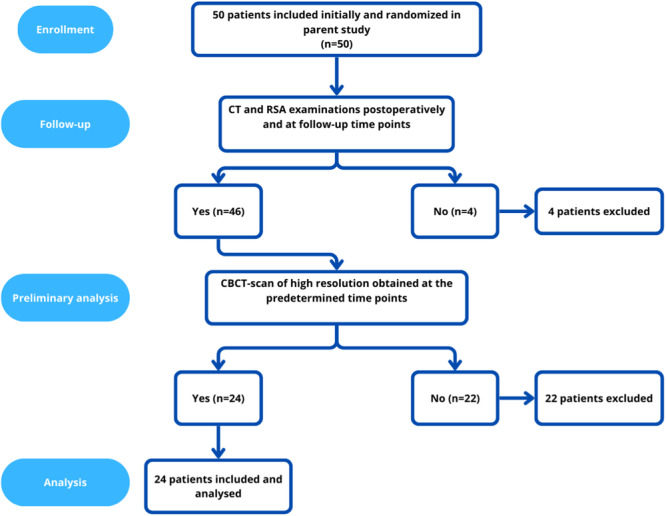
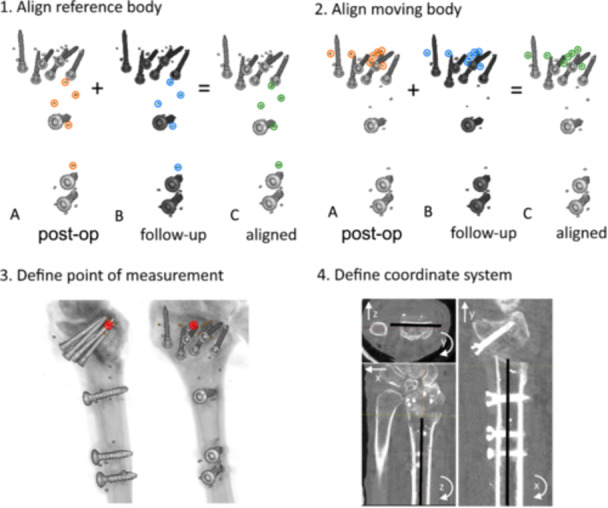
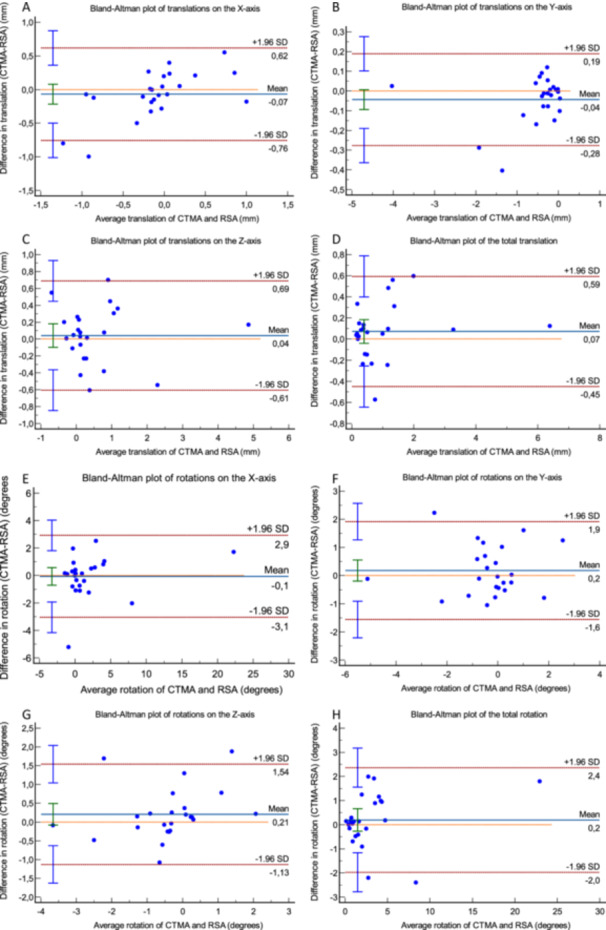
Radiostereometric Analysis (RSA) is the most accurate method for determining early micromotions of orthopedic implants. Computed Tomography Radiostereometric Analysis (CT-RSA) is a method that can be used to determine implant and bone micromovements using low-dose CT scans. This study aimed to evaluate the reliability of the CT-RSA method in measuring the interfragmental mobility in patients who have undergone a correction osteotomy due to a malunited distal radius fracture. Twenty-four patients were included and operated with a radiolucent volar plate. Markers were embedded in the plate and bone. RSA and CT examinations were obtained postoperatively up to 1-year postoperative. Micromovements of the distal radius segment relative to the proximal were compared between the methods with paired analysis and Bland-Altman plots. The limits of clinical significance were: dorsal/volar tilt < 10°, radial shortening < 5 mm, radial inclination ≥ 15°, and radial shift < 5 mm. For the dorsal/volar tilt, the paired analysis between the two methods, showed a mean difference (95% CI) of -0.06° (-0.67 to 0.55), for radial compression-0.04 mm (-0.09 to 0.01), for radial inclination 0.21° (-0.06 to 0.48), and for radial shift -0.07 mm (-0.21 to 0.07). The paired analysis for micromotions showed that the thresholds of clinical significance are excluded from the difference's 95% CI. The Bland-Altman plots showed comparable results up to 1 year, considering clinically relevant thresholds. In conclusion, the CT-RSA method is comparable to that of marker-based RSA in measuring micromotions after wrist osteotomy, as the differences between the methods are not clinically significant.
放射性立体测量分析(RSA)是确定骨科植入物早期微动的最准确方法。计算机断层扫描放射性立体测量分析(CT-RSA)是一种可用于通过低剂量CT扫描确定植入物和骨微动的方法。本研究旨在评估CT-RSA方法在测量因桡骨远端骨折畸形愈合而接受截骨矫正术患者的骨折块间活动度方面的可靠性。纳入24例患者,采用透射线掌侧钢板进行手术。在钢板和骨中植入标记物。术后直至术后1年进行RSA和CT检查。采用配对分析和Bland-Altman图比较两种方法中桡骨远端节段相对于近端的微动情况。临床显著性界限为:背侧/掌侧倾斜<10°,桡骨短缩<5mm,桡骨倾斜≥15°,桡骨移位<5mm。对于背侧/掌侧倾斜,两种方法之间的配对分析显示平均差异(95%CI)为-0.06°(-0.67至0.55),桡骨压缩为-0.04mm(-0.09至0.01),桡骨倾斜为0.21°(-0.06至0.48),桡骨移位为-0.07mm(-0.21至0.07)。微动的配对分析表明,临床显著性阈值被排除在差异的95%CI之外。考虑到临床相关阈值,Bland-Altman图在1年内显示了可比的结果。总之,CT-RSA方法在测量腕部截骨术后的微动方面与基于标记物的RSA方法相当,因为两种方法之间的差异在临床上不显著。