Garcia-Bernardo Javier, Hedde-von Westernhagen Christine, Emery Tom, van Hoek Albert Jan
ODISSEI Social Data Science (SoDa) Team & Department of Methodology and Statistics, Utrecht University, Utrecht, Netherlands.
Centre for Complex Systems Studies, Utrecht University, Utrecht, Netherlands.
Sci Rep. 2024 Dec 28;14(1):31248. doi: 10.1038/s41598-024-82646-7.
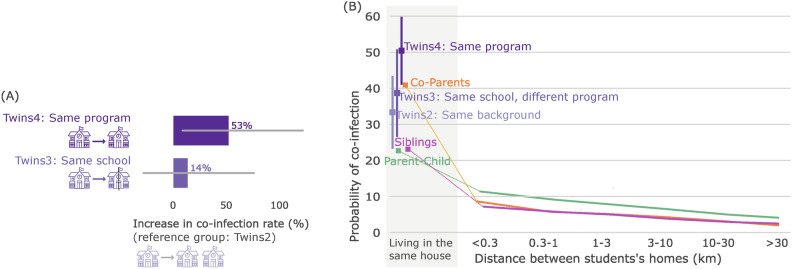
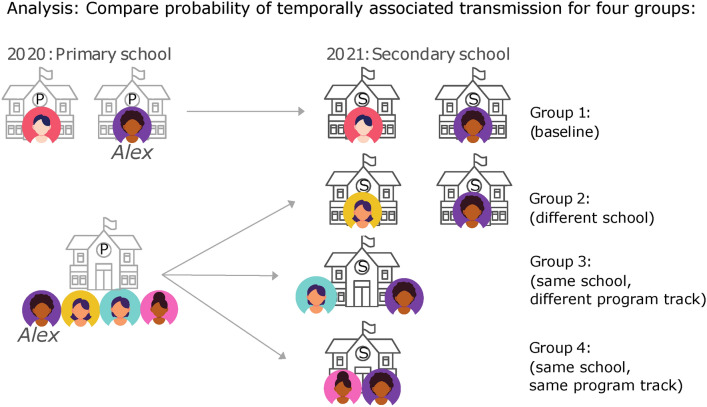
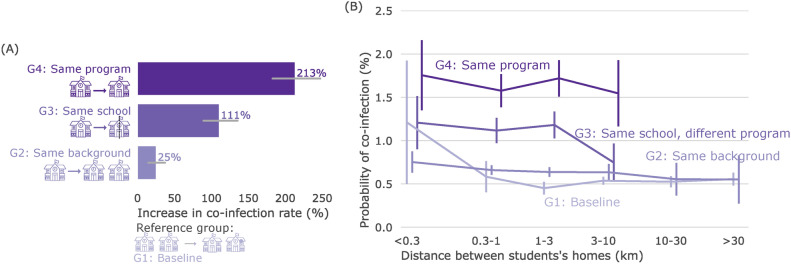
Understanding the impact of different types of social interactions is key to improving epidemic models. Here, we use extensive registry data-including PCR test results and population-level networks-to investigate the impact of school, family, and other social contacts on SARS-CoV-2 transmission in the Netherlands (June 2020-October 2021). We isolate and compare different contexts of potential SARS-CoV-2 transmission by matching pairs of students based on their attendance at the same or different primary school (in 2020) and secondary school (in 2021) and their geographic proximity. We then calculate the probability of temporally associated infections-i.e. the probability of both students testing positive within a 14-day period. Our results highlight the relative importance of household and family transmission in the spread of SARS-CoV-2 compared to school settings. The probability of temporally associated infections for siblings and parent-child pairs living in the same household ranged from 22.6-23.2%. Interestingly, a high probability (4.7-7.9%) was found even when family members lived in different households, underscoring the persistent risk of transmission within family networks. In contrast, the probability of temporally associated infections was 0.52% for pairs of students living nearby but not attending the same primary or secondary school, 0.66% for pairs attending different secondary schools but having attended the same primary school, and 1.65% for pairs attending the same secondary school. It is worth noting, however, that even small increases in school-related infection probabilities can trigger large-scale outbreaks due to the dense network of interactions in these settings. Finally, we used multilevel regression analyses to examine how individual, school, and geographic factors contribute to transmission risk. We found that the largest differences in transmission probabilities were due to unobserved individual (60%) and school-level (35%) factors. Only a small proportion (3%) could be attributed to geographic proximity of students or to school size, denomination, or the median income of the school area.
了解不同类型社交互动的影响是改进疫情模型的关键。在此,我们使用广泛的登记数据——包括聚合酶链式反应(PCR)检测结果和人口层面的网络数据——来研究学校、家庭及其他社交接触对荷兰2020年6月至2021年10月期间严重急性呼吸综合征冠状病毒2(SARS-CoV-2)传播的影响。我们通过根据学生在2020年的同一所或不同所小学以及2021年的同一所或不同所中学的就读情况及其地理距离来匹配学生对,从而分离并比较潜在SARS-CoV-2传播的不同背景。然后,我们计算时间关联感染的概率,即两名学生在14天内均检测呈阳性的概率。我们的结果凸显了与学校环境相比,家庭传播在SARS-CoV-2传播中的相对重要性。居住在同一家庭中的兄弟姐妹和亲子对的时间关联感染概率在22.6%至23.2%之间。有趣的是,即使家庭成员居住在不同家庭,也发现了较高的概率(4.7%至7.9%),这凸显了家庭网络内持续存在的传播风险。相比之下,居住在附近但未就读同一所小学或中学的学生对的时间关联感染概率为0.52%,就读不同中学但曾就读同一所小学的学生对为0.66%,就读同一所中学的学生对为1.65%。然而,值得注意的是,由于这些环境中密集的互动网络,即使与学校相关的感染概率有小幅增加也可能引发大规模疫情爆发。最后,我们使用多层回归分析来研究个体、学校和地理因素如何影响传播风险。我们发现,传播概率的最大差异归因于未观察到的个体因素(60%)和学校层面因素(35%)。只有一小部分(3%)可归因于学生的地理距离或学校规模、教派或学校所在地区的中位数收入。