
在健康筛查人群中使用层次聚类研究评估代谢前期代谢综合征的危险因素。
Risk factors for metabolic syndrome in the premetabolic state assessed using hierarchical clustering study in a health screening group.
作者信息
Park Se-Jun, Kim Yu Na, Oh Byeong Kil, Kang Jeonggyu
机构信息
Total Healthcare Center, Kangbuk Samsung Hospital, Sungkyunkwan University School of Medicine, Suwon, Republic of Korea.
Total Healthcare Center, Kangbuk Samsung Hospital, Sungkyunkwan University School of Medicine, Seoul, Republic of Korea.
出版信息
Sci Rep. 2024 Dec 28;14(1):31169. doi: 10.1038/s41598-024-82513-5.
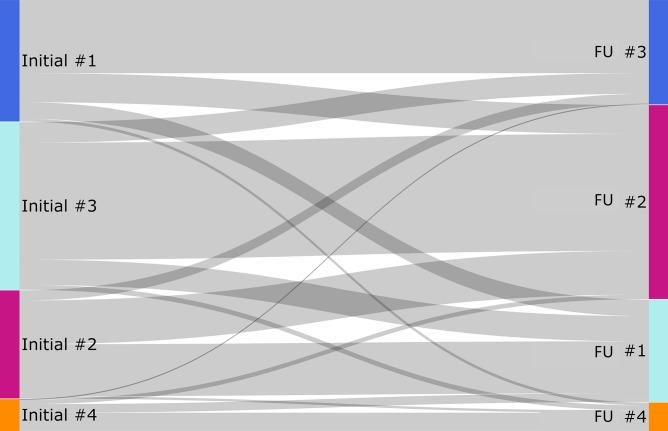
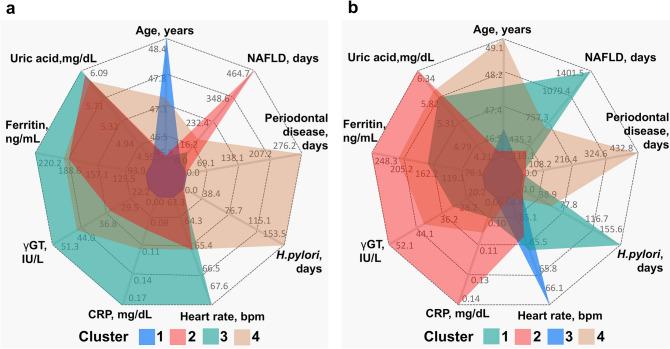
Early detection of a premetabolic status that is at risk for metabolic syndrome (MetS) but not meeting the criteria is crucial. This study examined 27,623 participants aged 20-50 (mean: 40.7) years who underwent initial health screening at Kangbuk Samsung Hospital (2011-2019), focusing on individuals with one or two MetS components. Hierarchical agglomerative clustering was used to form MetS risk clusters based on initial and follow-up data, including age, resting heart rate (rHR), serum uric acid (UA), C-reactive protein (CRP), gamma-glutamyl transpeptidase, and ferritin levels, and nonalcoholic fatty liver disease (NAFLD), periodontal disease, and Helicobacter pylori infection duration. Kaplan-Meier and generalized additive models were used to present the restricted mean survival time (RMST) and identify onset contributors. Clusters with NAFLD and elevated UA levels had the highest MetS risk, whereas those with uniformly low biomarker levels revealed the lowest risk. During follow-up, a cluster initially comprising 60.2% moderate-risk patients exhibited high biomarker levels and had the worst MetS prognosis (RMST: 211 days). UA, CRP levels, and rHR contributed to the incidence of MetS in the fitted model. Machine learning can predict the premetabolic state at MetS risk in a population-based cohort.
早期发现处于代谢综合征(MetS)风险但未达标准的代谢前状态至关重要。本研究对27623名年龄在20 - 50岁(平均40.7岁)之间、在江北三星医院(2011 - 2019年)接受首次健康筛查的参与者进行了检查,重点关注有一或两个MetS组分的个体。基于初始和随访数据,包括年龄、静息心率(rHR)、血清尿酸(UA)、C反应蛋白(CRP)、γ-谷氨酰转肽酶和铁蛋白水平,以及非酒精性脂肪性肝病(NAFLD)、牙周病和幽门螺杆菌感染持续时间,采用层次凝聚聚类法形成MetS风险簇。使用Kaplan-Meier法和广义相加模型来呈现受限平均生存时间(RMST)并确定发病的影响因素。患有NAFLD且UA水平升高的簇具有最高的MetS风险,而生物标志物水平均一较低的簇风险最低。在随访期间,一个最初由60.2%中度风险患者组成的簇呈现出高生物标志物水平且MetS预后最差(RMST:211天)。在拟合模型中,UA、CRP水平和rHR对MetS的发病有影响。机器学习可以在基于人群的队列中预测处于MetS风险的代谢前状态。
 Zotero 插件