Chauhan Neha
Department of Plastic Surgery, Fortis Hospital, Richmond Road, Bangalore, Karnataka, India.
Indian J Plast Surg. 2024 Sep 3;57(6):492-495. doi: 10.1055/s-0044-1788896. eCollection 2024 Dec.
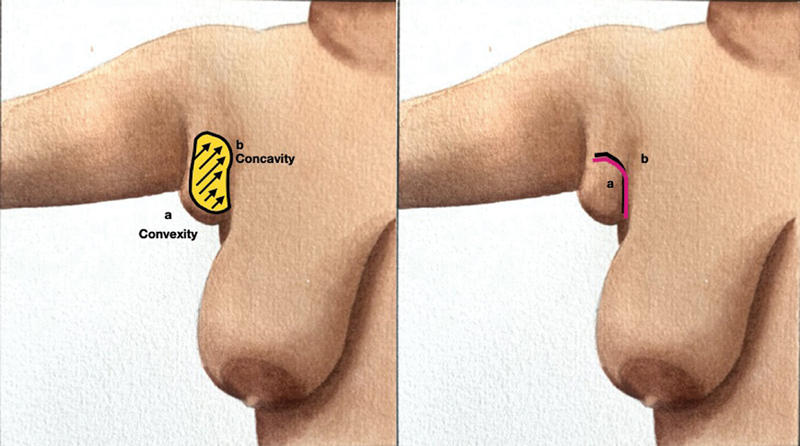
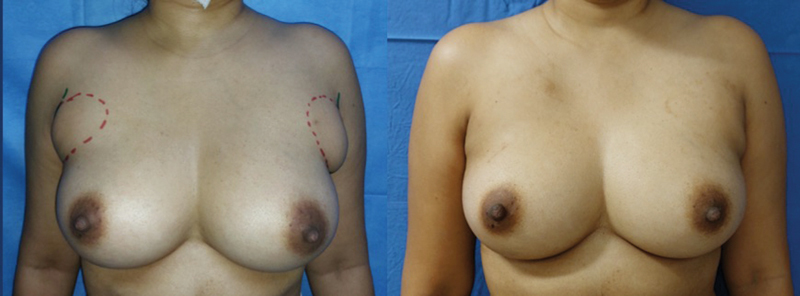
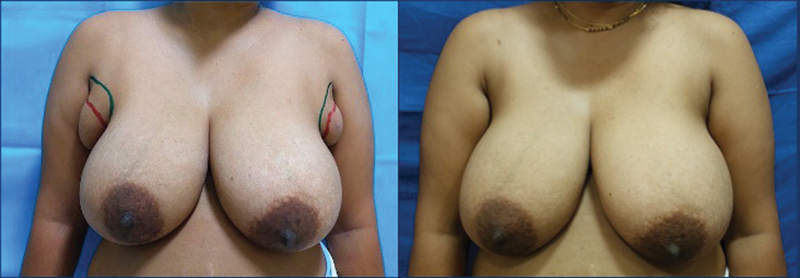
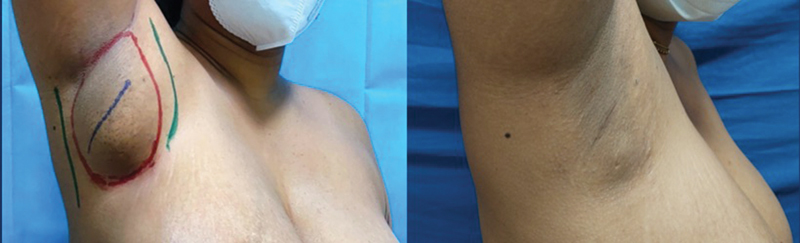
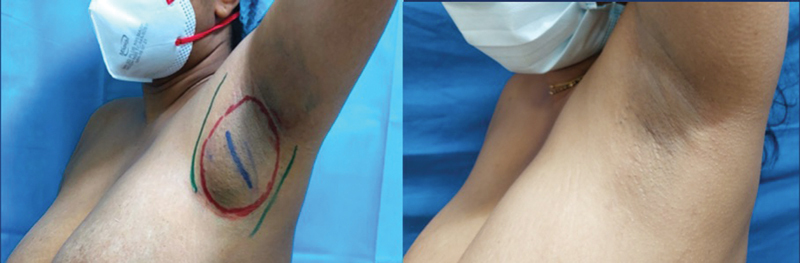
Axillary breasts are a common entity with a reported incidence of 2 to 6% in women and 1 to 3% in men. They are more common amongst Asians than Caucasians, namely amongst South East Asians and Indians, with the highest incidence amongst Japanese. While modalities like CoolScupting™, Kybella™ injections, and BodyTite™ have been used by surgeons for management of axillary breasts, the most effective treatment for this condition remains surgical management involving a combination of liposuction of the axillary breast with excision of the gland and skin. In the author's experience, primary skin excision always leaves a long visible scar that widens over time, at times leading to contractures and restricted axillary movements even when closure looks tension free on the table. Any skin excess is best dealt with secondarily. The author uses a modified protocol without any primary skin excision in axillary breast management to achieve excellent results with minimal scars.
腋下乳房是一种常见情况,据报道女性发病率为2%至6%,男性为1%至3%。在亚洲人中比在白种人中更常见,尤其是在东南亚人和印度人中,在日本人中发病率最高。虽然外科医生已使用如酷塑(CoolScupting™)、凯贝尔(Kybella™)注射和博迪泰(BodyTite™)等方法来处理腋下乳房,但针对这种情况最有效的治疗方法仍然是手术治疗,包括对腋下乳房进行抽脂并切除腺体和皮肤。根据作者的经验,初次皮肤切除总会留下一条长期可见的疤痕,随着时间推移会变宽,有时甚至会导致挛缩和腋窝活动受限,即使在手术台上缝合时看起来没有张力。任何多余的皮肤最好二期处理。作者在腋下乳房处理中采用一种不进行初次皮肤切除的改良方案,以实现瘢痕最小化并取得极佳效果。