Wang Yiran, Dalwood Narelle, Farlie Melanie, Lee Annemarie L
Department of Physiotherapy, School of Primary and Allied Health Care, Monash University, Frankston, Victoria - Australia.
Monash Centre for Scholarship in Health Professions Education (MCSHE), Faculty of Medicine, Nursing and Health Sciences, Monash University, Clayton, Victoria - Australia.
Arch Physiother. 2024 Dec 23;14:138-154. doi: 10.33393/aop.2024.3282. eCollection 2024 Jan-Dec.
While adverse events related to physiotherapy are possible, the type of adverse event and the area of physiotherapy practice in which they occur are not well understood. The purpose of this scoping review was to establish adverse events related to physiotherapy practice and understand the nature of these events and the circumstances in which they occurred.
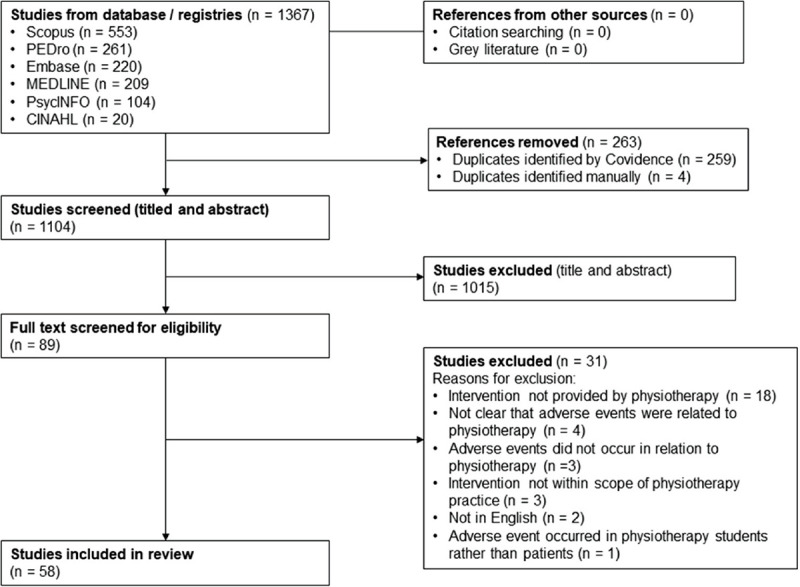
Relevant literature from January 2014 to February 2024 was gathered from five electronic databases. Studies reporting adverse events within any physiotherapy practice (intervention or assessment) were eligible. Two reviewers independently assessed title and abstract, and full texts. Findings were synthesised by clinical streams.
A total of 58 studies met the inclusion criteria. Common adverse events described in musculoskeletal physiotherapy involving manual therapy, exercise and electrotherapy were increased pain and stiffness. Cardiorespiratory physiotherapy interventions involving early mobilisation, exercise and airway clearance therapy reported desaturation and haemodynamic instability. Neurological physiotherapy studies reported falls and fatigue during gait and balance training and exercise. Oncology and aged care interventions involving exercise, balance training and lymphoedema management reported increased pain and muscle strain while studies including pelvic floor muscle training reported the adverse event of vaginal discomfort.
This review identified adverse events occurring during physiotherapy interventions or assessment procedures. Increased monitoring and proactive safety measures may be necessary to ensure patient safety during these treatments.
虽然与物理治疗相关的不良事件是可能发生的,但不良事件的类型及其发生的物理治疗实践领域尚不清楚。本范围综述的目的是确定与物理治疗实践相关的不良事件,并了解这些事件的性质以及发生的情况。
从五个电子数据库收集了2014年1月至2024年2月的相关文献。报告任何物理治疗实践(干预或评估)中不良事件的研究均符合条件。两名评审员独立评估标题、摘要和全文。研究结果按临床类别进行综合。
共有58项研究符合纳入标准。肌肉骨骼物理治疗中涉及手法治疗、运动和电疗法的常见不良事件是疼痛和僵硬加剧。心肺物理治疗干预措施,包括早期活动、运动和气道清除疗法,报告了血氧饱和度下降和血流动力学不稳定。神经物理治疗研究报告了步态和平衡训练及运动期间的跌倒和疲劳。肿瘤学和老年护理干预措施,包括运动、平衡训练和淋巴水肿管理,报告了疼痛加剧和肌肉拉伤,而包括盆底肌肉训练的研究报告了阴道不适这一不良事件。
本综述确定了物理治疗干预或评估过程中发生的不良事件。可能需要加强监测和采取积极的安全措施,以确保这些治疗过程中的患者安全。