Sadohara Rie, Wiesinger Jason A, Thompson Henry J, Glahn Raymond P, Cichy Karen
Department of Plant, Soil and Microbial Sciences, Michigan State University, East Lansing, MI, 48824, USA.
USDA-ARS Robert W. Holley Center for Agriculture and Health, Ithaca, NY, 14853, USA.
Curr Res Food Sci. 2024 Dec 2;10:100942. doi: 10.1016/j.crfs.2024.100942. eCollection 2025.
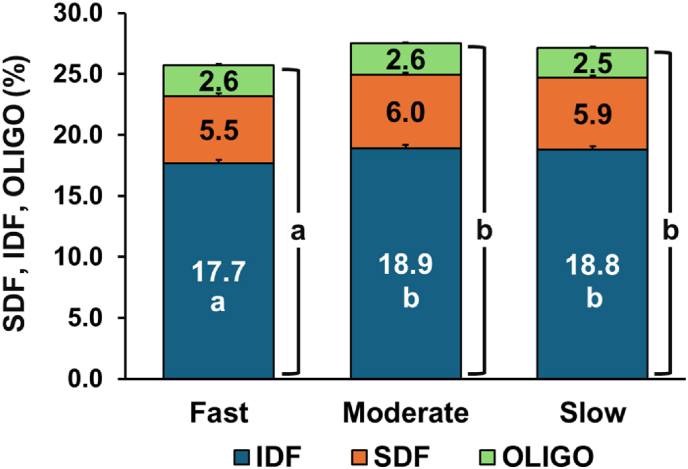
Some yellow-colored market classes of dry bean ( L.) are valued by consumers as an easy-to-digest, fast cooking alternative to darker colored red and black beans, which in comparison generally have longer cooking times and reduced iron bioavailability. There is evidence that the cooking time of yellow beans is linked to the dietary fiber content and may also contribute to nutrient digestibility and bioavailability. Therefore, 52 fast-, moderate-, and slow-cooking yellow beans with diverse iron bioavailability from five market classes (Amarillo, Canario, Green-yellow, Manteca, and Mayocoba) were selected for total dietary fiber (TDF) analysis. TDF was measured as insoluble (IDF) + soluble (SDF) + oligosaccharides (OLIGO) using method AOAC2011.25. Wide variations in the concentrations of IDF (16.0-23.1%), SDF (1.6-7.7%), OLIGO (1.5-3.4%), and TDF (20.6-31.3%) were detected among the yellow beans with various cooking times. Lower concentrations of IDF in yellow beans were associated with shorter cooking times and higher iron bioavailability. The larger sized Andean yellow beans had more SDF than Middle American. One Mayocoba breeding line from Puerto Rico, PR1146-124, had 42% less OLIGOs than average, and may be useful for breeding low-flatulence beans for consumer acceptability. Fast cooking yellow beans provide the same SDF and OLIGO concentrations as yellow beans with longer cooking times but have the added benefit of shorter cooking times (convenience) and provide more bioavailable iron after cooking.
一些黄色的干豆品种(菜豆属)受到消费者重视,它们易于消化、烹饪速度快,是深色红豆和黑豆的替代品,相比之下,红豆和黑豆通常烹饪时间更长,铁的生物利用率也较低。有证据表明,黄豆的烹饪时间与膳食纤维含量有关,也可能影响营养物质的消化率和生物利用率。因此,从五个市场类别(阿马里洛、加那利、绿黄、曼特卡和马约科巴)中挑选了52个烹饪速度快、适中、慢且铁生物利用率各异的黄豆品种进行总膳食纤维(TDF)分析。使用AOAC2011.25方法将TDF测定为不溶性膳食纤维(IDF)+可溶性膳食纤维(SDF)+低聚糖(OLIGO)。在不同烹饪时间的黄豆中,检测到IDF(16.0 - 23.1%)、SDF(1.6 - 7.7%)、OLIGO(1.5 - 3.4%)和TDF(20.6 - 31.3%)的浓度存在很大差异。黄豆中较低的IDF浓度与较短的烹饪时间和较高的铁生物利用率相关。较大尺寸的安第斯黄豆比中美洲黄豆含有更多的SDF。来自波多黎各的一个马约科巴育种系PR1146 - 124的低聚糖含量比平均水平低42%,可能有助于培育低胀气的黄豆品种以提高消费者接受度。快速烹饪的黄豆与烹饪时间较长的黄豆具有相同的SDF和OLIGO浓度,但具有烹饪时间短(方便)的额外优势,并且烹饪后能提供更多生物可利用的铁。