Liu Haiyun, Zhang Shuxia, Liu Xiaohui, Wang Qianqian, Zhang Hongjie, Cui Weihong
Department of Medicine, Shandong College of Traditional Chinese Medicine, Yantai, 264199, China.
Qixia City People's Hospital, Yantai, 265300, China.
BMC Cancer. 2024 Dec 30;24(1):1587. doi: 10.1186/s12885-024-13211-8.
Although thyroid cancer is associated with low mortality rates, significant racial disparities in thyroid cancer outcomes have not been adequately studied in Asia. Moreover, the Asian population consists of different ethnic groups that are not homogeneous. This study aimed to perform a population-based analysis of survival outcomes and prognostic factors in thyroid cancer patients.
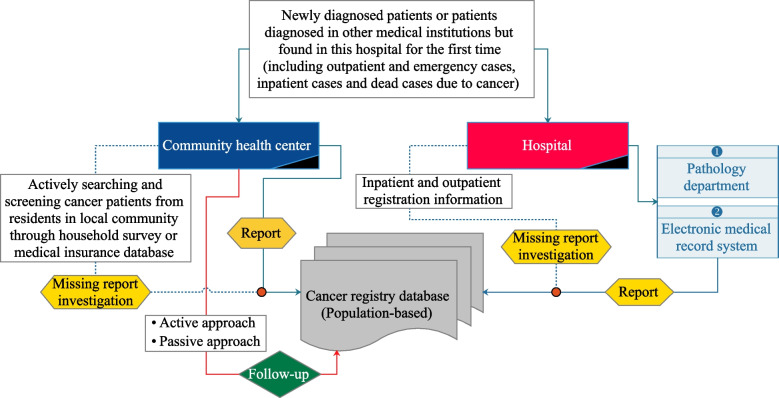
The demographic data and tumor characteristics of all the thyroid cancer patients identified were obtained from the Yantai Cancer Registry. The thyroid cancer-specific death risk in patients was evaluated using the proportion of deaths, standardized mortality ratio (SMR) and absolute excess risk (AER). The Kaplan‒Meier method and the Cox proportional hazards regression model were used to evaluate overall survival (OS) and prognosis.
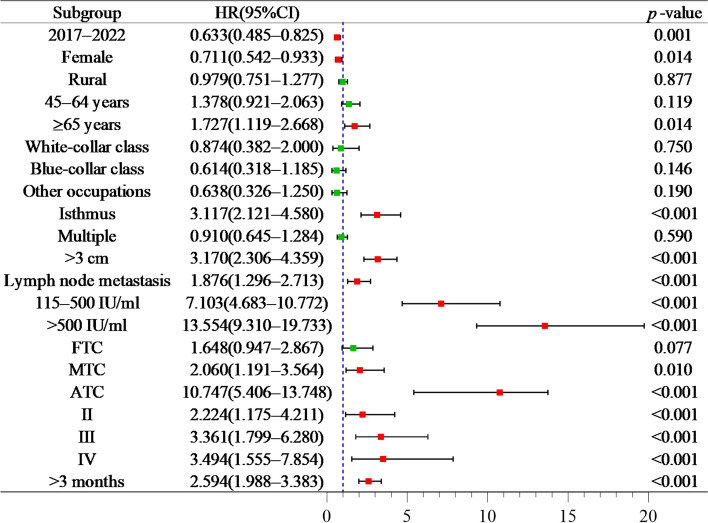
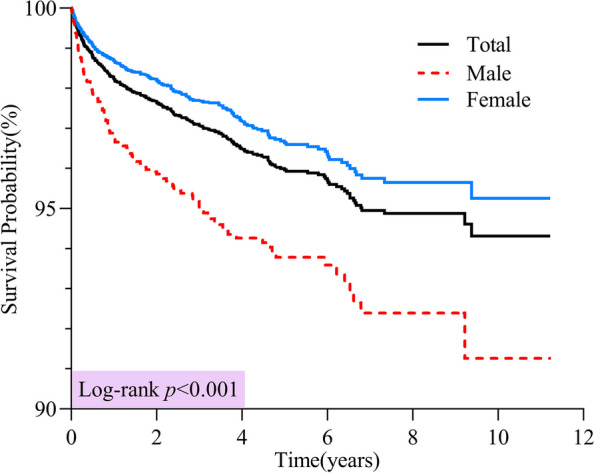
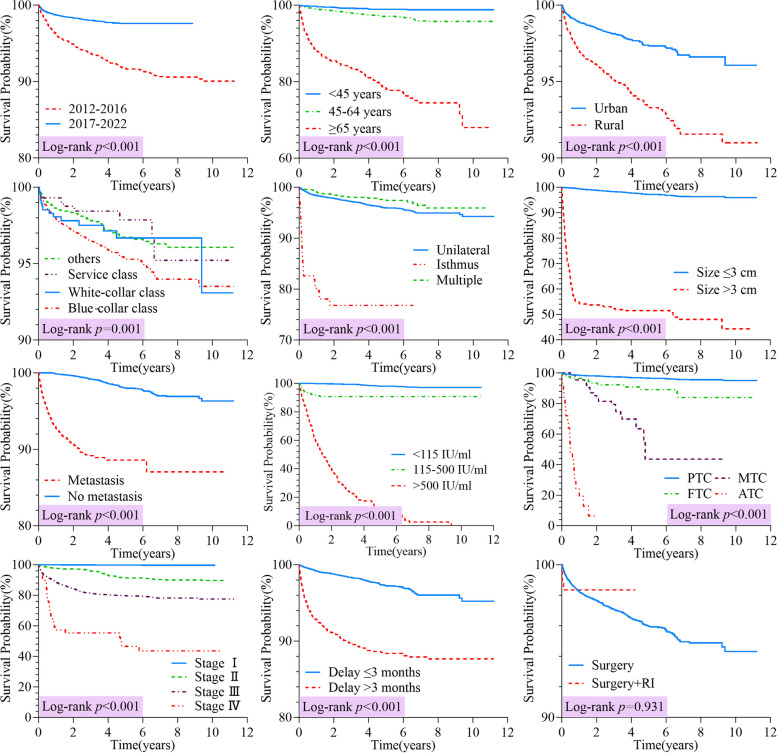
A total of 10,852 new cases of thyroid cancer occurred with a 5-year OS of 96.20% in Yantai from 2012 to 2022. The SMR decreased from 1.06 (95%CI: 0.93 - 1.33) in 2012 to 0.50 (95%CI: 0.42 - 0.63) in 2022 and the AER decreased from 11.07 (95%CI: -13.42 - 47.39) per 10,000 population in 2012 to -105.02 (95%CI: -149.53 - -63.02) per 10,000 population in 2022. Disparities in the OS of thyroid cancer patients were found across different diagnosis periods, genders, age groups, places of residence, occupational classes, tumor sites and sizes, cervical lymph node metastasis statuses, TgAb levels, pathological types, clinical stages and treatment timings (all p < 0.05). Multivariate analysis showed that age group (≥ 65 years: HR = 1.727), tumor site (location in the isthmus: HR = 3.117), tumor size (> 3 cm: HR = 3.170), cervival lymph node metastasis (HR = 1.876), TgAb levels (115 - 500 IU/ml: HR = 7.103; > 500 IU/ml: HR = 13.554), pathological types (MTC: HR = 2.060; ATC: HR = 10.747), clinical stages (stage II: HR = 2.224; stage III: HR = 3.361; stage IV: HR = 3.494), treatment timing (> 3 months: HR = 2.594), diagnosis period (2017 - 2022: HR = 0.633) and gender (female: HR = 0.711) were found to be associated with the risk of death; after stratified adjustment, significant differences in prognostic factors were identified among thyroid cancer patients with varying pathological types.
The risk of death from thyroid cancer in Yantai has significantly decreased and the OS of patients has improved significantly in the past decade. The prognosis of thyroid cancer in this area was notably impacted by various factors and the resolution of survival study outcomes for thyroid cancer patients should be enhanced.
尽管甲状腺癌的死亡率较低,但亚洲地区甲状腺癌预后的显著种族差异尚未得到充分研究。此外,亚洲人口由不同的种族群体组成,并非同质化。本研究旨在对甲状腺癌患者的生存结果和预后因素进行基于人群的分析。
从烟台癌症登记处获取所有确诊甲状腺癌患者的人口统计学数据和肿瘤特征。采用死亡比例、标准化死亡比(SMR)和绝对超额风险(AER)评估患者的甲状腺癌特异性死亡风险。采用Kaplan-Meier法和Cox比例风险回归模型评估总生存期(OS)和预后。
2012年至2022年,烟台共发生10852例甲状腺癌新发病例,5年总生存率为96.20%。SMR从2012年的1.06(95%CI:0.93-1.33)降至2022年的0.50(95%CI:0.42-0.63),AER从2012年每10000人口11.07(95%CI:-13.42-47.39)降至2022年每10000人口-105.02(95%CI:-149.53--63.02)。在不同诊断时期、性别、年龄组、居住地、职业阶层、肿瘤部位和大小、颈部淋巴结转移状态、TgAb水平、病理类型、临床分期和治疗时机方面,甲状腺癌患者的总生存期存在差异(均P<0.05)。多因素分析显示,年龄组(≥65岁:HR=1.727)、肿瘤部位(位于峡部:HR=3.117)、肿瘤大小(>3cm:HR=3.170)、颈部淋巴结转移(HR=1.876)、TgAb水平(115-500IU/ml:HR=7.103;>500IU/ml:HR=13.554)、病理类型(MTC:HR=2.060;ATC:HR=10.747)、临床分期(II期:HR=2.224;III期:HR=3.361;IV期:HR=3.494)、治疗时机(>3个月:HR=2.594)、诊断时期(2017-2022年:HR=0.633)和性别(女性:HR=0.711)与死亡风险相关;分层调整后,不同病理类型的甲状腺癌患者预后因素存在显著差异。
在过去十年中,烟台甲状腺癌的死亡风险显著降低,患者的总生存期显著改善。该地区甲状腺癌的预后受到多种因素的显著影响,应加强甲状腺癌患者生存研究结果的解析。