Johnson Mildred J, Lemer Sarah, Hirose Masato, Decker Sebastian H, Schwaha Thomas
Dept. Evolutionary Biology, University of Vienna, Djerassiplatz 1, Vienna, 1030, Austria.
Marine Laboratory, UOG Station, Mangilao Guam, 96923, USA.
Zoological Lett. 2024 Dec 31;10(1):23. doi: 10.1186/s40851-024-00246-9.
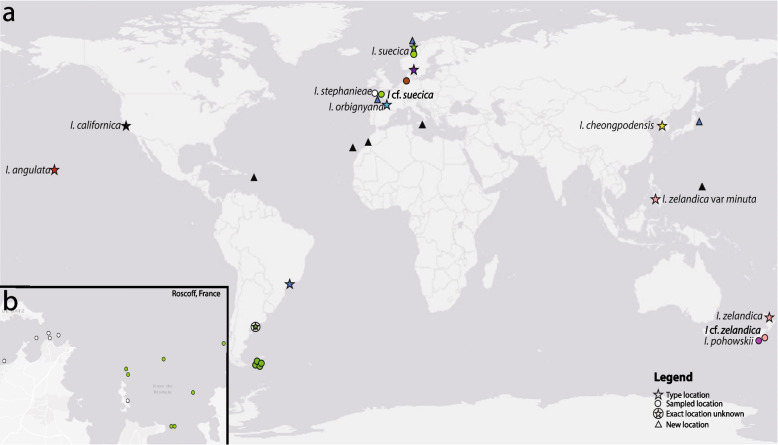
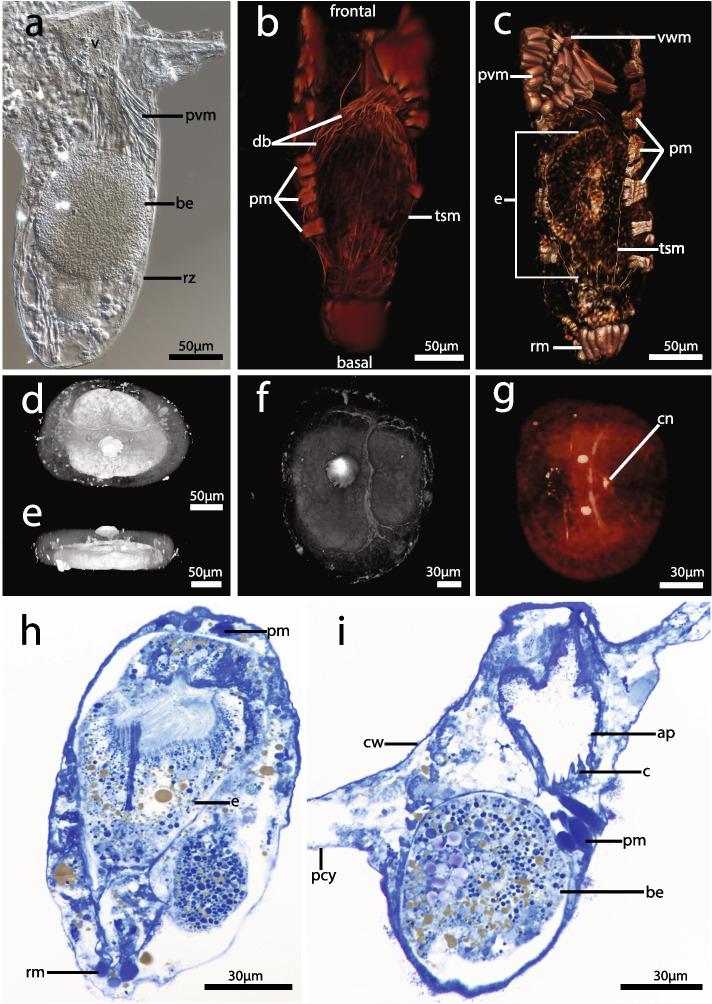
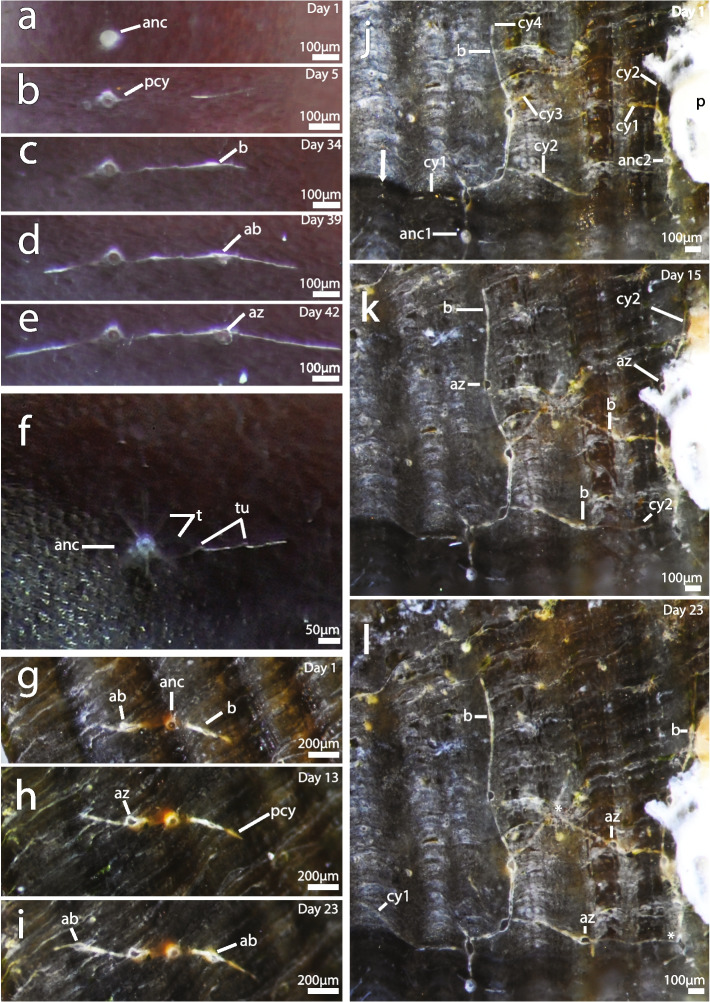
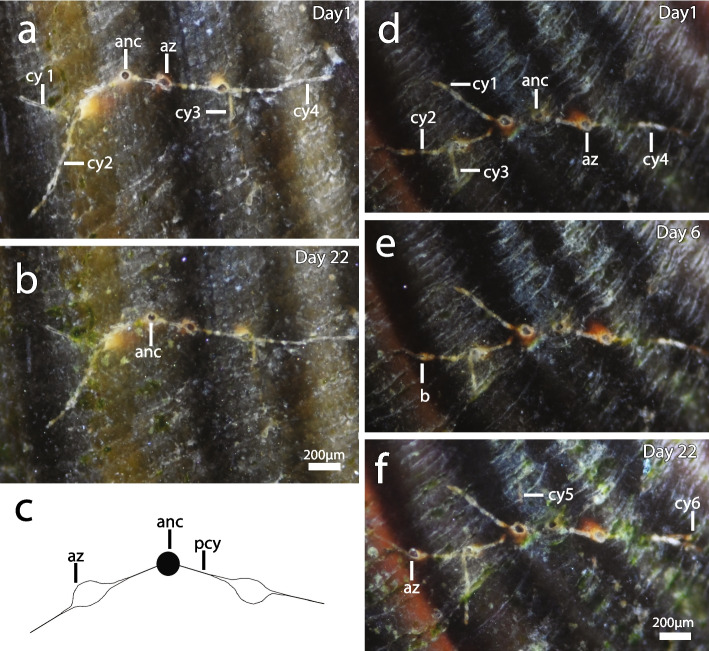
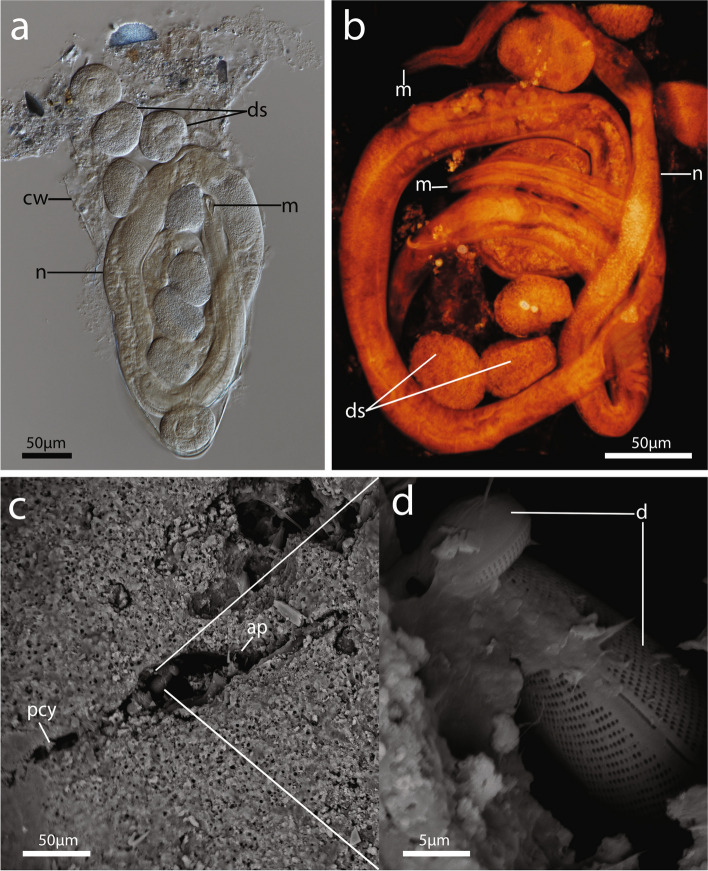
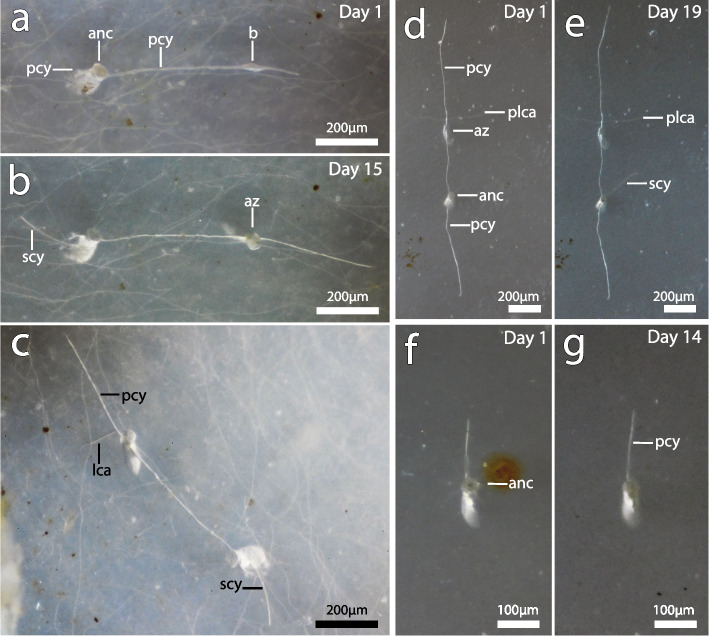
Boring bryozoans dissolve calcium carbonate substrates, leaving unique borehole traces. Depending on the shell type, borehole apertures and colony morphology can be diagnostic for distinguishing taxa, but to discriminate among species their combination with zooidal morphology is essential. All boring (endolithic) bryozoans are ctenostomes that, along with other boring taxa, are common in benthic communities. The growth rates of such bryozoans, including Immergentiidae, are largely unknown. For the first time laboratory experiments were conducted to determine growth rates and early colony development of the intertidal species Immergentia stephanieae and the subtidal species I. cf. suecica from Roscoff, France. In growth experiment 1, ancestrular growth rates varied, with the highest rates in I. stephanieae at 96.5 µm day and the lowest at 1.1 µm day, during the period of August to October, in which the number of reproductive zooids was comparably higher than in other months of the year. Immergentia cf. suecica had a higher proportion of reproductive zooids from December to March compared to other months. In growth experiment 2, the bryozoans were fed a culture mixture of Chaetoceros calcitrans and Tisochrysis lutea which was compared with a control. The growth rate of small colonies of comparable size was greater in the food-enriched samples compared to the control (non-enriched). In larger colonies, the trend differed with greater growth (cystid appendage expansion) rate reported for some samples in the control. In food-enriched samples ancestrulae of I. stephanieae grew at 23 µm day and I. cf. suecica 9.3 µm day while no growth was observed in the control of I. cf. suecica, but 0.4 µm day was reported for I. stephanieae. Growth patterns in the early developmental stages showed that the budding patterns from the ancestrulae were the same for both species, with different enantiomorphic tendencies. Inter- and intraspecific interactions are also discussed. The distribution of immergentiids is presented, as are records from new locations and the greatest subtidal depth of collection reported to date.
钻孔苔藓虫会溶解碳酸钙基质,留下独特的钻孔痕迹。根据壳的类型,钻孔孔径和群体形态可用于区分分类单元,但要区分物种,还必须将其与类虫体形态相结合。所有钻孔(内石生)苔藓虫都是栉口目动物,它们与其他钻孔类群一样,在底栖生物群落中很常见。包括浸没苔藓虫科在内的此类苔藓虫的生长速率在很大程度上尚不清楚。首次进行了实验室实验,以确定潮间带物种斯蒂芬浸没苔藓虫和来自法国罗斯科夫的潮下带物种疑似瑞典浸没苔藓虫的生长速率和早期群体发育情况。在生长实验1中,始祖体的生长速率各不相同,斯蒂芬浸没苔藓虫在8月至10月期间的生长速率最高,为96.5微米/天,最低为1.1微米/天,在此期间,生殖类虫体的数量比一年中的其他月份相对更高。与其他月份相比,疑似瑞典浸没苔藓虫在12月至3月期间生殖类虫体的比例更高。在生长实验2中,给苔藓虫投喂了角毛藻和等鞭金藻的培养混合物,并与对照组进行比较。与对照组(未富集)相比,食物富集样本中大小相当的小群体的生长速率更高。在较大的群体中,趋势有所不同,对照组中的一些样本报告的生长(囊状附属物扩展)速率更高。在食物富集样本中,斯蒂芬浸没苔藓虫的始祖体生长速率为23微米/天,疑似瑞典浸没苔藓虫为9.3微米/天,而在疑似瑞典浸没苔藓虫的对照组中未观察到生长,但斯蒂芬浸没苔藓虫的对照组报告为0.4微米/天。早期发育阶段的生长模式表明,两个物种始祖体的出芽模式相同,但具有不同的对映形态倾向。还讨论了种间和种内相互作用。介绍了浸没苔藓虫科的分布情况,以及新地点的记录和迄今为止报告的最大潮下带采集深度。