Le Busque B, Litchfield C, Shaw C L
Stem University of South Australia Adelaide South Australia Australia.
Conservation Psychology and Applied Animal Behaviour Research Group, Justice & Society University of South Australia Adelaide South Australia Australia.
Plant Environ Interact. 2024 Dec 29;5(6):e70025. doi: 10.1002/pei3.70025. eCollection 2024 Dec.
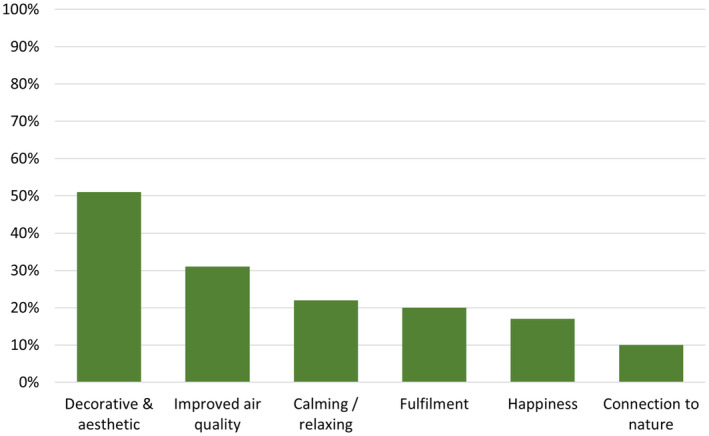
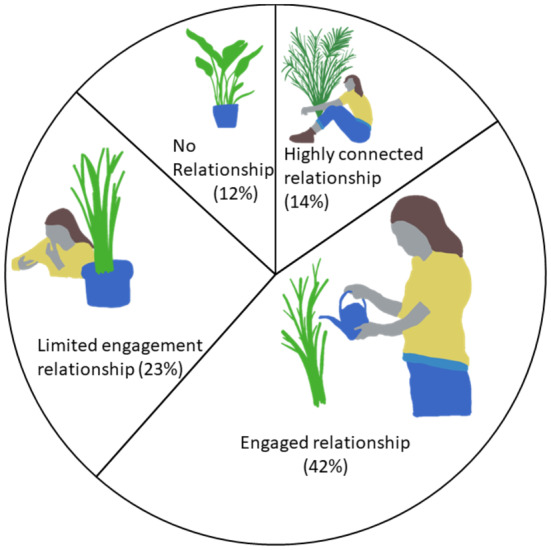
Humans have a long-standing relationship with the natural world, particularly in how they engage with plants-referred to as people-plant relationships. While plants naturally live outdoors, people have been including them inside built environments for centuries. Although the benefits of indoor plants are well documented in research, there is limited exploration of individuals' subjective relationships with their indoor plants. To address this gap, we examined the perceived benefits of owning indoor plants and how people describe their relationships with them through open-ended qualitative survey items. Data were collected from 115 indoor plant owners in Australia, and the qualitative responses were analyzed using a combination of thematic analysis and qualitative segmentation. On average, participants owned 15 indoor plants and in total participants identified 11 benefits. The most common being decorative and aesthetic value, improved air quality, and calming effects. Participants fell into one of four types of relationships with their indoor plants: highly connected, engaged, limited engagement, and no relationship. This qualitative segmentation approach allowed us to achieve a key goal of exploratory qualitative research-providing new insights to inform future quantitative studies. Given that we found that not all indoor plant-people relationships are equal, and that people have varying levels of connection to their plants, future research should explore these relationship types using quantitative methods.
人类与自然世界有着长期的关系,尤其是在他们与植物的互动方式上,这种互动被称为人-植物关系。虽然植物自然生长在户外,但几个世纪以来,人们一直将它们纳入室内环境。尽管室内植物的益处已在研究中得到充分记录,但对于个人与室内植物的主观关系的探索却很有限。为了填补这一空白,我们通过开放式定性调查项目,研究了拥有室内植物的感知益处以及人们如何描述他们与室内植物的关系。我们从澳大利亚的115名室内植物所有者那里收集了数据,并使用主题分析和定性细分相结合的方法对定性回复进行了分析。参与者平均拥有15株室内植物,总共确定了11项益处。最常见的是装饰和审美价值、改善空气质量以及舒缓效果。参与者与他们的室内植物形成了四种关系类型之一:高度关联、投入、有限投入和无关系。这种定性细分方法使我们实现了探索性定性研究的一个关键目标——提供新的见解以指导未来的定量研究。鉴于我们发现并非所有人与室内植物的关系都是平等的,而且人们与植物的联系程度各不相同,未来的研究应该使用定量方法来探索这些关系类型。