Leubner Emily, Levandowski Brooke A, Mikami Sage, Green Theresa, Betstadt Sarah
Department of Obstetrics and Gynecology, University of Rochester Medical Center, University of Rochester School of Medicine and Dentistry, Rochester, NY (Leubner, Levandowski, Mikami, and Betstadt).
Center for Community Health & Prevention, University of Rochester Medical Center, Rochester, NY (Green).
AJOG Glob Rep. 2024 Nov 20;5(1):100421. doi: 10.1016/j.xagr.2024.100421. eCollection 2025 Feb.
Postpartum contraception is typically provided during postpartum visits. When desired and accessible, the immediate postpartum period provides an additional opportunity to increase the use of more effective contraceptive methods to potentially reduce subsequent unintended pregnancies and improve pregnancy outcomes. In New York State, recent policy changes expanded Medicaid coverage to include immediate postplacental intrauterine device insertion.
This study aimed to investigate clinically documented intrauterine device expulsion within 12 months of placement in patients who depend on state-funded health insurance.
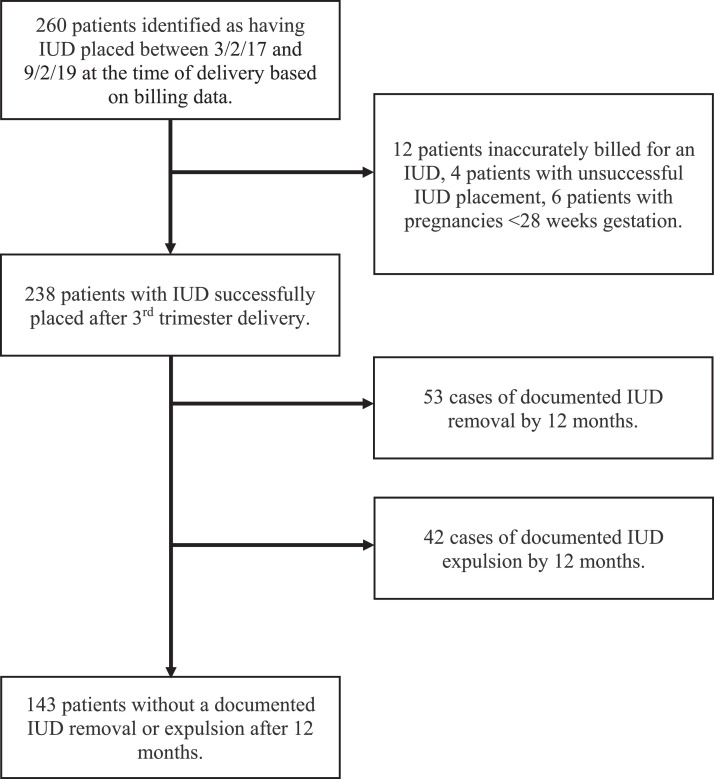
This retrospective cohort study included Medicaid patients with an immediate postplacental intrauterine device placed after third-trimester delivery, who delivered between March 2, 2017 and September 2, 2019. Current Procedural Terminology code billing data were used to identify 238 patients who underwent intrauterine device placement during their delivery admission. Electronic medical record data were analyzed using chi-squared tests, tests, and multivariable logistic regression.
There were 17.6% (42/238) documented intrauterine device expulsions within the first year after placement. Among patients with vaginal deliveries, 22.1% (29/131) of intrauterine devices placed had a documented expulsion, whereas the expulsion rate was 12.2% (13/107) among patients who had cesarean deliveries (=.04). After controlling for body mass index, parity, intrauterine device type, and gestational age, patients who delivered vaginally were more likely to experience intrauterine device expulsion within 1 year compared with those who had cesarean delivery (adjusted odds ratio, 2.71; 95% confidence interval, 1.27-5.80). Patients with a documented intrauterine device expulsion within 1 year were more likely to have a subsequent pregnancy before October 2020 (35.7% [15/42] vs 15.3% [30/196] in the no-expulsion group; =.002).
The overall percentage of documented intrauterine device expulsion within 1 year following immediate postplacental placement was 17.6%, with a greater percentage of expulsion in patients who underwent vaginal delivery. Patients with a documented intrauterine device expulsion within 1 year of placement were significantly more likely to experience a subsequent pregnancy.
产后避孕通常在产后访视期间提供。在有需求且可及的情况下,产后即刻阶段提供了一个额外的机会,可增加使用更有效的避孕方法,以潜在地减少随后的意外妊娠并改善妊娠结局。在纽约州,最近的政策变化扩大了医疗补助覆盖范围,将胎盘娩出后即刻宫内节育器放置纳入其中。
本研究旨在调查依赖国家资助医疗保险的患者在宫内节育器放置后12个月内临床记录的宫内节育器排出情况。
这项回顾性队列研究纳入了在2017年3月2日至2019年9月2日期间分娩的、在妊娠晚期分娩后胎盘娩出后即刻放置宫内节育器的医疗补助患者。使用当前程序编码计费数据来识别238例在分娩入院期间接受宫内节育器放置的患者。使用卡方检验、检验和多变量逻辑回归分析电子病历数据。
放置后第一年内有17.6%(42/238)记录了宫内节育器排出。在阴道分娩的患者中,放置的宫内节育器有22.1%(29/131)记录有排出,而剖宫产患者的排出率为12.2%(13/107)(P = 0.04)。在控制了体重指数、产次、宫内节育器类型和孕周后,与剖宫产患者相比,阴道分娩的患者在1年内更有可能发生宫内节育器排出(调整后的优势比为2.71;95%置信区间为1.27 - 5.80)。在1年内有记录的宫内节育器排出的患者在2020年10月前更有可能再次妊娠(排出组为35.7%[15/42],未排出组为15.3%[30/196];P = 0.002)。
胎盘娩出后即刻放置宫内节育器后1年内记录的宫内节育器排出的总体百分比为17.6%,阴道分娩患者的排出百分比更高。在放置后1年内有记录的宫内节育器排出的患者发生随后妊娠的可能性显著更高。