• 文献检索
  • 文档翻译
  • 深度研究
  • 学术资讯
  • Suppr Zotero 插件Zotero 插件
  • 邀请有礼
  • 套餐&价格
  • 历史记录
应用&插件
Suppr Zotero 插件Zotero 插件浏览器插件Mac 客户端Windows 客户端微信小程序
定价
高级版会员购买积分包购买API积分包
服务
文献检索文档翻译深度研究API 文档MCP 服务
关于我们
关于 Suppr公司介绍联系我们用户协议隐私条款
关注我们

Suppr 超能文献

核心技术专利:CN118964589B侵权必究
粤ICP备2023148730 号-1Suppr @ 2026

文献检索

告别复杂PubMed语法,用中文像聊天一样搜索,搜遍4000万医学文献。AI智能推荐,让科研检索更轻松。

立即免费搜索

文件翻译

保留排版,准确专业,支持PDF/Word/PPT等文件格式,支持 12+语言互译。

免费翻译文档

深度研究

AI帮你快速写综述,25分钟生成高质量综述,智能提取关键信息,辅助科研写作。

立即免费体验

对具有物体、动物或人体背景的密集恐惧症图像的情绪和视觉反应:一项眼动追踪研究。

Emotional and visual responses to trypophobic images with object, animal, or human body backgrounds: an eye-tracking study.

作者信息

Yu Pengfei, Yu Li, Li Yuting, Qian Cheng, Hu Jia, Zhu Weiyi, Liu Fang, Wang Qi

机构信息

School of Mental Health, Wenzhou Medical University, Wenzhou, Zhejiang, China.

Xinchang Center for Disease Control and Prevention, Xinchang, Zhejiang, China.

出版信息

Front Psychol. 2024 Dec 16;15:1467608. doi: 10.3389/fpsyg.2024.1467608. eCollection 2024.

DOI:10.3389/fpsyg.2024.1467608
PMID:39737229
原文链接:https://pmc.ncbi.nlm.nih.gov/articles/PMC11684096/
Abstract

BACKGROUND

Trypophobia refers to the visual discomfort (e.g., disgust or anxiety) experienced by some people when viewing clusters of bumps or holes. The spectral profile framework suggests that the spectral components of clustered patterns induces trypophobia. In contrast, the cognitive framework speculates that cognitive appraisal of dangerous objects (e.g., ectoparasites) causes trypophobia. A background effect (e.g., more disgust toward trypophobic patterns on the skin than on a desk) seems to support the cognitive framework. However, there is no study providing objective evidence for that effect and verifying these frameworks at the same time. This study aims to address that limitation by psychometric and eye-tracking experiments.

METHODS

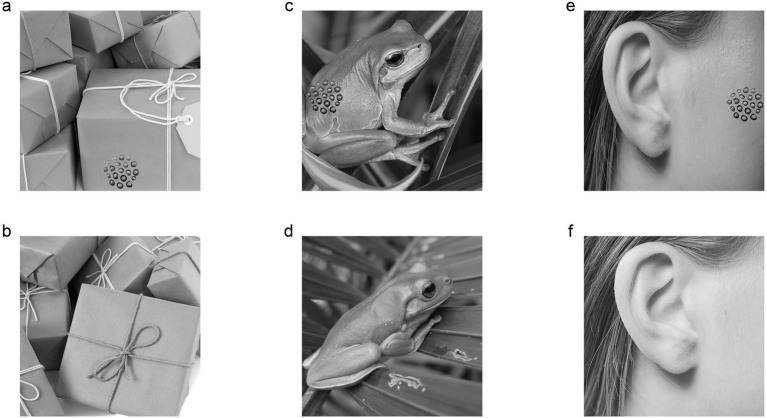
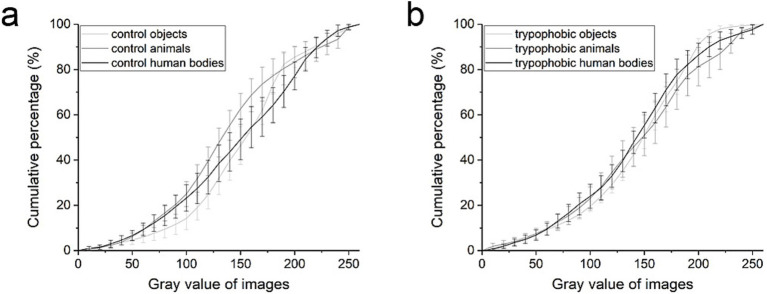
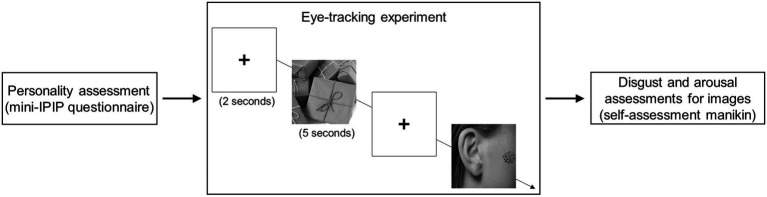
We recruited 183 participants from colleges. Initially, participants finished a personality questionnaire. The cohort then completed an eye-tracking experiment which showed the trypophobic pattern of lotus seed on three categories of background images (objects, animals and human bodies). Finally, participants rated the image's disgust and arousal levels using a self-assessment rating scale. Meanwhile, we compared all images' luminosity and power spectra.

RESULTS

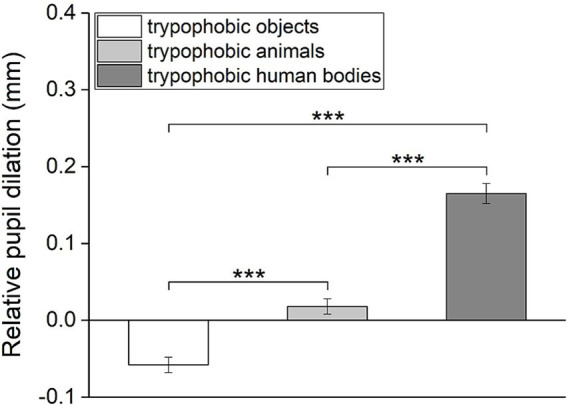
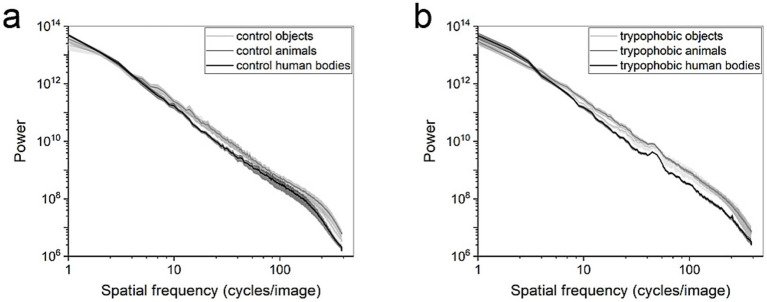
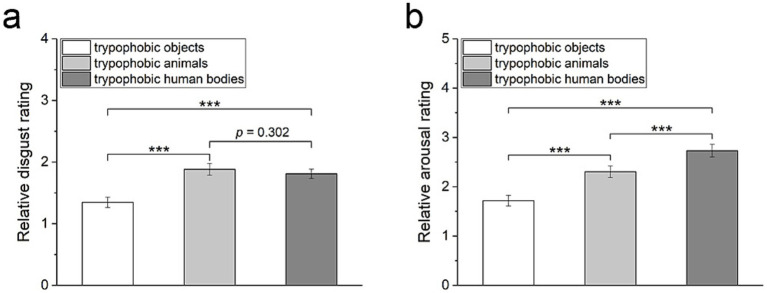
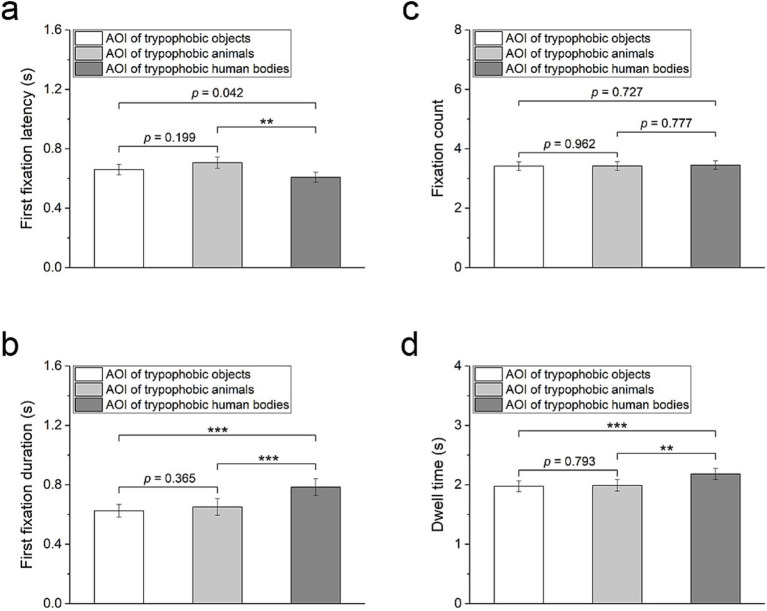
Trypophobic images with the human body or animal backgrounds induced a higher level of disgust and arousal than those with the object backgrounds. Participants gazed faster and dwelled longer at the trypophobic patterns on human body images than on object or animal images. Furthermore, trypophobic images with human body or animal backgrounds induced more substantial pupil dilation than those upon object backgrounds. No significant difference was detected between the power of trypophobic images with human body backgrounds and objects backgrounds. As the trypophobic images with human body backgrounds induced significant emotional or visual responses compared to those with inanimate object backgrounds. Such inconsistent results imply that the differential emotional or visual responses to trypophobic images are probably not induced by the difference in power spectra. Finally, the disgust/arousal level toward trypophobic images did not correlate with personality traits.

CONCLUSION

These results supported the background effect of trypophobia, namely, trypophobic images with animal or human body backgrounds induce more severe disgust and cause more arousal than those with object backgrounds. Our results support the cognitive, but not spectral profile, framework of trypophobia.

摘要

背景

密集恐惧症是指一些人在看到密集的肿块或孔洞时所体验到的视觉不适(如厌恶或焦虑)。光谱特征框架表明,密集图案的光谱成分会诱发密集恐惧症。相比之下,认知框架推测对危险物体(如体外寄生虫)的认知评估会导致密集恐惧症。一种背景效应(例如,对皮肤上的密集恐惧症图案比对桌子上的更厌恶)似乎支持认知框架。然而,尚无研究为该效应提供客观证据并同时验证这些框架。本研究旨在通过心理测量和眼动追踪实验来解决这一局限性。

方法

我们从高校招募了183名参与者。最初,参与者完成一份人格问卷。然后该队列完成一项眼动追踪实验,实验展示了莲子的密集恐惧症图案在三类背景图像(物体、动物和人体)上的情况。最后,参与者使用自我评估量表对图像的厌恶和唤醒水平进行评分。同时,我们比较了所有图像的亮度和功率谱。

结果

以人体或动物为背景的密集恐惧症图像比以物体为背景的图像诱发更高水平的厌恶和唤醒。参与者注视人体图像上的密集恐惧症图案比注视物体或动物图像上的图案更快且停留时间更长。此外,以人体或动物为背景的密集恐惧症图像比以物体为背景的图像诱发更明显的瞳孔扩张。以人体为背景的密集恐惧症图像和以物体为背景的图像在功率上未检测到显著差异。由于与无生命物体背景的图像相比,以人体为背景的密集恐惧症图像诱发了显著的情绪或视觉反应。这种不一致的结果意味着对密集恐惧症图像的不同情绪或视觉反应可能不是由功率谱的差异引起的。最后,对密集恐惧症图像的厌恶/唤醒水平与人格特质无关。

结论

这些结果支持密集恐惧症的背景效应,即,以动物或人体为背景的密集恐惧症图像比以物体为背景的图像诱发更强烈的厌恶并引起更高的唤醒。我们的结果支持密集恐惧症的认知框架,而非光谱特征框架。
https://cdn.ncbi.nlm.nih.gov/pmc/blobs/1320/11684096/d3e3e53ad043/fpsyg-15-1467608-g007.jpg
https://cdn.ncbi.nlm.nih.gov/pmc/blobs/1320/11684096/a8c141c1a2ad/fpsyg-15-1467608-g001.jpg
https://cdn.ncbi.nlm.nih.gov/pmc/blobs/1320/11684096/648f68622f8e/fpsyg-15-1467608-g002.jpg
https://cdn.ncbi.nlm.nih.gov/pmc/blobs/1320/11684096/2e0d3e975f86/fpsyg-15-1467608-g003.jpg
https://cdn.ncbi.nlm.nih.gov/pmc/blobs/1320/11684096/f549328ac249/fpsyg-15-1467608-g004.jpg
https://cdn.ncbi.nlm.nih.gov/pmc/blobs/1320/11684096/ca1f08832ffa/fpsyg-15-1467608-g005.jpg
https://cdn.ncbi.nlm.nih.gov/pmc/blobs/1320/11684096/f67071f1f242/fpsyg-15-1467608-g006.jpg
https://cdn.ncbi.nlm.nih.gov/pmc/blobs/1320/11684096/d3e3e53ad043/fpsyg-15-1467608-g007.jpg
https://cdn.ncbi.nlm.nih.gov/pmc/blobs/1320/11684096/a8c141c1a2ad/fpsyg-15-1467608-g001.jpg
https://cdn.ncbi.nlm.nih.gov/pmc/blobs/1320/11684096/648f68622f8e/fpsyg-15-1467608-g002.jpg
https://cdn.ncbi.nlm.nih.gov/pmc/blobs/1320/11684096/2e0d3e975f86/fpsyg-15-1467608-g003.jpg
https://cdn.ncbi.nlm.nih.gov/pmc/blobs/1320/11684096/f549328ac249/fpsyg-15-1467608-g004.jpg
https://cdn.ncbi.nlm.nih.gov/pmc/blobs/1320/11684096/ca1f08832ffa/fpsyg-15-1467608-g005.jpg
https://cdn.ncbi.nlm.nih.gov/pmc/blobs/1320/11684096/f67071f1f242/fpsyg-15-1467608-g006.jpg
https://cdn.ncbi.nlm.nih.gov/pmc/blobs/1320/11684096/d3e3e53ad043/fpsyg-15-1467608-g007.jpg

相似文献

1
Emotional and visual responses to trypophobic images with object, animal, or human body backgrounds: an eye-tracking study.对具有物体、动物或人体背景的密集恐惧症图像的情绪和视觉反应:一项眼动追踪研究。
Front Psychol. 2024 Dec 16;15:1467608. doi: 10.3389/fpsyg.2024.1467608. eCollection 2024.
2
Is trypophobia more related to disgust than to fear? Assessing the disease avoidance and ancestral fear hypotheses.密集恐惧症与厌恶感的关联是否比与恐惧的关联更大?评估疾病规避和祖传恐惧假说。
Q J Exp Psychol (Hove). 2025 Feb 11:17470218251323236. doi: 10.1177/17470218251323236.
3
Trypophobia is predicted by disgust sensitivity, empathic traits, and visual discomfort.密集恐惧症可由厌恶敏感性、共情特质和视觉不适来预测。
Springerplus. 2016 Aug 30;5(1):1449. doi: 10.1186/s40064-016-3149-6. eCollection 2016.
4
Object Clusters or Spectral Energy? Assessing the Relative Contributions of Image Phase and Amplitude Spectra to Trypophobia.物体集群还是光谱能量?评估图像相位和幅度光谱对密集恐惧症的相对贡献。
Front Psychol. 2020 Jul 24;11:1847. doi: 10.3389/fpsyg.2020.01847. eCollection 2020.
5
Preschool children aged 4 to 5 years show discomfort with trypophobic images.4至5岁的学龄前儿童对密集恐惧症图像表现出不适。
Sci Rep. 2023 Feb 16;13(1):2768. doi: 10.1038/s41598-023-29808-1.
6
Contamination in Trypophobia: investigating the role of disgust.密集恐惧症中的污染:探究厌恶情绪的作用。
Cogn Emot. 2025 May;39(3):635-648. doi: 10.1080/02699931.2024.2389388. Epub 2024 Aug 9.
7
Trypophobia, skin disease, and the visual discomfort of natural textures.密集恐惧症、皮肤病,以及对天然纹理的视觉不适。
Sci Rep. 2024 Feb 29;14(1):5050. doi: 10.1038/s41598-024-55149-8.
8
Evaluating the 'skin disease-avoidance' and 'dangerous animal' frameworks for understanding trypophobia.评估“皮肤疾病回避”和“危险动物”框架以理解密集恐惧症。
Cogn Emot. 2022 Aug;36(5):943-956. doi: 10.1080/02699931.2022.2071236. Epub 2022 May 3.
9
Fear of eyes: triadic relation among social anxiety, trypophobia, and discomfort for eye cluster.对眼睛的恐惧:社交焦虑、密集恐惧症和对眼睛集群不适感之间的三元关系。
PeerJ. 2016 May 5;4:e1942. doi: 10.7717/peerj.1942. eCollection 2016.
10
Trypophobic images gain preferential access to early visual processes.密集恐惧症图像优先进入早期视觉加工过程。
Conscious Cogn. 2019 Jan;67:56-68. doi: 10.1016/j.concog.2018.11.009. Epub 2018 Dec 6.

本文引用的文献

1
Trypophobia, skin disease, and the visual discomfort of natural textures.密集恐惧症、皮肤病,以及对天然纹理的视觉不适。
Sci Rep. 2024 Feb 29;14(1):5050. doi: 10.1038/s41598-024-55149-8.
2
Is trypophobia real?恐丑症是真的吗?
BJPsych Open. 2024 Feb 16;10(2):e48. doi: 10.1192/bjo.2023.621.
3
The social learning account of trypophobia.恐密集症的社会学习解释。
Q J Exp Psychol (Hove). 2024 Oct;77(10):2076-2083. doi: 10.1177/17470218241232665. Epub 2024 Feb 23.
4
Excessive fear of clusters of holes, its interaction with stressful life events and the association with anxiety and depressive symptoms: large epidemiological study of young people in Hong Kong.对密集孔洞的过度恐惧、其与应激性生活事件的相互作用以及与焦虑和抑郁症状的关联:香港年轻人的大型流行病学研究
BJPsych Open. 2023 Aug 14;9(5):e151. doi: 10.1192/bjo.2023.540.
5
From pupil to the brain: New insights for studying cortical plasticity through pupillometry.从瞳孔到大脑:通过瞳孔测量研究皮层可塑性的新见解。
Front Neural Circuits. 2023 Mar 31;17:1151847. doi: 10.3389/fncir.2023.1151847. eCollection 2023.
6
Preschool children aged 4 to 5 years show discomfort with trypophobic images.4至5岁的学龄前儿童对密集恐惧症图像表现出不适。
Sci Rep. 2023 Feb 16;13(1):2768. doi: 10.1038/s41598-023-29808-1.
7
Evaluating the 'skin disease-avoidance' and 'dangerous animal' frameworks for understanding trypophobia.评估“皮肤疾病回避”和“危险动物”框架以理解密集恐惧症。
Cogn Emot. 2022 Aug;36(5):943-956. doi: 10.1080/02699931.2022.2071236. Epub 2022 May 3.
8
Eye pupil - a window into central autonomic regulation via emotional/cognitive processing.瞳孔 - 通过情绪/认知加工观察中枢自主调节的窗口。
Physiol Res. 2021 Dec 30;70(Suppl4):S669-S682. doi: 10.33549/physiolres.934749.
9
The Perceived Beauty of Convex Polygon Tilings: The Influence of Regularity, Curvature, and Density.凸多边形平铺的美感感知:规则性、曲率和密度的影响。
Perception. 2021 Dec;50(12):1002-1026. doi: 10.1177/03010066211064194.
10
Infants show pupil dilatory responses to happy and angry facial expressions.婴儿对快乐和愤怒的面部表情会表现出瞳孔扩张反应。
Dev Sci. 2022 Mar;25(2):e13182. doi: 10.1111/desc.13182. Epub 2021 Oct 18.