Tozadore Daniel C, Romero Roseli A F
CHILI Lab, School of Information and Computer Science, École Polytechnique Fédérale de Lausanne (EPFL), Lausanne, Switzerland.
Robot Learning Laboratory, Instituto de Ciências Matemáticas e de Computação (ICMC), University of São Paulo (USP), SãoCarlos, Brazil.
Front Robot AI. 2024 Dec 16;11:1409671. doi: 10.3389/frobt.2024.1409671. eCollection 2024.
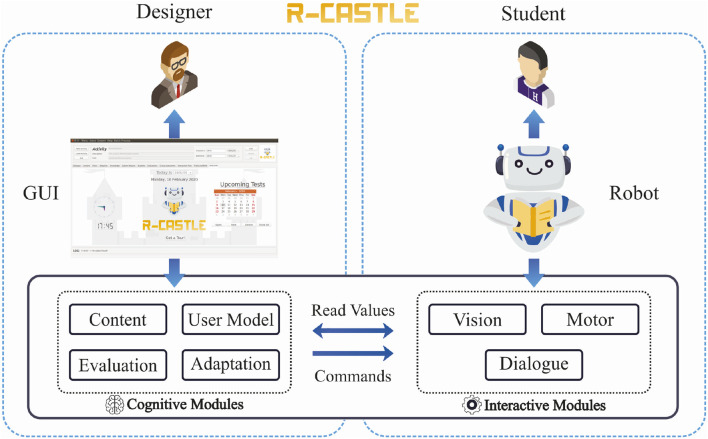
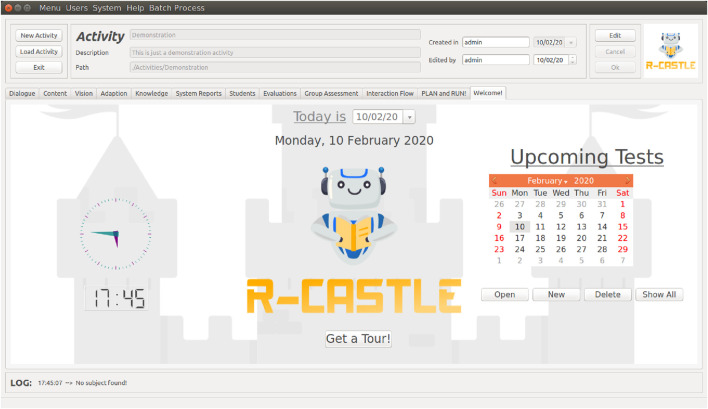
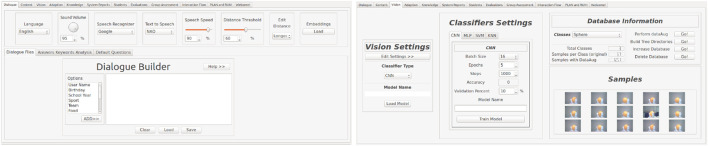
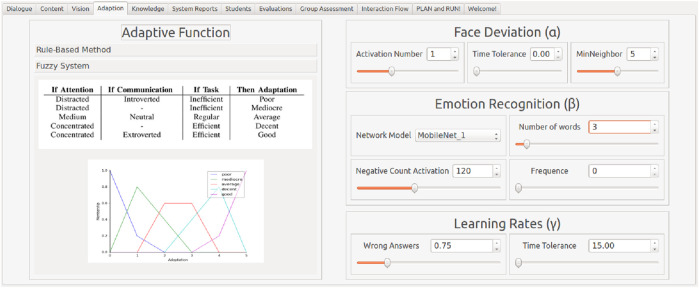
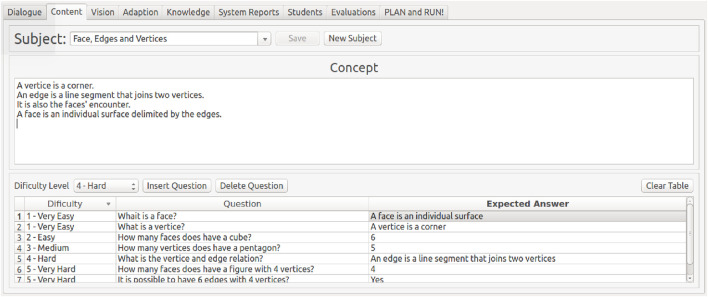
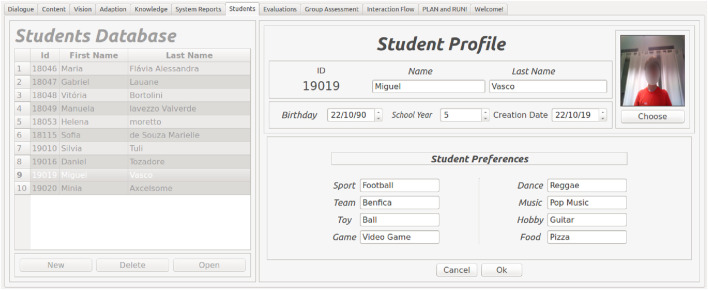
Research on social assistive robots in education faces many challenges that extend beyond technical issues. On one hand, hardware and software limitations, such as algorithm accuracy in real-world applications, render this approach difficult for daily use. On the other hand, there are human factors that need addressing as well, such as student motivations and expectations toward the robot, teachers' time management and lack of knowledge to deal with such technologies, and effective communication between experimenters and stakeholders. In this paper, we present a complete evaluation of the design process for a robotic architecture targeting teachers, students, and researchers. The contribution of this work is three-fold: (i) we first present a high-level assessment of the studies conducted with students and teachers that allowed us to build the final version of the architecture's module and its graphical interface; (ii) we present the R-CASTLE architecture from a technical perspective and its implications for developers and researchers; and, finally, (iii) we validated the R-CASTLE architecture with an in-depth qualitative analysis with five new teachers. Findings suggest that teachers can intuitively import their daily activities into our architecture at first glance, even without prior contact with any social robot.
教育领域中社交辅助机器人的研究面临诸多挑战,这些挑战超出了技术问题的范畴。一方面,硬件和软件存在局限性,例如在实际应用中的算法准确性,这使得这种方法在日常使用中存在困难。另一方面,也存在一些需要解决的人为因素,比如学生对机器人的动机和期望、教师的时间管理以及缺乏应对此类技术的知识,还有实验者与利益相关者之间的有效沟通。在本文中,我们对一种面向教师、学生和研究人员的机器人架构的设计过程进行了全面评估。这项工作的贡献体现在三个方面:(i)我们首先对与学生和教师开展的研究进行了高层次评估,这使我们能够构建架构模块及其图形界面的最终版本;(ii)我们从技术角度介绍了R-CASTLE架构及其对开发者和研究人员的影响;最后,(iii)我们通过对五位新教师进行深入的定性分析,验证了R-CASTLE架构。研究结果表明,即使教师此前没有接触过任何社交机器人,他们也能在第一眼就直观地将自己的日常活动导入到我们的架构中。