Scoglio Arielle Aj, Reilly Erin D, Gorman Jay A, Drebing Charles E
Social & Community Reintegration Research Program, Edith Nourse Rogers Memorial Veterans Hospital, Bedford, MA, United States.
J Med Internet Res. 2019 Jul 24;21(7):e13322. doi: 10.2196/13322.
Technology-assisted clinical interventions are increasingly common in the health care field, often with the proposed aim to improve access to and cost-effectiveness of care. Current technology platforms delivering interventions are largely mobile apps and online websites, although efforts have been made to create more personalized and embodied technology experiences. To extend and improve on these platforms, the field of robotics has been increasingly included in conversations of how to deliver technology-assisted, interactive, and responsive mental health and psychological well-being interventions. Socially assistive robots (SARs) are robotic technology platforms with audio, visual, and movement capabilities that are being developed to interact with individuals socially while also assisting them with management of their physical and psychological well-being. However, little is known about the empirical evidence or utility of using SARs in mental health interventions.
The review synthesizes and describes the nascent empirical literature of SARs in mental health research and identifies strengths, weaknesses, and opportunities for improvement in future research and practice.
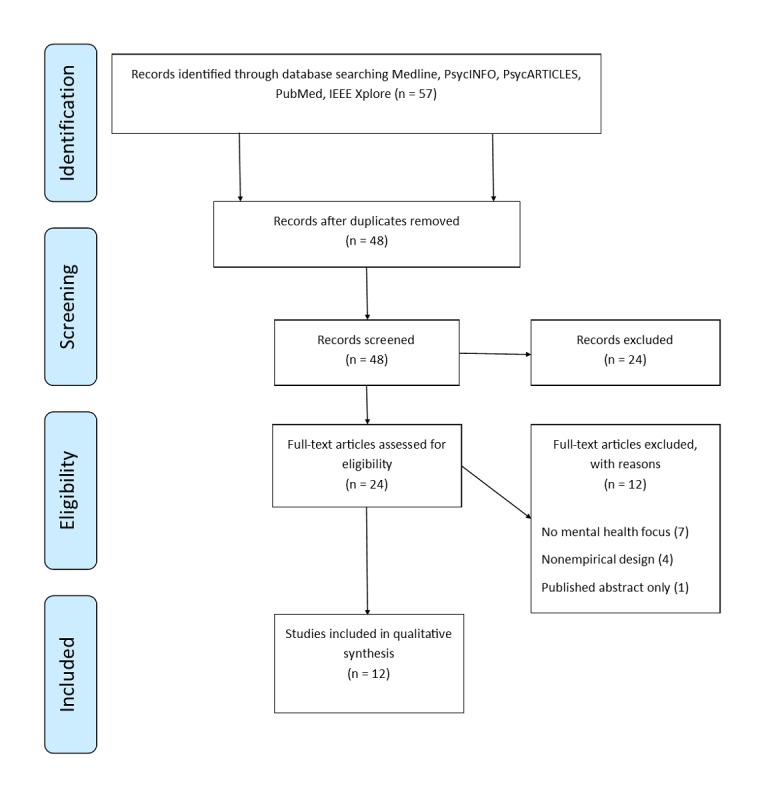
Searches in Medline, PsycINFO, PsycARTICLES, PubMed, and IEEE Xplore yielded 12 studies included in the final review after applying inclusion and exclusion criteria. Abstract and full-text reviews were conducted by two authors independently.
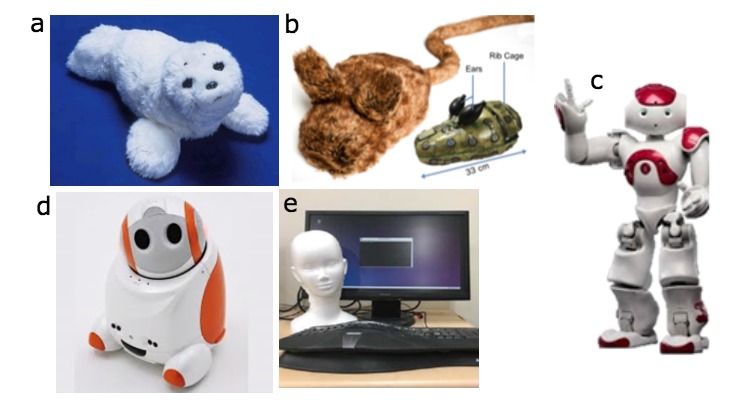
This systematic review of the literature found 5 distinct SARs used in research to investigate the potential for this technology to address mental health and psychological well-being outcomes. Research on mental health applications of SARs focuses largely on elderly dementia patients and relies on usability pilot data with methodological limitations.
The current SARs research in mental health use is limited in generalizability, scope, and measurement of psychological outcomes. Opportunities for expansion of research in this area include diversifying populations studied, SARs used, clinical applications, measures used, and settings for those applications.
技术辅助临床干预在医疗保健领域日益普遍,其目的通常是改善医疗服务的可及性和成本效益。目前提供干预措施的技术平台主要是移动应用程序和在线网站,尽管人们已努力创造更个性化和具身化的技术体验。为了扩展和改进这些平台,机器人技术领域越来越多地被纳入关于如何提供技术辅助、交互式和响应式心理健康及心理幸福感干预措施的讨论中。社交辅助机器人(SAR)是具有音频、视觉和运动能力的机器人技术平台,旨在与个人进行社交互动,同时协助他们管理身心健康。然而,关于在心理健康干预中使用SAR的实证证据或效用知之甚少。
本综述综合并描述了心理健康研究中SAR的新兴实证文献,并确定了未来研究和实践中有待改进的优势、劣势和机会。
在Medline、PsycINFO、PsycARTICLES、PubMed和IEEE Xplore中进行检索,在应用纳入和排除标准后,最终综述纳入了12项研究。由两位作者独立进行摘要和全文评审。
这项系统的文献综述发现,有5种不同的SAR被用于研究该技术解决心理健康和心理幸福感问题的潜力。关于SAR心理健康应用的研究主要集中在老年痴呆患者身上,并依赖于存在方法学局限性的可用性试点数据。
目前关于心理健康用途的SAR研究在普遍性、范围和心理结果测量方面存在局限性。该领域研究扩展的机会包括使研究人群、使用的SAR、临床应用、使用的测量方法以及这些应用的环境多样化。