Völschow Ben, Goßling Alina, Kellner Caroline, Neumann Johannes T
Department of Cardiology, University Heart and Vascular Center Hamburg, Hamburg, Germany.
Center for Population Health Innovation (POINT), University Heart and Vascular Center Hamburg, University Medical Center Hamburg-Eppendorf, Hamburg, Germany.
Lancet Reg Health Eur. 2024 Dec 9;49:101168. doi: 10.1016/j.lanepe.2024.101168. eCollection 2025 Feb.
Frailty is a significant predictor for adverse outcomes. Yet, data on prevalence and treatment of frail patients with acute coronary syndrome (ACS) remains limited. We aimed to investigate frailty prevalence, interventional treatment frequency, and in-hospital outcome for all patients hospitalized for ACS in Germany from 2005 to 2022 and validate the Hospital Frailty Risk Score (HFRS) in this population.
Data for 2005-2022 from the Statistical Federal Office included all cases with primary diagnosis of ACS treated in Germany. Patients were categorized into low, intermediate, and high frailty by HFRS. Diagnoses, procedures, and in-hospital outcomes were analyzed. Univariable and multivariable logistic regressions as well as sensitivity analyses were performed.
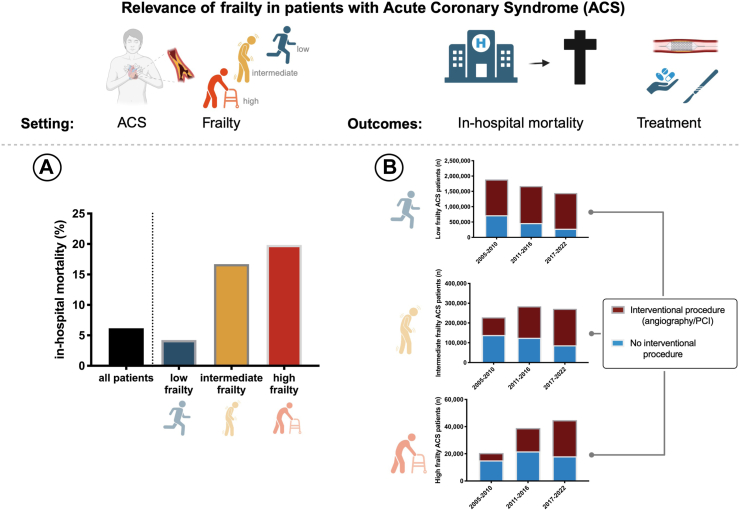
Between 2005 and 2022, 5,889,972 ACS patients were hospitalized in Germany. Mean age was 69 years (standard deviation (SD) ± 12.85 years) and 2,060,224 (34.98%) were female. In-hospital mortality was 6.2%. Among all, 5,001,812 (84.9%) had a low, 784,106 (13.3%) an intermediate, and 104,054 (1.8%) a high HFRS. High-frailty patients were less likely to undergo coronary intervention than low-frailty patients (47.0% vs. 70.6%, p < 0.001), had longer hospital stays (21.6 days SD 19.4 ± vs. 5.6 days SD ± 5.2, p < 0.001), and higher in-hospital mortality (adjusted odds ratio (OR) 3.34 [confidence interval (95% CI) 3.29-3.4]).
Nearly one-sixth of ACS-patients were frail according to HFRS. Frail patients had longer hospital stays, less often received interventional procedures, and showed substantially increased in-hospital mortality. In our aging population, frailty will play an increasing role in patient management. Frailty scores based on electronic patient records, like the HFRS, offer clinicians a tool for assessing in-hospital outcome in ACS patients, potentially enabling more individualized treatment approaches.
None.
衰弱是不良结局的重要预测因素。然而,关于急性冠状动脉综合征(ACS)衰弱患者的患病率和治疗的数据仍然有限。我们旨在调查2005年至2022年在德国因ACS住院的所有患者的衰弱患病率、介入治疗频率和院内结局,并在该人群中验证医院衰弱风险评分(HFRS)。
德国联邦统计局2005年至2022年的数据包括在德国接受治疗的所有原发性诊断为ACS的病例。根据HFRS将患者分为低、中、高衰弱组。分析诊断、治疗程序和院内结局。进行单变量和多变量逻辑回归以及敏感性分析。
2005年至2022年期间,德国有5889972例ACS患者住院。平均年龄为69岁(标准差(SD)±12.85岁),女性为2060224例(34.98%)。院内死亡率为6.2%。其中,5001812例(84.9%)HFRS低,784106例(13.3%)HFRS中等,104054例(1.8%)HFRS高。高衰弱患者比低衰弱患者接受冠状动脉介入治疗的可能性更小(47.0%对70.6%,p<0.001),住院时间更长(平均21.6天,标准差±19.4天对5.6天,标准差±5.2天,p<0.001),院内死亡率更高(调整后的优势比(OR)为3.34[置信区间(95%CI)3.29 - 3.4])。
根据HFRS,近六分之一的ACS患者衰弱。衰弱患者住院时间更长,接受介入治疗的频率更低,院内死亡率显著增加。在我们老龄化的人口中,衰弱在患者管理中将发挥越来越大的作用。基于电子病历的衰弱评分,如HFRS,为临床医生提供了一种评估ACS患者院内结局的工具,可能使治疗方法更具个性化。
无。