Kastner Lydia, Suenkel Ulrike, von Thaler Anna-Katharina, Eschweiler Gerhard W, Dankowski Theresa, Mychajliw Christian, Brockmann Kathrin, Heinzel Sebastian, Thiel Ansgar
Institute for Sport Science, Eberhard Karls University of Tübingen, Tübingen, Germany.
Tübingen Center for Mental Health (TüCMH), Department of Psychiatry and Psychotherapy, Tübingen University Hospital, Tübingen, Germany.
Front Public Health. 2024 Dec 16;12:1456829. doi: 10.3389/fpubh.2024.1456829. eCollection 2024.
Social isolation is a main risk factor for loneliness, health issues and psychological diseases. With its restriction measures, the coronavirus pandemic has led to an objective reduction in meaningful interactions, communication, and social contacts in general (social isolation). However, it has been shown that older adults cope differently with social isolation. Therefore, the aim of the present study was to investigate the changes of social contacts of older adults over the pandemic period of 4 years.
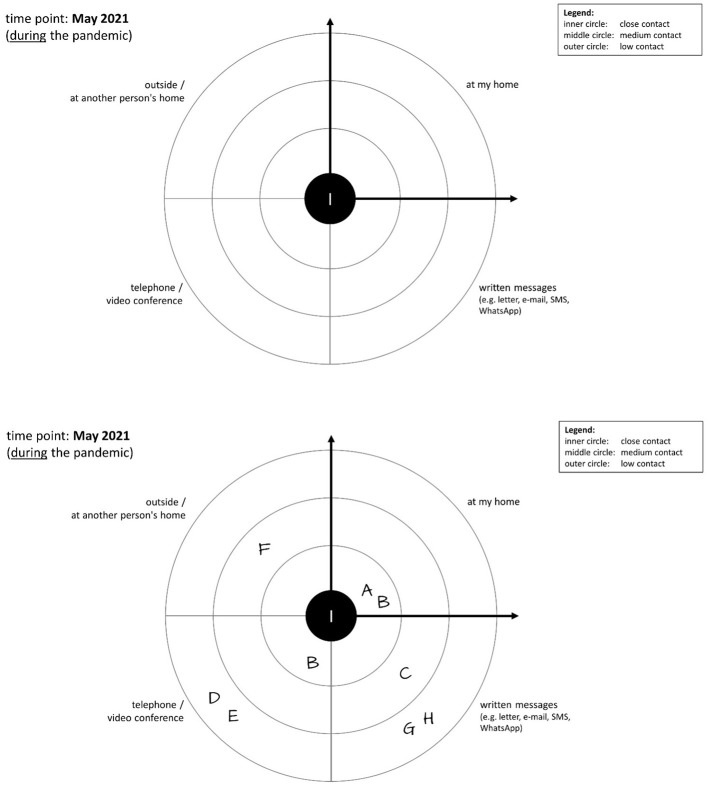
For this purpose, = 175 older adults ( = 72.60, = 6.12 years, = 72, Range: 60-87 years) were asked at 3 time points (2019, 2021, 2023) with how many people they had contact in the reference month (May, November). In addition to the number of contacts, participants were also asked about the type of the relationship (e.g., family, friends, neighbors), the type of contact (e.g., telephone, video conference and/or by written messages) and the emotional closeness (close, medium, low). We used an ego-centered "social network" circle to measure social contacts of older adults before, during and after the pandemic. The data collection was limited by the changing corona restrictions.
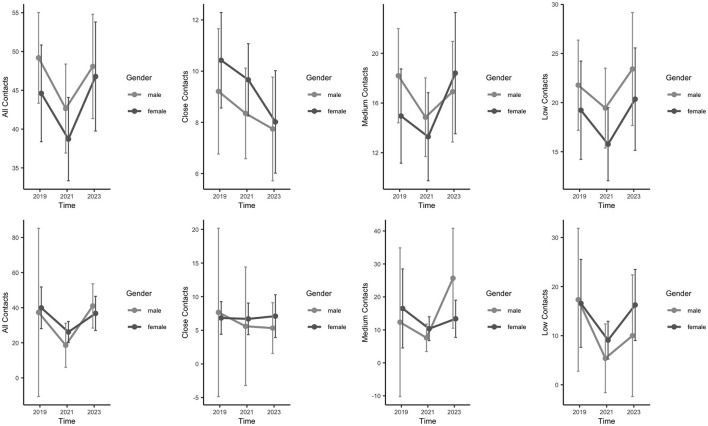
Results indicate that behavior in social contacts essentially depends on age, gender, and level of depression. We found a clear temporal drop in social contacts independently of age and gender during the pandemic. After the pandemic close contacts did not recover to prepandemic level. Especially, Young-Old (<72 years) recovered less in terms of the number of social contacts than the Old-Old (≥72 years).
Our study, thus, provides longitudinal insights into the course of social contacts and suggests that social isolation may have more negative and long-term impact on close contacts, which need further clarification and temporal extension.
社会隔离是孤独感、健康问题和心理疾病的主要风险因素。由于其限制措施,新冠疫情导致有意义的互动、交流以及总体社交接触(社会隔离)客观上减少。然而,已有研究表明老年人应对社会隔离的方式有所不同。因此,本研究的目的是调查老年人在4年疫情期间社交接触的变化情况。
为此,175名老年人(平均年龄 = 72.60岁,标准差 = 6.12岁,n = 72,年龄范围:60 - 87岁)在3个时间点(2019年、2021年、2023年)被问及在参考月份(5月、11月)与多少人有过接触。除了接触人数外,参与者还被问及关系类型(如家人、朋友、邻居)、接触方式(如电话、视频会议和/或书面信息)以及情感亲密度(亲密、中等、低)。我们使用以自我为中心的“社交网络”圈来衡量疫情前、疫情期间和疫情后老年人的社交接触情况。数据收集受到不断变化的新冠限制措施的影响。
结果表明,社交接触行为主要取决于年龄、性别和抑郁程度。我们发现疫情期间社交接触明显随时间下降,且与年龄和性别无关。疫情结束后,亲密接触并未恢复到疫情前的水平。特别是,年轻老年人(<72岁)在社交接触数量方面的恢复程度低于年长老年人(≥72岁)。
因此,我们的研究提供了关于社交接触过程的纵向见解,并表明社会隔离可能对亲密接触产生更负面和长期的影响,这需要进一步阐明和时间上的延伸研究。