Fekih-Romdhane Feten, Jebreen Kamel, Swaitti Tasnim, Jebreen Mohammed, Radwan Eqbal, Kammoun-Rebai Wafa, Abu Samra Mahmoud A, Abusamra Asmaa, Obeid Sahar, Hallit Souheil
The Tunisian Center of Early Intervention in Psychosis, Department of Psychiatry "Ibn Omrane", Razi Hospital, Manouba, 2010, Tunisia.
Faculty of Medicine of Tunis, Tunis El Manar University, Tunis, Tunisia.
Sci Rep. 2024 Dec 30;14(1):32035. doi: 10.1038/s41598-024-83679-8.
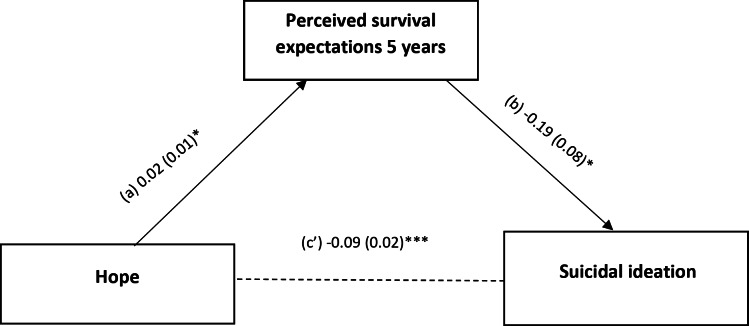
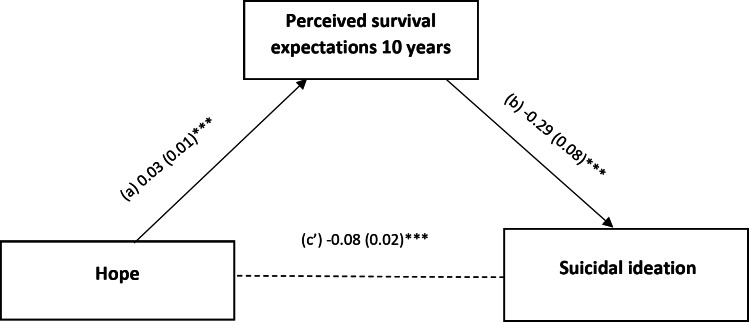
Understanding how hope can be protective against suicide may improve prevention efficiency by helping identify and target those most at risk for suicide, and develop individualized treatment strategies. However, no studies have yet focused on the processes underlying the relationship between hope and suicidality in war-affected populations. The objective of this study was to explore the direct and indirect effects of hope on suicidal ideation through perceived survival expectations in Palestinian adults who currently live in Gaza in the midst of war. This is a cross-sectional study that has adopted the snowball sampling method and used an Internet-based survey that was distributed during the month of September 2024. The target population consisted of 534 adult Gazan people from the general population who were aged over 18 years and were living in Gaza Strip at the time of data collection. 44.6% of participants had suicidal ideation. A total of 43%, 44% and 45% of participants perceived < 50% chances of living for the next year, the next 5 years, and the next 10 years, respectively. After adjusting for covariates (age, education status, and living arrangements), perceived survival expectations at 5 years (indirect effect: Beta = -0.004; Boot SE = 0.002; Boot CI -0.01; -0.001) and 10 years (indirect effect: Beta = -0.01; Boot SE = 0.004; Boot CI -0.02; -0.003) mediated the association between hope and suicidal ideation. Higher hope was significantly associated with higher perceived survival expectations at 5 years, and directly with lower suicidal ideation. Finally, higher perceived survival expectations at 5 and 10 years were significantly associated with lower suicidal ideation. Our findings contend that hope might confer protection against suicide through the indirect effect of perceived survival expectations in individuals living in a constantly life-threatened state. Future experimental research is warranted to test whether intervening on low perceived survival expectations can be successful in mitigating related psychopathological outcomes, including suicidal ideation.
了解希望如何预防自杀,有助于识别和定位自杀风险最高的人群,并制定个性化治疗策略,从而提高预防效率。然而,尚无研究关注受战争影响人群中希望与自杀倾向之间关系的潜在过程。本研究旨在探讨希望通过当前生活在加沙地带战争中的巴勒斯坦成年人的生存期望认知,对自杀意念产生的直接和间接影响。这是一项采用雪球抽样法的横断面研究,使用了2024年9月期间进行的基于互联网的调查。目标人群为534名来自加沙地区的成年居民,年龄超过18岁,在数据收集时居住在加沙地带。44.6%的参与者有自杀意念。分别有43%、44%和45%的参与者认为未来一年、五年和十年的生存几率低于50%。在调整协变量(年龄、教育程度和生活安排)后,5年(间接效应:Beta = -0.004;Boot SE = 0.002;Boot CI -0.01;-0.001)和10年(间接效应:Beta = -0.01;Boot SE = 0.004;Boot CI -0.02;-0.003)的生存期望认知介导了希望与自杀意念之间的关联。较高的希望与5年时较高的生存期望认知显著相关,并与较低的自杀意念直接相关。最后,5年和10年时较高的生存期望认知与较低的自杀意念显著相关。我们的研究结果表明,对于生活在持续生命威胁状态下的个体,希望可能通过生存期望认知的间接作用来预防自杀。未来有必要进行实验研究,以检验干预较低的生存期望认知能否成功减轻包括自杀意念在内的相关心理病理结果。