Rauh Susanne S, Cameron Donnie, Gurney-Champion Oliver J, Smithuis Frank, Maas Mario, Froeling Martijn, Kan Hermien E, Nederveen Aart J, Strijkers Gustav J, Hooijmans Melissa T
Department of Biomedical Engineering and Physics, Amsterdam University Medical Center, Amsterdam, The Netherlands.
Amsterdam Movement Sciences, Sports, Amsterdam, The Netherlands.
Sci Rep. 2024 Dec 30;14(1):31998. doi: 10.1038/s41598-024-83644-5.
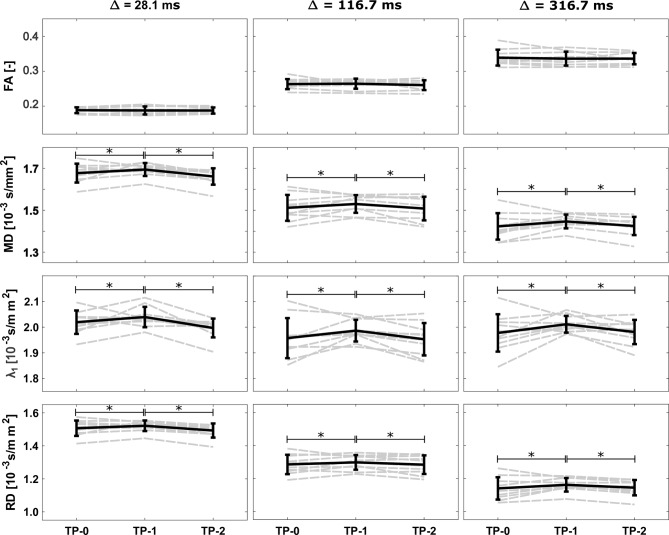
Repeated muscle micro-trauma may cause severe muscle damage. Diffusion tensor imaging (DTI) exhibits sensitivity to microstructural changes in skeletal muscle. We hypothesize that longer diffusion times enhance sensitivity to micro-trauma and that membrane permeability increases with micro-trauma. We obtained DTI scans of the thighs in ten male runners 1 week before (TP-0), 24-48 h after (TP-1), and 2 weeks after (TP-2) they completed a marathon. Diffusion times were 28.1, 116.7, and 316.7 ms. The random permeable barrier model (RPBM) was fitted to the radial diffusivities to obtain estimates for fiber diameter and membrane permeability. Hamstring and quadriceps muscles were manually segmented. A linear mixed model assessed variations across time points and diffusion times within the DTI and RPBM parameters and assessed sensitivity to micro-trauma by comparing %-changes in DTI parameters at TP-1 and TP-2 to TP-0. All DTI parameters except FA significantly changed between TP-0 and TP-1, and between TP-1 and TP-2. The %-change did not differ between diffusion times. The permeability increased at TP-1 and TP-2 compared to TP-0. In conclusion, longer diffusion times did not improve sensitivity to micro-trauma. The increased permeability post-marathon underscores the potential of RPBM-derived parameters as a biomarker for micro-trauma and muscle injuries.
反复的肌肉微创伤可能会导致严重的肌肉损伤。扩散张量成像(DTI)对骨骼肌的微观结构变化具有敏感性。我们假设更长的扩散时间会增强对微创伤的敏感性,并且膜通透性会随着微创伤而增加。我们在十名男性跑步者完成马拉松比赛前1周(TP - 0)、赛后24 - 48小时(TP - 1)以及赛后2周(TP - 2)获取了他们大腿的DTI扫描图像。扩散时间分别为28.1、116.7和316.7毫秒。将随机渗透屏障模型(RPBM)拟合到径向扩散率以获得纤维直径和膜通透性的估计值。手动分割了绳肌和股四头肌。线性混合模型评估了DTI和RPBM参数在各时间点和扩散时间之间的变化,并通过比较TP - 1和TP - 2相对于TP - 0时DTI参数的百分比变化来评估对微创伤的敏感性。除FA外,所有DTI参数在TP - 0和TP - 1之间以及TP - 1和TP - 2之间均有显著变化。百分比变化在不同扩散时间之间没有差异。与TP - 0相比,TP - 1和TP - 2时的通透性增加。总之,更长的扩散时间并没有提高对微创伤的敏感性。马拉松赛后通透性的增加凸显了RPBM衍生参数作为微创伤和肌肉损伤生物标志物的潜力。