Duan Xiaocui, Shao Yujiao, Zhao Shuang, Zhang Zeyu, Chen Yongxia, Wang Fuzhi, Yang Xiumu
School of Nursing, Bengbu Medical University, Bengbu, China.
The First Affiliated Hospital of Bengbu Medical University, Bengbu, China.
Support Care Cancer. 2024 Dec 30;33(1):62. doi: 10.1007/s00520-024-09091-0.
Based on a dyadic perspective, the interaction between two variables of dyadic coping and post-traumatic growth in couples with breast cancer is explored, which facilitates an empirical basis for healthcare professionals to develop an intervention program to improve psychological care and quality of life for breast cancer couples.
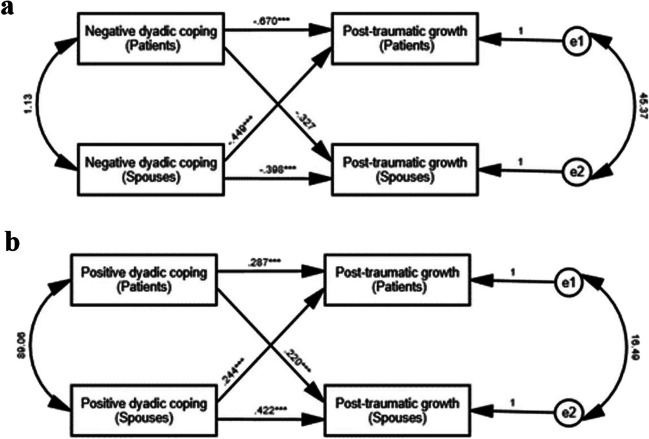
Two hundred ten pairs of breast cancer couples attending the department of surgical oncology of a hospital affiliated with Bengbu Medical University from July to December 2023 were surveyed through a cross-sectional method. Both breast cancer couples' completed questionnaire data were investigated using the General Information Questionnaire, the Dyadic Coping Inventory, and the Post-Traumatic Growth Inventory. Investigating the connection between post-traumatic growth and dyadic coping in patients and partners using an actor-partner interdependence model.
Breast cancer patients had higher dyadic coping scores (118.32 ± 12.10) than their spouses (117.76 ± 11.93); post-traumatic growth scores (65.30 ± 10.24) were significantly higher than their spouses (62.11 ± 10.30). In breast cancer couples, positive dyadic coping positively predicted post-traumatic growth in both themselves and their partners (P < 0.001). Patients' and spouses' negative dyadic coping had a negative effect on their post-traumatic growth.
Dyadic coping is an important correlate of post-traumatic growth in spouses and patients with breast cancer. Accordingly, healthcare professionals can incorporate dyadic coping into family-wide dyadic interventions that enhance the couple's post-traumatic growth and life quality.
基于二元视角,探讨二元应对与乳腺癌夫妻创伤后成长这两个变量之间的相互作用,为医护人员制定干预方案以改善乳腺癌夫妻的心理护理和生活质量提供实证依据。
采用横断面研究方法,对2023年7月至12月在蚌埠医学院附属医院肿瘤外科就诊的210对乳腺癌夫妻进行调查。使用一般信息问卷、二元应对量表和创伤后成长量表对乳腺癌夫妻双方填写完成的问卷数据进行调查。采用actor-partner相互依赖模型研究患者及其伴侣创伤后成长与二元应对之间的联系。
乳腺癌患者的二元应对得分(118.32±12.10)高于其配偶(117.76±11.93);创伤后成长得分(65.30±10.24)显著高于其配偶(62.11±10.30)。在乳腺癌夫妻中,积极的二元应对对自身及其伴侣的创伤后成长均有正向预测作用(P<0.001)。患者及其配偶的消极二元应对对其创伤后成长有负面影响。
二元应对是乳腺癌患者及其配偶创伤后成长的重要相关因素。因此,医护人员可将二元应对纳入全家庭的二元干预措施中,以促进夫妻的创伤后成长和生活质量。