Tanaka Ryoya, Mitaka Yuki, Takemoto Daigo, Sato Mitsuhiko P, Kamikouchi Azusa, Suzuki Yoshinori
Graduate School of Science, Nagoya University, Nagoya, Aichi, 464-8602, Japan.
Institute for Advanced Research, Nagoya University, Nagoya, Aichi, 464-8601, Japan.
Commun Biol. 2024 Dec 30;7(1):1714. doi: 10.1038/s42003-024-07368-y.
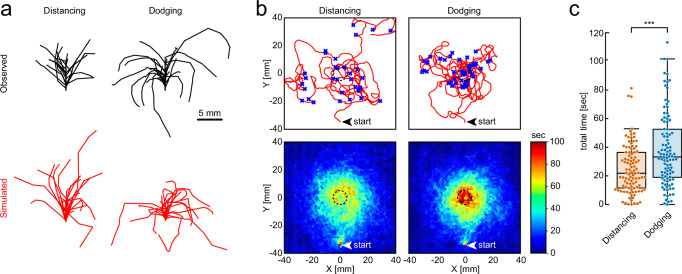
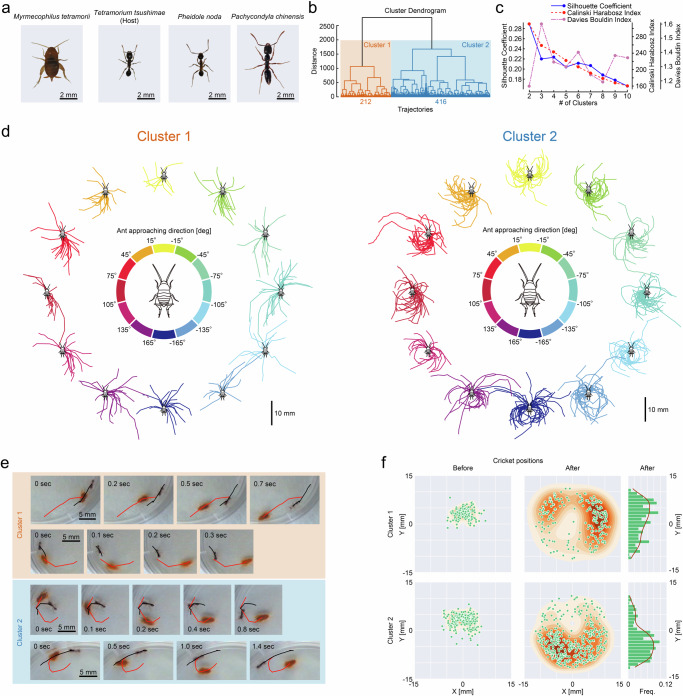
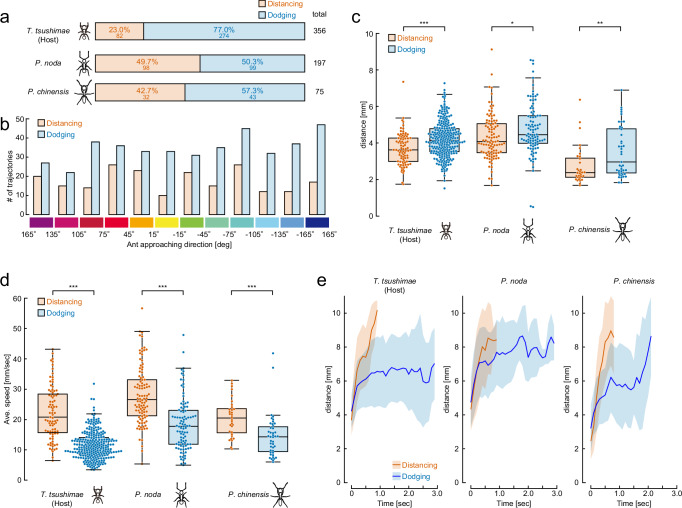
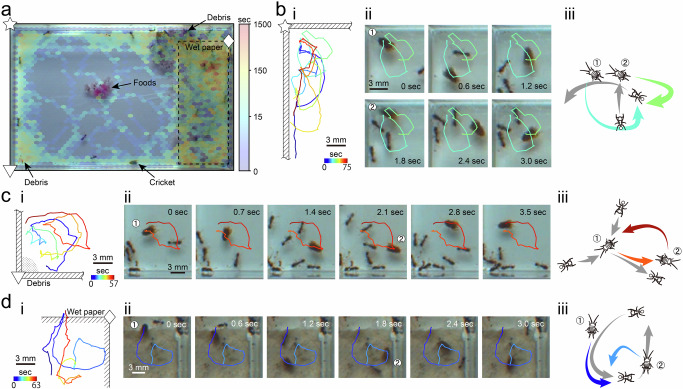
Social parasites employ diverse strategies to deceive and infiltrate their hosts in order to benefit from stable resources. Although escape behaviours are considered an important part of these multipronged strategies, little is known about the repertoire of potential escape behaviours and how they facilitate integration into the host colony. Here, we investigated the escape strategies of the parasitic ant cricket Myrmecophilus tetramorii Ichikawa (Orthoptera: Myrmecophilidae) toward its host and non-host ant workers. We identified two escape strategies with distinct trajectory characteristics by clustering analysis; distancing (defined by high-speed straight movement away from ants for emergency avoidance) and dodging (circular escape movement to get behind ants under low-threat conditions). Interestingly, dodging is dominantly elicited over distancing for host species. Furthermore, our simulations proposed that dodging contributes to efficient foraging while avoiding ants. These results demonstrate that switching to a host-adapted escape strategy facilitates integration of this parasitic cricket into ant nests.
社会性寄生虫采用多种策略来欺骗和渗透宿主,以便从稳定的资源中获益。尽管逃避行为被认为是这些多管齐下策略的重要组成部分,但对于潜在逃避行为的全部技能以及它们如何促进融入宿主群体,我们却知之甚少。在这里,我们研究了寄生蚁蟋四节蚁蟋(Myrmecophilus tetramorii Ichikawa,直翅目:蚁蟋科)对其宿主和非宿主蚂蚁工蚁的逃避策略。通过聚类分析,我们确定了两种具有不同轨迹特征的逃避策略;远离(定义为高速直线远离蚂蚁以进行紧急躲避)和躲避(在低威胁条件下绕圈逃避移动到蚂蚁身后)。有趣的是,对于宿主物种,躲避比远离更占主导地位。此外,我们的模拟表明,躲避有助于在避开蚂蚁的同时高效觅食。这些结果表明,切换到适应宿主的逃避策略有助于这种寄生蟋融入蚁巢。