Xiao Xiang, Du Yong, Sun Si, Su Xiaojun, Xing Junji, Wang Guangchuan, Elzein Steven M, Zou Dawei, Minze Laurie J, Mao Zhuyun, Ghobrial Rafik M, Connor Ashton A, Chen Wenhao, Zhang Zhiqiang, Li Xian C
Immunobiology and Transplant Science Center and Department of Surgery.
Department of Cardiovascular Sciences, and.
J Clin Invest. 2024 Dec 31;135(4):e183671. doi: 10.1172/JCI183671.
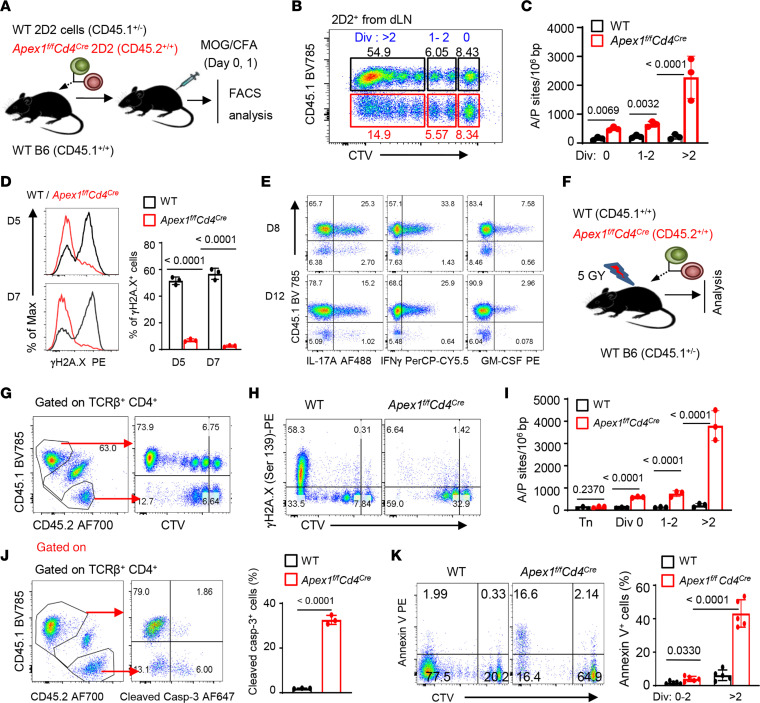
T cells have a remarkable capacity to clonally expand, a process that is intricately linked to their effector activities. As vigorously proliferating T cell also incur substantial DNA lesions, how the dividing T cells safeguard their genomic integrity to allow the generation of T effector cells remains largely unknown. Here we report the identification of the apurinic/apyrimidinic endonuclease-1 (Apex1) as an indispensable molecule for the induction of cytopathic T effectors in mouse models. We demonstrate that conditional deletion of Apex1 in T cells resulted in a remarkable accumulation of baseless DNA sites in the genome of proliferating T cells, which further led to genomic instability and apoptotic cell death. Consequently, Apex1-deleted T cells failed to acquire any effector features after activation and failed to mediate autoimmune diseases and allergic tissue damages. Detailed mutational analyses pinpointed the importance of its endonuclease domain in the generation of T effector cells. We provide further evidence that inhibiting the base repair activities of Apex1 with chemical inhibitors similarly abrogated the induction of autoimmune diseases. Collectively, our study suggests that Apex1 serves as a gatekeeper for the generation of cytopathic T cells and that therapeutically targeting Apex1 may have important clinical implications in the treatment of autoimmune diseases.
T细胞具有显著的克隆性扩增能力,这一过程与其效应功能密切相关。由于快速增殖的T细胞也会产生大量DNA损伤,因此分裂中的T细胞如何保护其基因组完整性以产生T效应细胞在很大程度上仍不清楚。在此,我们报告在小鼠模型中鉴定出脱嘌呤/脱嘧啶核酸内切酶-1(Apex1)是诱导细胞病变性T效应细胞所必需的分子。我们证明,T细胞中Apex1的条件性缺失导致增殖T细胞基因组中无碱基DNA位点显著积累,进而导致基因组不稳定和凋亡性细胞死亡。因此,缺失Apex1的T细胞在激活后无法获得任何效应特征,也无法介导自身免疫性疾病和过敏性组织损伤。详细的突变分析确定了其核酸内切酶结构域在T效应细胞产生中的重要性。我们进一步证明,用化学抑制剂抑制Apex1的碱基修复活性同样会消除自身免疫性疾病的诱导。总之,我们的研究表明Apex1是细胞病变性T细胞产生的守门人,靶向Apex1进行治疗可能对自身免疫性疾病的治疗具有重要的临床意义。