Zeballos Diana, Magno Laio, Soares Fabiane, Pinto Junior Jony Arrais, Amorim Leila, Greco Dirceu, Grangeiro Alexandre, Dourado Inês
Instituto de Saúde Coletiva, Universidade Federal da Bahia, Salvador, Bahia, Brazil.
Departamento de Ciências da Vida, Universidade do Estado da Bahia, Salvador, Bahia, Brazil.
PLoS One. 2024 Dec 31;19(12):e0310861. doi: 10.1371/journal.pone.0310861. eCollection 2024.
Consistent monitoring of PrEP adherence with accurate measurement tools at point-of-care could greatly contribute to reaching adolescents with poor adherence. We aimed to assess the performance of indirect adherence measures to oral PrEP among adolescent men who have sex with men (AMSM) and adolescent transgender women (ATGW).
PrEP15-19 is a prospective, multicenter, PrEP demonstration cohort study that includes AMSM and ATGW aged 15-19 in three Brazilian cities. A diagnostic accuracy study was conducted using tenofovir-diphosphate (TFV-DP) concentrations in dried blood spots as the reference standard, along with three index tests: medication possession ratio (MPR), pill count, and self-report. We calculated the area under the curve (AUC) for protective TFV-DP levels (≥800 fmol/punch) and sensitivity (SE) and specificity (SP) for established cutoff points.
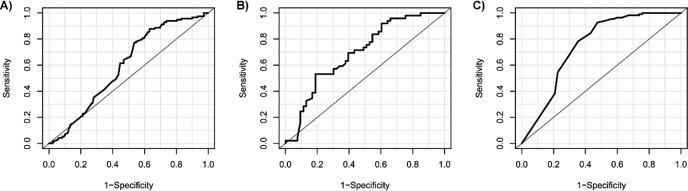
We included 302 samples from 188 participants. Most of participants were AMSM (78.7%), aged 18-19 years (80.3%), and non-whites (72.9%). The AUC was 0.59 for MPR, 0.69 for pill count, and 0.75 for self-report. When combining MPR and self-report, the AUC increased to 0.77. Sensitivity was high for the cutoff points identified by the Youden index, 80% for MPR, 92% for self-report, and 97% for pill count. However, specificities were low 40%, 46%, and 38%, respectively.
Indirect measures were able to discriminate adolescents with good adherence. However, their performance in identifying those with low adherence might be limited, suggesting that it is necessary to initiate adherence interventions when there is no evidence of perfect adherence. Combining measures can provide wider information on adherence.
在医疗现场使用准确的测量工具持续监测暴露前预防(PrEP)的依从性,对于接触依从性差的青少年有很大帮助。我们旨在评估男男性行为青少年(AMSM)和跨性别女性青少年(ATGW)中口服PrEP间接依从性测量方法的性能。
PrEP15 - 19是一项前瞻性、多中心的PrEP示范队列研究,纳入了巴西三个城市中年龄在15 - 19岁的AMSM和ATGW。以干血斑中的二磷酸替诺福韦(TFV - DP)浓度作为参考标准进行诊断准确性研究,同时采用三项指标检测:药物持有率(MPR)、药片计数和自我报告。我们计算了保护性TFV - DP水平(≥800 fmol/打孔)的曲线下面积(AUC)以及既定切点的敏感性(SE)和特异性(SP)。
我们纳入了188名参与者的302个样本。大多数参与者为AMSM(78.7%),年龄在18 - 19岁(80.3%),且为非白人(72.9%)。MPR的AUC为0.59,药片计数的AUC为0.69,自我报告的AUC为0.75。当将MPR和自我报告相结合时,AUC增至0.77。对于约登指数确定的切点,敏感性较高,MPR为80%,自我报告为92%,药片计数为97%。然而,特异性较低,分别为40%、46%和38%。
间接测量方法能够区分依从性良好的青少年。然而,它们在识别依从性低的青少年方面的表现可能有限,这表明在没有完美依从证据时就有必要启动依从性干预措施。综合多种测量方法可以提供更广泛的依从性信息。