Iverson Thomas, Alfares Hadil, Nijjar Gurkirat Singh, Wong Jeffrey, Abbasi Emaan, Esfandiari Elham, Lin Margaret, Petrella Robert J, Symes Bobbi, Chudyk Anna, Ashe Maureen C
Department of Family Practice, The University of British Columbia, Vancouver, Canada.
Department of Sociology, Trinity Western University, Langley, Canada.
PLOS Glob Public Health. 2024 Dec 31;4(12):e0004071. doi: 10.1371/journal.pgph.0004071. eCollection 2024.
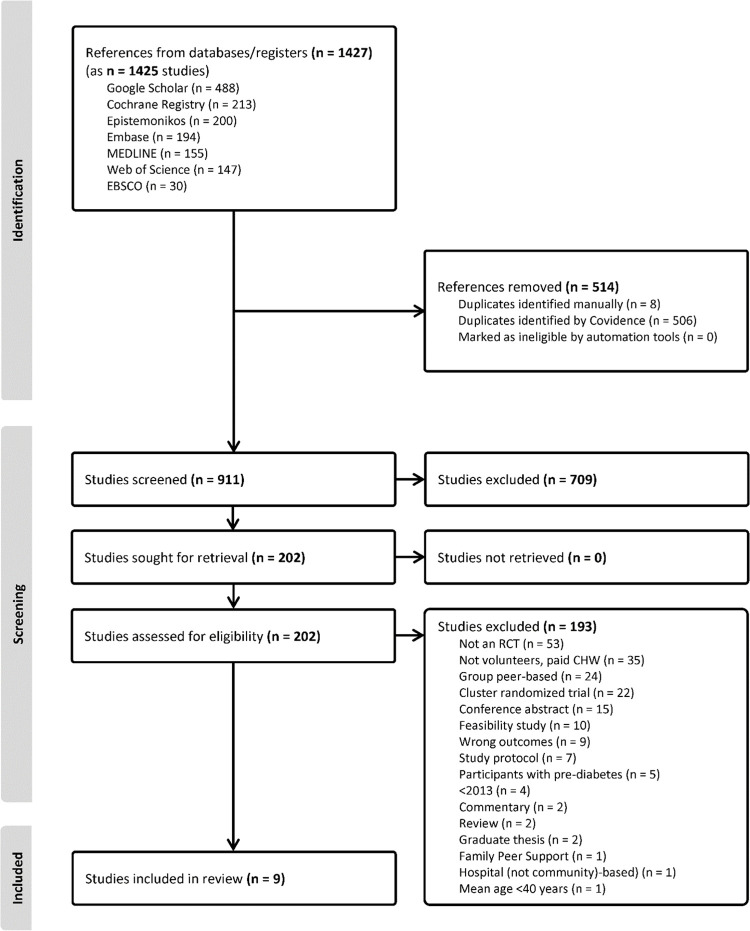
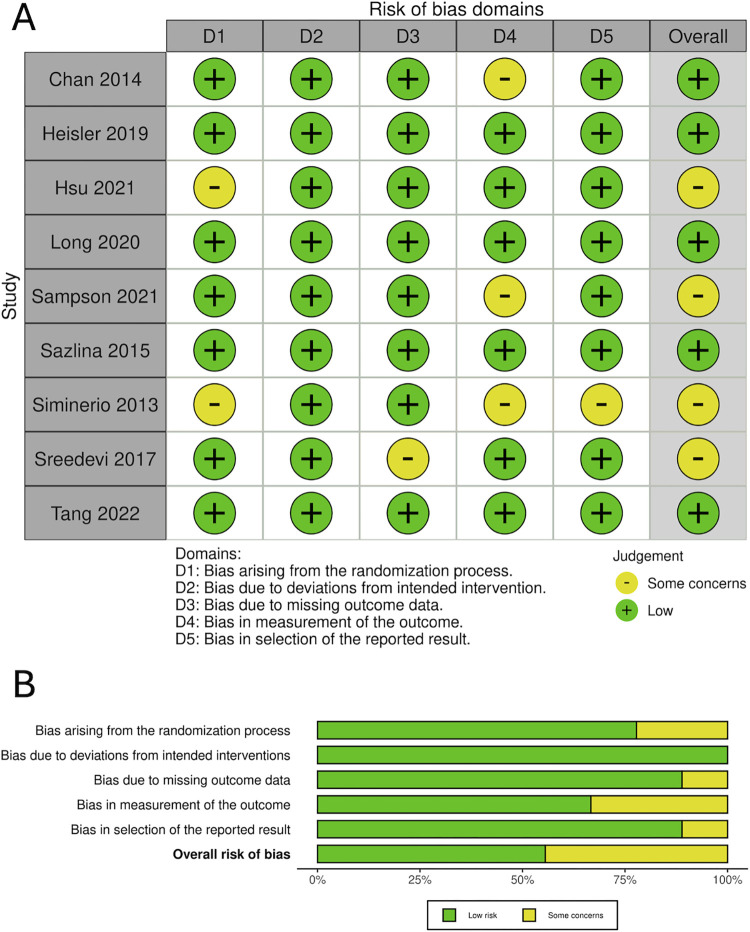
Social prescribing is a model of care, usually in the community-setting, which aims to address people's unmet social needs. Volunteers support primary health care and community-based care in non-medical roles. However, few studies focus on volunteers in social prescribing, therefore, aimed to synthesize the effect of health or peer volunteer-led interventions on psychosocial and behavioural outcomes for middle-aged and older adults with Type 2 Diabetes Mellitus (T2DM) to inform future work for volunteering in social prescribing. We followed Preferred Reporting Items for Systematic reviews and Meta-Analyses (PRISMA) guidelines and searched six databases and Google Scholar for peer-reviewed studies from 2013+ (last search May 16, 2024). We included randomized controlled trials (RCTs) from all languages, and synthesized data using the Cochrane's Synthesis Without Meta-analysis (SWiM) guidelines; and assessed risk of bias using the "Risk of Bias 2 Tool". We identified nine RCTs (reported in 10 publications). Interventions aimed to promote self-management of T2DM, and study duration ranged from one to 46 months. Training for volunteers varied between one to 32 hours, and most volunteers were offered a stipend. For psychosocial outcomes, only one outcome on social support favoured the intervention group, with the remaining outcomes reporting no differences between study groups. For behaviour, six outcomes (from three studies) favoured the intervention group, and for three outcomes there were no differences between study groups. In conclusion, volunteers bring a unique perspective to health interventions, but volunteer training, matching and retention, as well as intervention mode and duration, and geographical context need to be thoughtfully considered as important implementation factors. This work generates ideas for future studies focused on volunteers and T2DM management and social prescribing. Trial registration: PROSPERO registration: CRD42023453506.
社会处方是一种护理模式,通常在社区环境中实施,旨在满足人们未得到满足的社会需求。志愿者以非医疗角色支持初级卫生保健和社区护理。然而,很少有研究关注社会处方中的志愿者,因此,本研究旨在综合健康或同伴志愿者主导的干预措施对2型糖尿病(T2DM)中老年患者心理社会和行为结局的影响,为社会处方中志愿服务的未来工作提供参考。我们遵循系统评价和Meta分析的首选报告项目(PRISMA)指南,检索了六个数据库和谷歌学术,查找2013年及以后的同行评审研究(最后一次检索时间为2024年5月16日)。我们纳入了所有语言的随机对照试验(RCT),并使用Cochrane无Meta分析综合法(SWiM)指南对数据进行综合分析;使用“偏倚风险2工具”评估偏倚风险。我们确定了9项RCT(发表在10篇出版物中)。干预措施旨在促进T2DM的自我管理,研究持续时间从1个月到46个月不等。志愿者培训时间从1小时到32小时不等,大多数志愿者都获得了津贴。对于心理社会结局,只有一项关于社会支持的结局有利于干预组,其余结局表明研究组之间没有差异。对于行为方面,六项结局(来自三项研究)有利于干预组,三项结局研究组之间没有差异。总之,志愿者为健康干预带来了独特的视角,但志愿者培训、匹配和留用,以及干预模式和持续时间,还有地理背景等作为重要的实施因素需要仔细考虑。这项工作为未来关注志愿者与T2DM管理及社会处方的研究提供了思路。试验注册:PROSPERO注册编号:CRD42023453506。