Ruiz Leire, Jaramillo Sebastian, Calvo Andrea, Torrente M A, Tassies Dolors, Reverter J C, Blasi Annabel, Troconiz Iñaki
University of Navarra, Pamplona, Spain.
Hospital Clinic Barcelona, Barcelona, Spain.
Pharmacol Res Perspect. 2025 Feb;13(1):e70014. doi: 10.1002/prp2.70014.
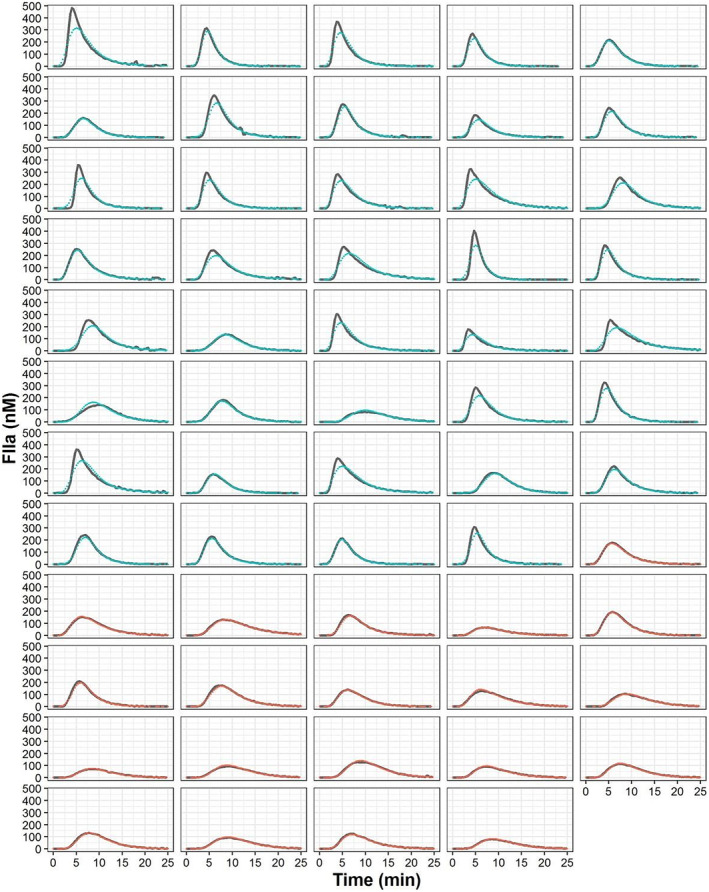
Mathematical models of thrombin generation (TG) that have been developed are based on a systems biology approach. Although this approach provides important information about the coagulation system, its clinical applicability is limited by its complexity and number of input variables required. The aim of this study was to develop a semimechanistic model able to describe TG in trauma and control patients. A dataset containing longitudinal data of TG assays and coagulation factors from 40 trauma patients and 20 control patients was used for model building. The model considered three fundamental processes: the degradation of tissue factor (TF) through a first-order process, the activation of factor II by the TF through a first-order process, and the degradation of thrombin through a first-order process. Model fitting was performed using a nonlinear mixed-effects approach. The condition of the patient (trauma and control) and coagulation factors were modelled as covariates. Model building demonstrated the presence of two additional processes that improved the predictive capacity of the model: the activation of factor II by TF governed by a second-order constant and, a mechanism of factor II activation by TF characterized by a 7-compartment transit chain governed by a second-order constant. In the covariate model only the inclusion of patient condition was significant. Model evaluation demonstrated excellent performance in describing the temporal pattern of TG in trauma and control patients. Thrombin generation can be adequately modelled using a semimechanistic approach. Its application in practice could help to better assess the risk of hemorrhage and/or thrombosis in different settings.
已开发的凝血酶生成(TG)数学模型基于系统生物学方法。尽管这种方法提供了有关凝血系统的重要信息,但其临床适用性受到其复杂性和所需输入变量数量的限制。本研究的目的是开发一种能够描述创伤患者和对照患者TG的半机制模型。一个包含40名创伤患者和20名对照患者的TG检测和凝血因子纵向数据的数据集用于模型构建。该模型考虑了三个基本过程:组织因子(TF)通过一级过程降解、TF通过一级过程激活因子II以及凝血酶通过一级过程降解。使用非线性混合效应方法进行模型拟合。将患者状况(创伤和对照)和凝血因子作为协变量进行建模。模型构建表明存在另外两个过程,它们提高了模型的预测能力:TF以二阶常数控制激活因子II,以及TF激活因子II的机制,其特征为二阶常数控制的7房室转运链。在协变量模型中,仅纳入患者状况具有显著性。模型评估表明,在描述创伤患者和对照患者TG的时间模式方面表现出色。使用半机制方法可以充分模拟凝血酶生成。其在实践中的应用有助于更好地评估不同情况下出血和/或血栓形成的风险。