Gogte Kalpshree, Mamashli Fatemeh, Herrera Maria Georgina, Kriegler Simon, Bader Verian, Kamps Janine, Grover Prerna, Winter Roland, Winklhofer Konstanze F, Tatzelt Jörg
Department Biochemistry of Neurodegenerative Diseases, Institute of Biochemistry and Pathobiochemistry, Ruhr University Bochum, Bochum 44801, Germany.
Department Molecular Cell Biology, Institute of Biochemistry and Pathobiochemistry, Ruhr University Bochum, Bochum 44801, Germany.
Proc Natl Acad Sci U S A. 2025 Jan 7;122(1):e2415250121. doi: 10.1073/pnas.2415250121. Epub 2024 Dec 31.
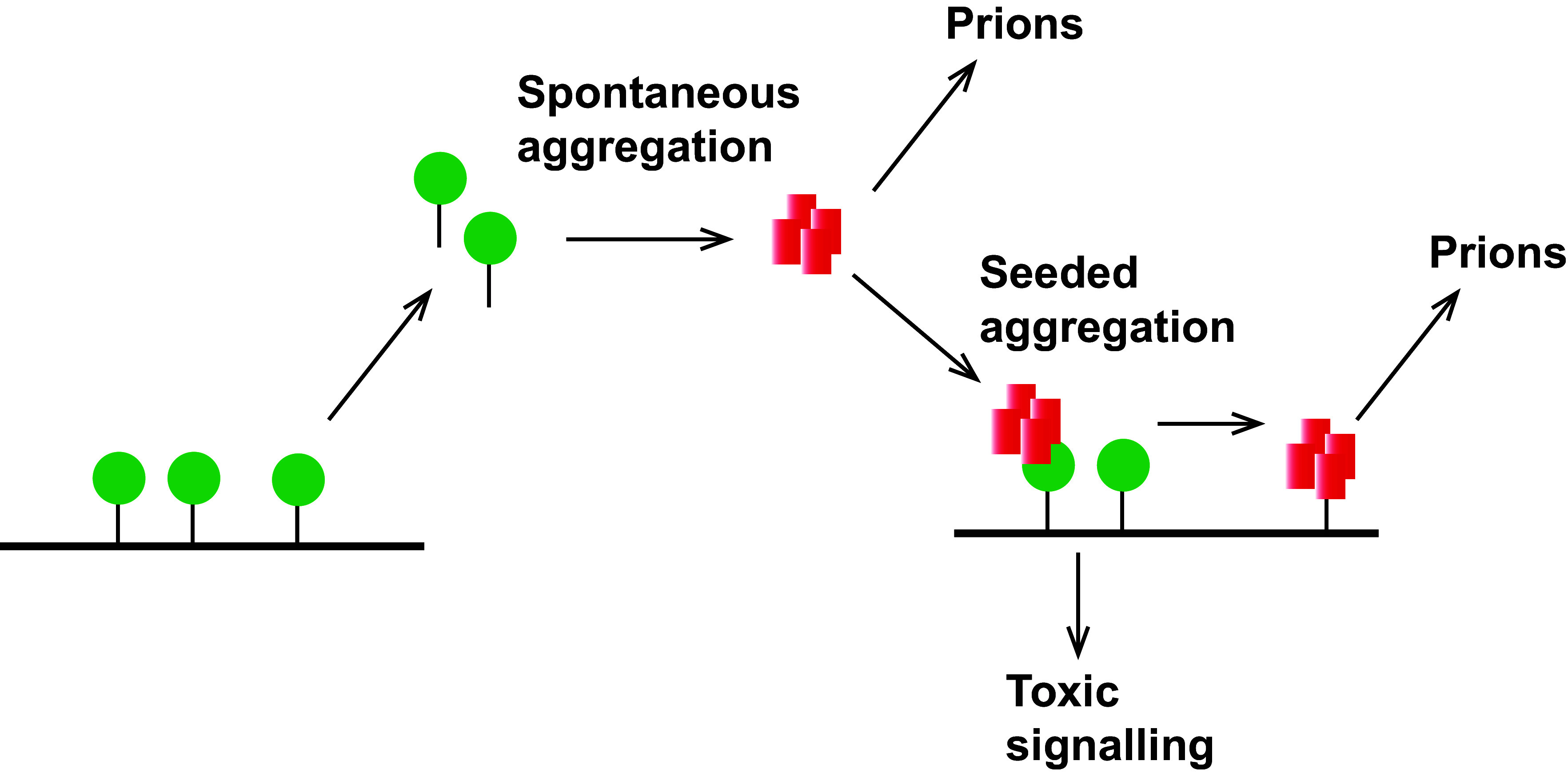
Protein misfolding and aggregation are a hallmark of various neurodegenerative disorders. However, the underlying mechanisms driving protein misfolding in the cellular context are incompletely understood. Here, we show that the two-dimensional confinement imposed by a membrane anchor stabilizes the native protein conformation and suppresses liquid-liquid phase separation (LLPS) and protein aggregation. Inherited prion diseases in humans and neurodegeneration in transgenic mice are linked to the expression of anchorless prion protein (PrP), suggesting that the C-terminal glycosylphosphatidylinositol (GPI) anchor of native PrP impedes spontaneous formation of neurotoxic and infectious PrP species. Combining unique in vitro and in vivo approaches, we demonstrate that anchoring to membranes prevents LLPS and spontaneous aggregation of PrP. Upon release from the membrane, PrP undergoes a conformational transition to detergent-insoluble aggregates. Our study demonstrates an essential role of the GPI anchor in preventing spontaneous misfolding of PrP and provides a mechanistic basis for inherited prion diseases associated with anchorless PrP.
蛋白质错误折叠和聚集是多种神经退行性疾病的标志。然而,在细胞环境中驱动蛋白质错误折叠的潜在机制尚未完全了解。在这里,我们表明膜锚定施加的二维限制稳定了天然蛋白质构象,并抑制了液-液相分离(LLPS)和蛋白质聚集。人类遗传性朊病毒疾病和转基因小鼠的神经退行性变与无锚定朊病毒蛋白(PrP)的表达有关,这表明天然PrP的C末端糖基磷脂酰肌醇(GPI)锚阻碍了神经毒性和传染性PrP物种的自发形成。结合独特的体外和体内方法,我们证明锚定到膜上可防止PrP的LLPS和自发聚集。从膜上释放后,PrP经历构象转变为去污剂不溶性聚集体。我们的研究证明了GPI锚在防止PrP自发错误折叠中的重要作用,并为与无锚定PrP相关的遗传性朊病毒疾病提供了机制基础。