Lee Yurimi, Kim Hyun-Soo
Department of Pathology and Translational Genomics, Samsung Medical Center, Sungkyunkwan University School of Medicine, Seoul, Republic of Korea.
Department of Pathology and Translational Genomics, Samsung Medical Center, Sungkyunkwan University School of Medicine, Seoul, Republic of Korea
In Vivo. 2025 Jan-Feb;39(1):325-334. doi: 10.21873/invivo.13831.
BACKGROUND/AIM: Lymphangioleiomyomatosis (LAM) belongs to the perivascular epithelioid cell tumor (PEComa) family. The relationship between LAM and tuberous sclerosis complex (TSC) is of particular concern in a subset of women with clinically occult LAM involving the pelvic lymph nodes. This study aimed to investigate the clinicopathological features of incidental nodal LAM detected during the surgical staging of gynecological tumors.
During the study period of 10 years, we identified 17 patients with pelvic nodal LAM that was incidentally detected during surgery for gynecological neoplastic lesions. We conducted immunostaining to assess the diagnostic utility of a panel of PEComa markers.
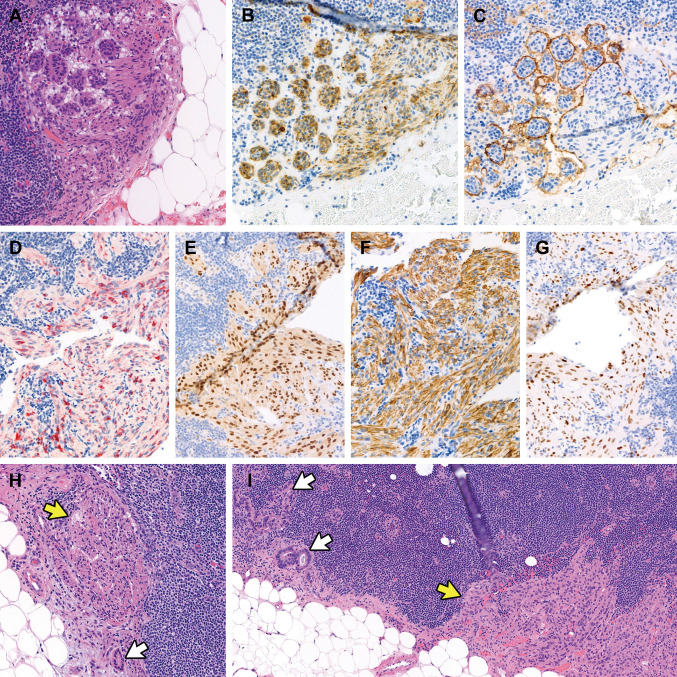
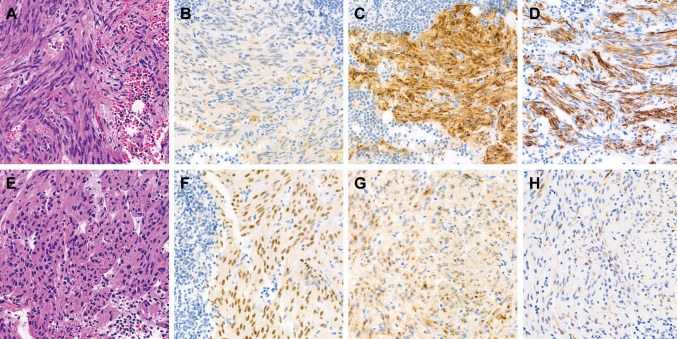
Two of the 17 patients (11.8%) were diagnosed with TSC before surgery without any pulmonary symptoms. During the follow-up, both patients developed pulmonary and extrapulmonary LAMs. All affected nodes were multiple and unilateral in the pelvic region. The mean nodal size was 5.4 mm, and the mean proportion of the area involved in the LAM was 34.1%. In two patients with TSC, the largest affected node measured 19.3 mm and 7.6 mm, respectively, and the proportion of the area replaced by LAM was 99% and 90%, respectively. The most frequently expressed markers were human melanoma black 45 and cathepsin K, which showed 100% positivity in all the examined cases.
While most small nodal LAMs incidentally discovered during surgery have insignificant prognostic value, larger nodal LAMs occupying most of the nodal parenchyma at reproductive age should raise awareness of pulmonary and extrapulmonary LAMs as well as TSC.
背景/目的:淋巴管平滑肌瘤病(LAM)属于血管周上皮样细胞瘤(PEComa)家族。LAM与结节性硬化症(TSC)之间的关系在一部分患有隐匿性盆腔淋巴结受累的LAM女性中尤为受到关注。本研究旨在调查在妇科肿瘤手术分期过程中偶然发现的淋巴结LAM的临床病理特征。
在为期10年的研究期间,我们确定了17例在妇科肿瘤性病变手术中偶然发现盆腔淋巴结LAM的患者。我们进行了免疫染色以评估一组PEComa标志物的诊断效用。
17例患者中有2例(11.8%)在手术前被诊断为TSC,且无任何肺部症状。在随访期间,这两名患者均出现了肺部和肺外LAM。所有受累淋巴结均为多发且位于盆腔单侧。淋巴结平均大小为5.4mm,LAM累及区域的平均比例为34.1%。在两名患有TSC的患者中,最大的受累淋巴结分别为19.3mm和7.6mm,被LAM取代的区域比例分别为99%和90%。最常表达的标志物是人类黑色素瘤黑色45和组织蛋白酶K,在所有检查病例中均显示100%阳性。
虽然手术中偶然发现的大多数小淋巴结LAM预后价值不大,但在育龄期占据大部分淋巴结实质的较大淋巴结LAM应提高对肺部和肺外LAM以及TSC的认识。