Zhou Guisheng, Zhang Junzhi, Guo Hongli, Hu Xiaochao, Wang Yingzhuo, Shi Kunqun, Liu Tongtong, Yin Shengyan, Liu Huanhuan, Liu Chunling, Liu Shijia
Affiliated Hospital of Nanjing University of Chinese Medicine Jiangsu Province Hospital of Chinese Medicine 210029, Nanjing, China.
Jiangsu Collaborative Innovation Center of Chinese Medicinal Resources Industrialization and Jiangsu Key Laboratory for High Technology Research of TCM Formulae Nanjing University of Chinese Medicine 210023, Nanjing, China.
Cardiovasc Ther. 2024 Aug 14;2024:7004371. doi: 10.1155/2024/7004371. eCollection 2024.
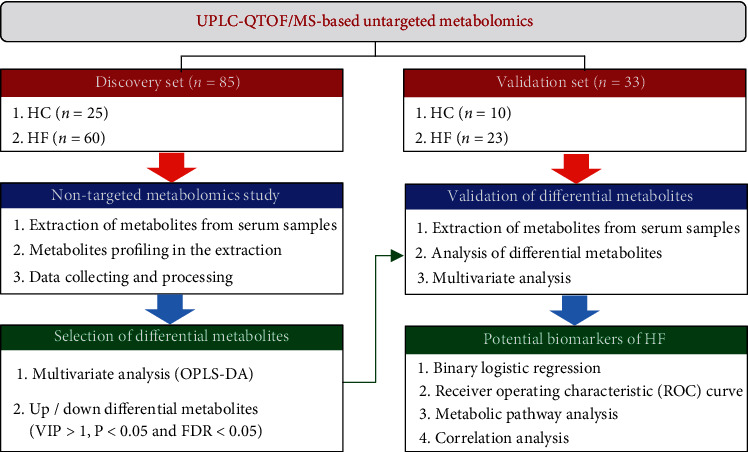
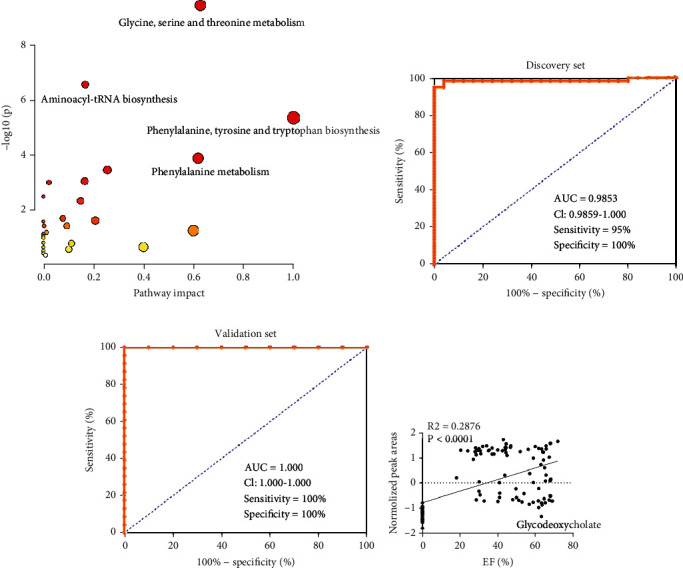
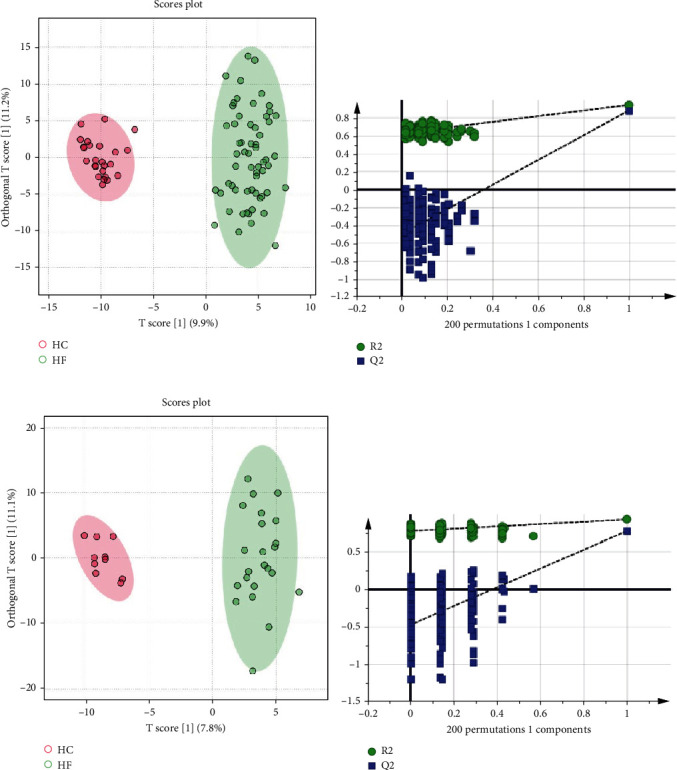
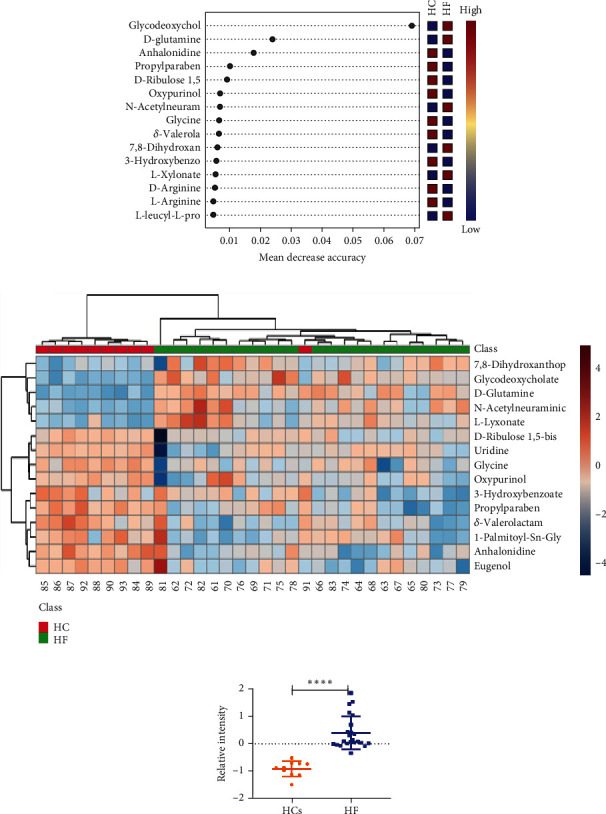
Detection of biomarkers was extremely important for the early diagnosis, prognosis, and therapy optimization of diseases. The purpose of this study was to investigate the differences in serum metabolites between patients with heart failure (HF) and healthy control (HC) and to diagnose HF qualitatively. In this study, serum samples from 83 patients with HF and 35 HCs were used as the research subjects for untargeted metabolomic analysis using ultraperformance liquid chromatography combined with quadrupole-time of flight mass spectrometry (UPLC-QTOF/MS) technology. Potential biomarkers were screened and validated using the orthogonal partial least squares discriminant analysis (OPLS-DA), random forest (RF), binary logistic regression (BLR), and receiver operating characteristic (ROC) analysis. The results indicated that a total of 43 metabolites were considered as differentially expressed metabolites (DEMs). Among these DEMs, glycodeoxycholate was identified as a specific biomarker of HF. A ROC curve analysis for HC versus HF discrimination showed an area under the ROC curve (AUC) of 0.9853 (95% CI: 0.9859-1.0000), a sensitivity of 95%, and a specificity of 100%. Hence, glycodeoxycholate might serve as a potential biomarker for HF. Furthermore, the amino acid metabolism was screened as the most significantly altered pathway in patients with HF. By identifying serum biomarkers and analyzing metabolic pathways, our study provided opportunities to enhance the understanding of the pathogenesis and early diagnosis of HF.
生物标志物的检测对于疾病的早期诊断、预后评估和治疗优化极为重要。本研究旨在探究心力衰竭(HF)患者与健康对照(HC)血清代谢物的差异,并对HF进行定性诊断。在本研究中,收集了83例HF患者和35例HC的血清样本,作为研究对象,采用超高效液相色谱结合四极杆飞行时间质谱(UPLC-QTOF/MS)技术进行非靶向代谢组学分析。使用正交偏最小二乘法判别分析(OPLS-DA)、随机森林(RF)、二元逻辑回归(BLR)和受试者工作特征(ROC)分析筛选并验证潜在的生物标志物。结果表明,共有43种代谢物被视为差异表达代谢物(DEM)。在这些DEM中,甘氨脱氧胆酸盐被鉴定为HF的特异性生物标志物。对HC与HF进行鉴别的ROC曲线分析显示,ROC曲线下面积(AUC)为0.9853(95%CI:0.9859 - 1.0000),灵敏度为95%,特异性为100%。因此,甘氨脱氧胆酸盐可能作为HF的潜在生物标志物。此外,氨基酸代谢被筛选为HF患者中变化最显著的途径。通过鉴定血清生物标志物和分析代谢途径,本研究为加深对HF发病机制和早期诊断的理解提供了契机。