Wang Zhu-Bo, Zhang Yan-Lei, Hu Xin-Xin, Chen Guang-Jie, Li Ming, Yang Peng-Fei, Zou Xu-Bo, Zhang Peng-Fei, Dong Chun-Hua, Li Gang, Zhang Tian-Cai, Guo Guang-Can, Zou Chang-Ling
CAS Key Laboratory of Quantum Information & CAS Center For Excellence in Quantum Information and Quantum Physics, University of Science and Technology of China, Hefei, 230026, China.
State Key Laboratory of Quantum Optics and Quantum Optics Devices, and Institute of Opto-Electronics, Shanxi University, Taiyuan, 030006, China.
Light Sci Appl. 2025 Jan 2;14(1):23. doi: 10.1038/s41377-024-01692-y.
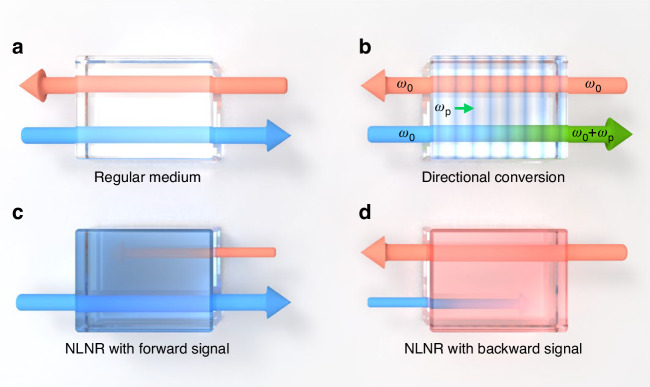
Non-reciprocal optical components are indispensable in optical applications, and their realization without any magnetic field has attracted increasing research interest in photonics. Exciting experimental progress has been achieved by either introducing spatial-temporal modulation of the optical medium or combining Kerr-type optical nonlinearity with spatial asymmetry in photonic structures. However, extra driving fields are required for the first approach, while the isolation of noise and the transmission of the signal cannot be simultaneously achieved for the other approach. Here, we propose the mechanism of nonlinear non-reciprocal susceptibility for optical media and experimentally realize the self-induced isolation of optical signals without any external bias field. The self-induced isolation by the input signal is demonstrated with an extremely high isolation ratio of 63.4 dB, a bandwidth of 2.1 GHz for 60 dB isolation, and a low insertion loss of ~1 dB. Furthermore, the new mechanism allows novel functional optical devices, including polarization purification and non-reciprocal leverage. A complete passive isolator is realized by introducing an asymmetry cavity. It is demonstrated that the 70 μW signal could lever the non-reciprocity and realize a 30 dB isolation of the backward laser with a power 100 times higher. The demonstrated nonlinear non-reciprocal medium provides a versatile tool to control light and deepen our understanding of light-matter interactions and enables applications ranging from topological photonics to unidirectional quantum information transfer in a network.
非互易光学元件在光学应用中不可或缺,并且在无任何磁场情况下实现此类元件已在光子学领域引发了越来越多的研究兴趣。通过引入光学介质的时空调制或将克尔型光学非线性与光子结构中的空间不对称性相结合,已取得了令人振奋的实验进展。然而,第一种方法需要额外的驱动场,而另一种方法无法同时实现噪声隔离和信号传输。在此,我们提出了光学介质的非线性非互易磁化率机制,并通过实验实现了无需任何外部偏置场的光信号自感应隔离。通过输入信号实现的自感应隔离表现出极高的隔离比,达到63.4 dB,60 dB隔离时的带宽为2.1 GHz,插入损耗低至约1 dB。此外,这种新机制允许实现新型功能性光学器件,包括偏振纯化和非互易杠杆效应。通过引入不对称腔实现了一个完整的无源隔离器。结果表明,70 μW的信号能够利用非互易性,实现对功率高出100倍的反向激光30 dB的隔离。所展示的非线性非互易介质为控制光提供了一种通用工具,加深了我们对光与物质相互作用的理解,并实现了从拓扑光子学到网络中单向量子信息传输等一系列应用。