Hossain Md Amjad, Coe-Sessions Kira, Ault Joe, Gboyero Felix O, Wenzel Michael J, Dhokale Bhausaheb, Davies Alathea E, Yang Qian, de Sousa Oliveira Laura, Li Xuesong, Hoberg John O
Department of Chemistry, University of Wyoming, Laramie, WY, United States.
Center for Advanced Scientific Instrumentation, University of Wyoming, Laramie, WY, United States.
Front Chem. 2024 Dec 18;12:1502401. doi: 10.3389/fchem.2024.1502401. eCollection 2024.
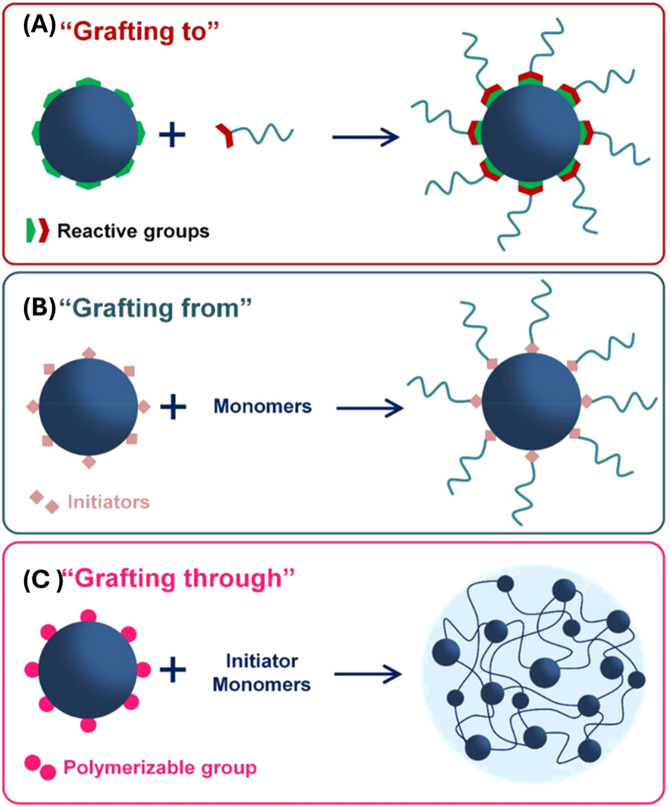
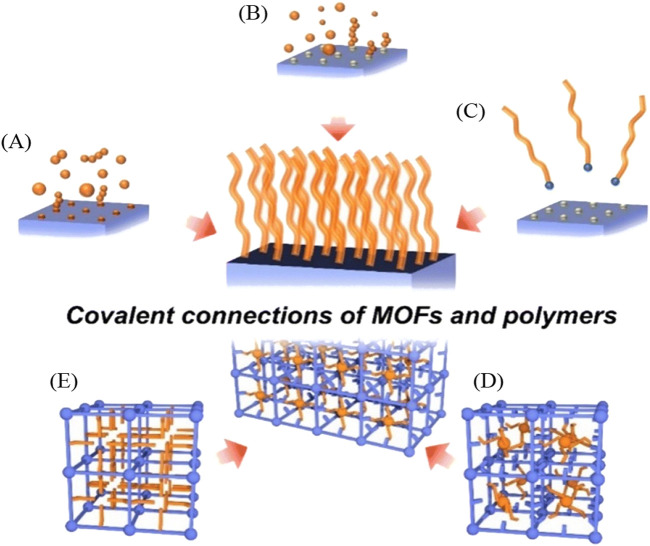
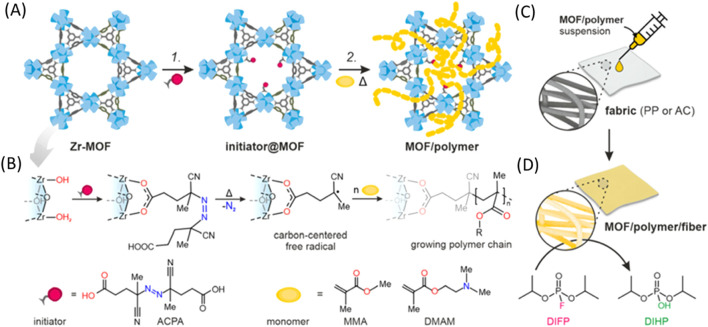
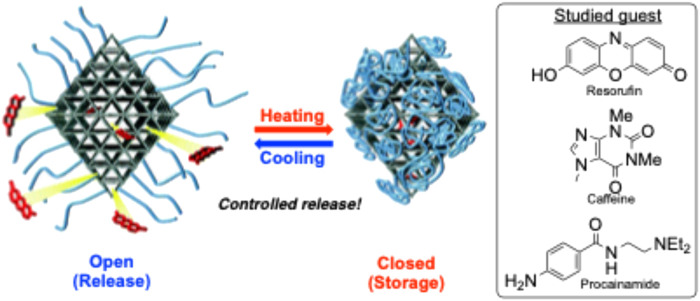
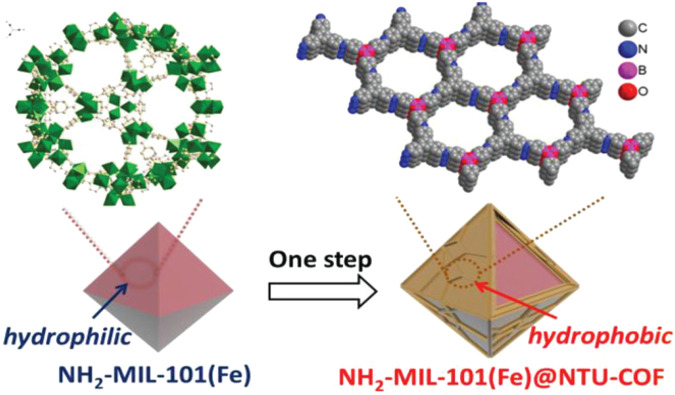
Covalent integration of polymers and porous organic frameworks (POFs), including metal-organic frameworks (MOFs), covalent organic frameworks (COFs) and hydrogen-bonded organic frameworks (HOFs), represent a promising strategy for overcoming the existing limitations of traditional porous materials. This integration allows for the combination of the advantages of polymers, i.e., flexibility, processability and chemical versatility etc., and the superiority of POFs, like the structural integrity, tunable porosity and the high surface area, creating a type of hybrid materials. These resulting polymer-POF hybrid materials exhibit enhanced mechanical strength, chemical stability and functional diversity, thus opening up new opportunities for applications across a large variety of fields, such as gas separation, catalysis, biomedical applications, environmental remediation and energy storage. In this review, an overview of synthetic routes and strategies on how to covalently integrate different polymers with various POFs is discussed, especially with a particular focus on methods like polymerization within, on and among POF structures. To investigate the unique properties and functions of these resultant hybrid materials, the characterization techniques, including nuclear magnetic resonance spectroscopy (NMR), Fourier transform infrared spectroscopy (FTIR), X-ray diffraction (XRD), thermogravimetric analysis (TGA), transmission electron microscopy (TEM) and scanning electron microscopy (SEM), gas adsorption analysis (BET) and computational modeling and machine learning, are also presented. The ability of polymer-POFs to manipulate the pore environments at the molecular level affords these materials a wide range of applications, providing a versatile platform for future advancements in material science. Looking forward, to fully realize the potential of these hybrid materials, the authors highlight the scalability, green synthesis methods, and potential for stimuli-responsive polymer-POF materials as critical areas for future research.
聚合物与多孔有机框架材料(POFs)的共价整合,包括金属有机框架材料(MOFs)、共价有机框架材料(COFs)和氢键有机框架材料(HOFs),是克服传统多孔材料现有局限性的一种很有前景的策略。这种整合能够将聚合物的优点,即柔韧性、可加工性和化学多功能性等,与POFs的优势,如结构完整性、可调孔隙率和高比表面积相结合,从而创造出一种混合材料。这些所得的聚合物-POF混合材料表现出增强的机械强度、化学稳定性和功能多样性,从而为气体分离、催化、生物医学应用、环境修复和能量存储等众多领域的应用开辟了新机遇。在这篇综述中,将讨论如何将不同聚合物与各种POFs进行共价整合的合成路线和策略概述,尤其特别关注诸如在POF结构内部、表面和之间进行聚合等方法。为了研究这些所得混合材料的独特性质和功能,还介绍了包括核磁共振光谱(NMR)、傅里叶变换红外光谱(FTIR)、X射线衍射(XRD)、热重分析(TGA)、透射电子显微镜(TEM)和扫描电子显微镜(SEM)、气体吸附分析(BET)以及计算建模和机器学习在内的表征技术。聚合物-POFs在分子水平上调控孔环境的能力赋予了这些材料广泛的应用,为材料科学的未来发展提供了一个通用平台。展望未来,为了充分实现这些混合材料的潜力,作者强调可扩展性、绿色合成方法以及刺激响应型聚合物-POF材料的潜力是未来研究的关键领域。