Yamazaki Masaya, Ishimoto Takatsugu
Division of Carcinogenesis, The Cancer Institute, Japanese Foundation for Cancer Research, Tokyo, Japan.
International Research Center of Medical Sciences (IRCMS), Kumamoto University, Kumamoto, Japan.
Cancer Sci. 2025 Mar;116(3):613-621. doi: 10.1111/cas.16443. Epub 2025 Jan 2.
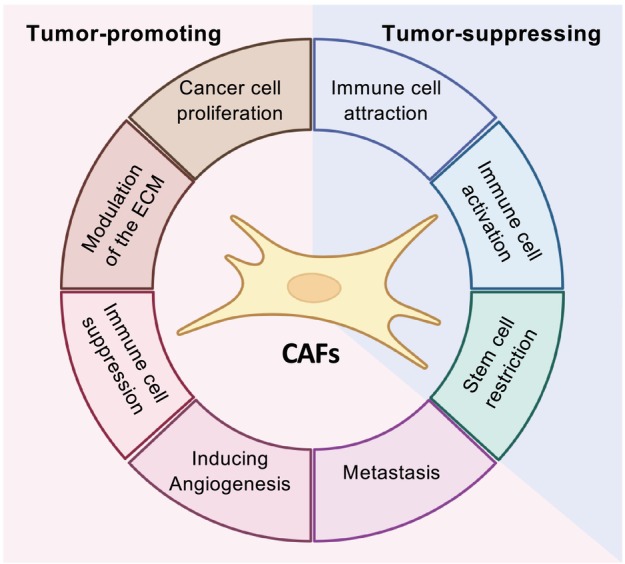
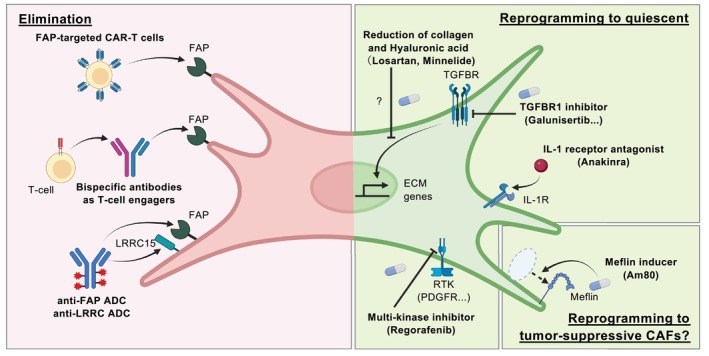
Cancer-associated fibroblasts (CAFs) are key components of the tumor microenvironment (TME). Given their various roles in tumor progression and treatment resistance, CAFs are promising therapeutic targets in cancer. The elimination of tumor-promoting CAFs has been investigated in various animal models to determine whether it effectively suppresses tumor growth. Based on recent evidence, several simple strategies have been proposed to eliminate tumor-promoting CAFs and attenuate these features. In addition, attention has focused on the critical role that CAFs play in the immunosuppressive TME. Therefore, the functional reprogramming of CAFs in combination with immune checkpoint inhibitors has also been investigated as a possible therapeutic approach. However, although potential targets in CAFs have been widely characterized, the plasticity and heterogeneity of CAFs complicate the understanding of their properties and present difficulties for clinical application. Moreover, the identification of tumor-suppressive CAFs highlights the necessity for the development of therapeutic approaches that can distinguish and switch between tumor-promoting and tumor-suppressive CAFs in an appropriate manner. In this review, we introduce the origins and diversity of CAFs, their role in cancer, and current therapeutic strategies aimed at targeting CAFs, including ongoing clinical evaluations.
癌症相关成纤维细胞(CAFs)是肿瘤微环境(TME)的关键组成部分。鉴于其在肿瘤进展和治疗抵抗中的多种作用,CAFs是癌症中有前景的治疗靶点。在各种动物模型中已经研究了消除促进肿瘤的CAFs,以确定其是否能有效抑制肿瘤生长。基于最近的证据,已经提出了几种简单的策略来消除促进肿瘤的CAFs并减弱这些特征。此外,人们的注意力集中在CAFs在免疫抑制性TME中所起的关键作用上。因此,将CAFs的功能重编程与免疫检查点抑制剂相结合也作为一种可能的治疗方法进行了研究。然而,尽管CAFs中的潜在靶点已得到广泛表征,但CAFs的可塑性和异质性使得对其特性的理解变得复杂,并给临床应用带来困难。此外,肿瘤抑制性CAFs的鉴定突出了开发能够以适当方式区分促进肿瘤和抑制肿瘤的CAFs并在它们之间进行转换的治疗方法的必要性。在这篇综述中,我们介绍了CAFs的起源和多样性、它们在癌症中的作用以及目前针对CAFs的治疗策略,包括正在进行的临床评估。