Damin Daniel C, Contu Paulo C, Savaris Ricardo Francalacci, Biazi Bruna
Department of Surgery, Division of Coloproctology, Hospital de Clínicas de Porto Alegre, Federal University of Rio Grande Do Sul. Room 600 A, Rua Ramiro Barcelos, Porto Alegre, RS, 2350, Brazil.
Hospital Mãe de Deus, Porto Alegre, RS, Brazil.
Int J Colorectal Dis. 2025 Jan 2;40(1):3. doi: 10.1007/s00384-024-04796-4.
The presence of chaperones during intimate physical examinations is a matter of ongoing debate. While most guidelines recommend the use of chaperones in all cases, there are no clinical trials specifically investigating intimate exams performed on women by male physicians. We aimed to evaluate female patients' perceptions regarding the presence or absence of chaperones during proctological examinations conducted by male physicians.
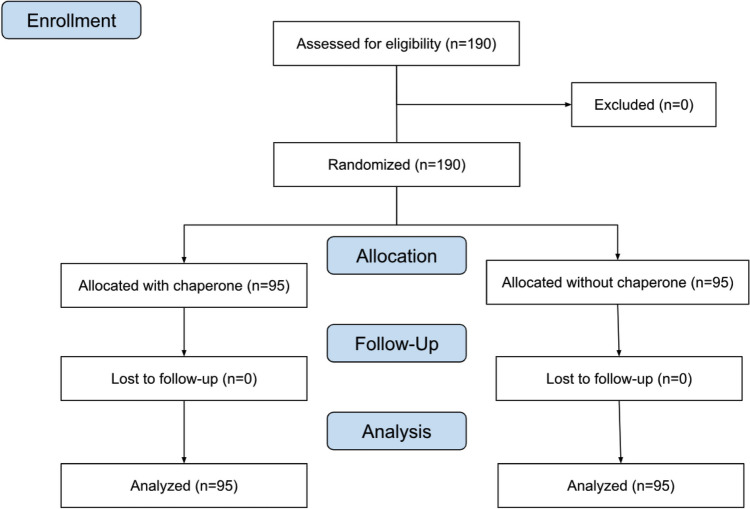
In this randomised clinical trial, patients were assigned, unaware that they were participating in a study, to either Group 1 (without a chaperone during their proctological exam) or Group 2 (with a chaperone). After the appointment, they completed a questionnaire regarding the examination they had just undergone. The study was conducted at two hospitals in Southern Brazil.
Ninety-five patients were included in each group. The mean (SD) comfort score was 8.3 (2.9) with a chaperone and 8.8 (2.5) without a chaperone (P = 0.25). When asked if they would want the exam performed the same way in the future, 72.6% in Group 1 answered 'yes', compared to 58.9% in Group 2 (P = 0.046). In Group 2, 48.4% of patients did not feel more protected by the chaperone, while none of the patients in Group 1 felt less protected without one.
Forgoing chaperones during proctological examinations of women, when the physician is male, is well accepted by most patients. Preferences regarding chaperones are complex, demanding a selective approach. The use of chaperones should remain a recommendation, not a requirement, to accommodate individual needs while maintaining the doctor-patient relationship.
ClinicalTrials.gov number, NCT03615586.
在亲密体格检查期间陪护人员的存在是一个仍在争论的问题。虽然大多数指南建议在所有情况下都使用陪护人员,但尚无专门针对男性医生对女性进行的亲密检查的临床试验。我们旨在评估女性患者对男性医生进行直肠检查时有无陪护人员的看法。
在这项随机临床试验中,患者在不知情的情况下被分配到第1组(直肠检查期间无陪护人员)或第2组(有陪护人员)。预约结束后,他们完成了一份关于刚刚接受的检查的问卷。该研究在巴西南部的两家医院进行。
每组纳入95名患者。有陪护人员时的平均(标准差)舒适度评分为8.3(2.9),无陪护人员时为8.8(2.5)(P = 0.25)。当被问及她们未来是否希望以同样的方式进行检查时,第1组中有72.6%的患者回答“是”,而第2组中这一比例为58.9%(P = 0.046)。在第2组中,48.4%的患者感觉陪护人员并没有给她们更多的保护,而第1组中没有患者觉得没有陪护人员会使她们的受保护程度降低。
在男性医生为女性进行直肠检查时不使用陪护人员,大多数患者对此接受良好。关于陪护人员的偏好很复杂,需要采取有选择性的方法。使用陪护人员应仍然是一项建议,而非要求,以便在维持医患关系的同时满足个人需求。
ClinicalTrials.gov编号,NCT03615586。