Xia Bing, Lu Yan-Lin, Peng Jin, Liang Jing-Wei, Li Fang-Qin, Ding Jiu-Yang, Wan Chang-Wu, Le Cui-Yun, Dai Jia-Lin, Guo Bing, Huang Jiang
School of Forensic Medicine, Guizhou Medical University, Guiyang, 550004, China.
School of Basic Medicine, Guizhou Medical University, Guiyang, 550004, China.
Sci Rep. 2025 Jan 2;15(1):603. doi: 10.1038/s41598-024-85036-1.
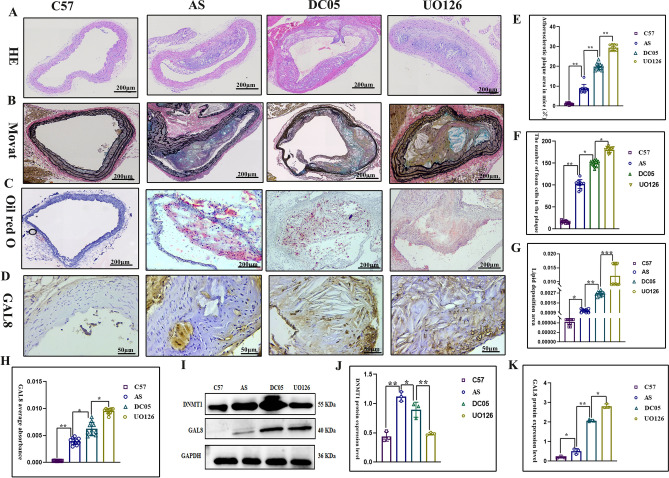
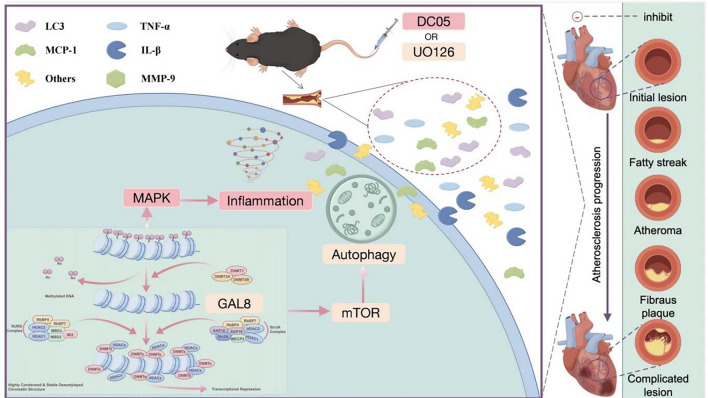
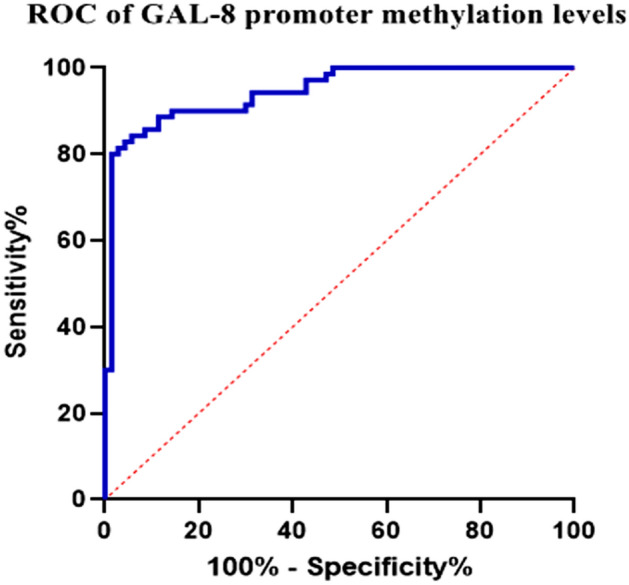
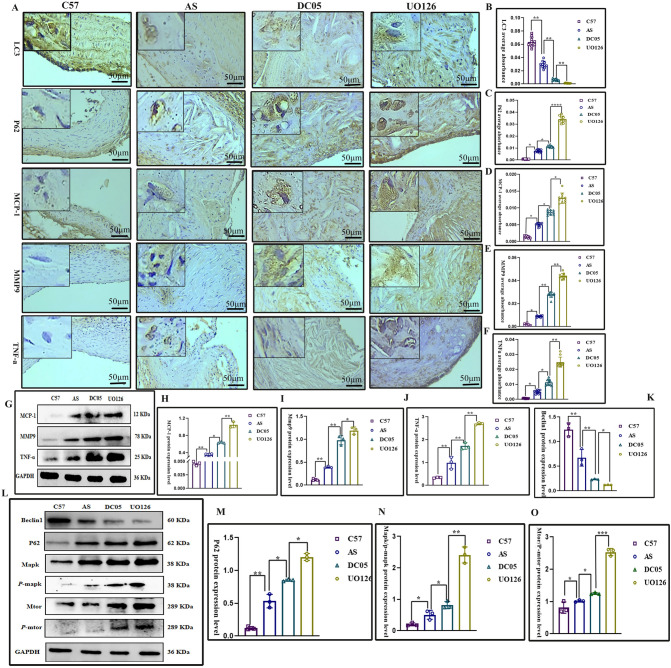
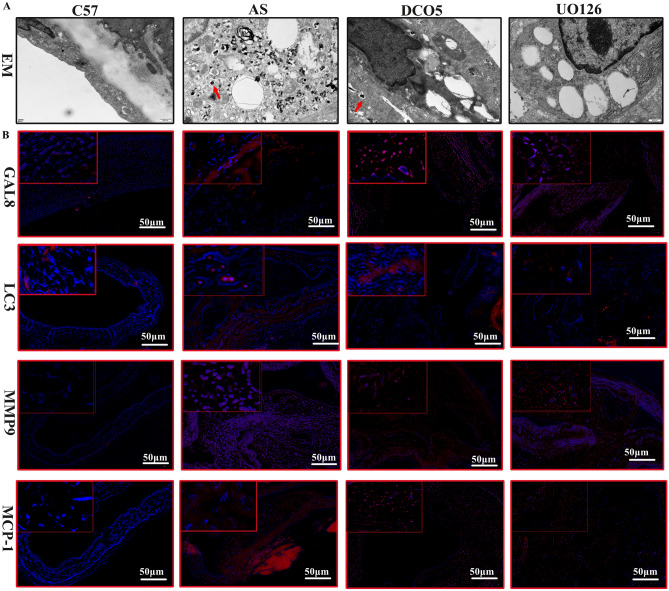
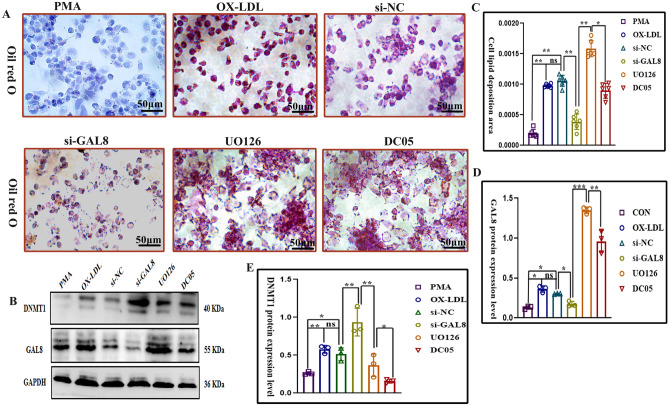
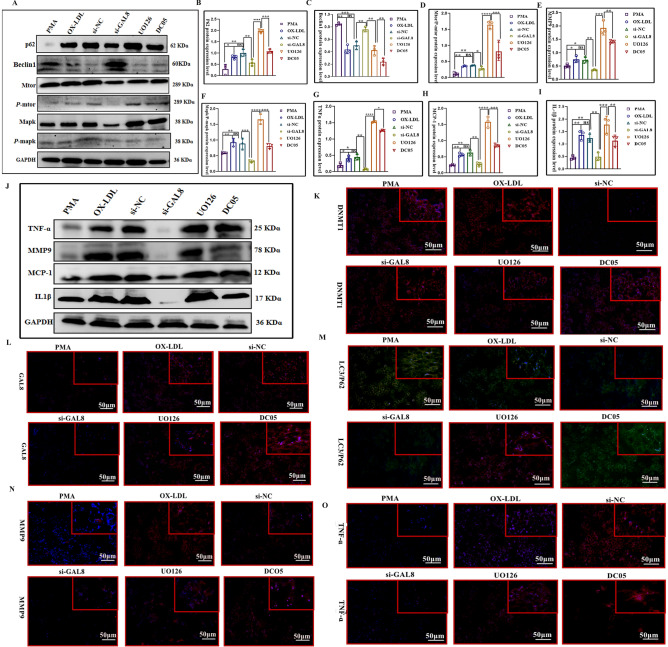
DNA methylation modifications are an important mechanism affecting the process of atherosclerosis (AS). Previous studies have shown that Galectin-8 (GAL8) DNA methylation level is associated with sudden death of coronary heart disease or acute events of coronary heart disease. However, the mechanism of GAL8 DNA methylation and gene expression in AS has not been elucidated, prompting us to carry out further research on it. ApoE mice were used to establish an atherosclerosis model, and DNA methylation inhibitor DO05 and MAPK/mTOR inhibitor UO126 were used for intervention. Pyrosequencing was used to detect changes in GAL8 DNA methylation levels of the mouse aorta between groups. ROC curve analysis was performed to assess the relationship between GAL8 DNA methylation and atherosclerosis. Aortic staining with hematoxylin and eosin (H&E) was used to observe the aortic intima, plaque area, and characteristics of secondary lesions within the plaque. Oil Red O staining was used to detect lipid deposition in mouse arterial plaques or macrophages. Movat staining was used to detect the number of foam cells in the plaque. Immunohistochemistry (IHC) and Western blot were used to quantify the localization and expression levels of DNA methyltransferase1 (DNMT1), GAL8, MAPK/mTOR pathway proteins, Light Chain3 (LC3), Beclin1, Sequestosome1 (p62), Tumor Necrosis Factor-α (TNF-α), and other proteins. Immunofluorescence (IF) was used to detect the fluorescence intensity of GAL8, LC3, Monocyte chemoattractant protein-1(MCP-1), and other proteins. Detection of autophagosomes in macrophages by transmission electron microscopy was also performed. The foam cell model was induced with human monocytes (THP-1) and co-cultured with foam cells using siRNAs targeting GAL8, DO05, and UO126. The level of DNMT1 was detected by Western blot; Oil red O staining was used to detect lipid deposition in foam cells in each group, and the localization and expression levels of GAL8, MAPK/mTOR pathway proteins, LC3, Beclin1, p62, and TNF-α were quantitatively determined by Western blot. Immunofluorescence (IF) was used to detect the fluorescence intensity of GAL8, MAPK/mTOR pathway protein, LC3, p62, TNF-α, and other proteins. The GAL-8 promoter region harbors six CpG sites susceptible to DNA methylation. Following DNMT1 inhibition, the DC05 group displayed a significant decrease in methylation across all six CpG sites compared to the C57 and AS groups. Conversely, the UO126 group exhibited increased methylation at the first three CpG loci relative to the AS group. ROC curve analysis revealed GAL8 DNA methylation as an independent risk factor for atherosclerosis: GAL8, along with inflammation-related proteins MCP-1, MMP9, and TNF-α, were upregulated in the mouse lesion group, while expression of autophagy-related proteins LC3 and Beclin1 was downregulated. Additionally, phosphorylated MAPK/mTOR pathway proteins were detected in the mouse model of atherosclerosis. After inhibiting the methylation level of GAL-8 DNA, the expression of GAL-8 was up-regulated, macrophage autophagy was inhibited, inflammation was increased, and atherosclerotic lesions in mice were aggravated. After direct inhibition of the activity of the MAPK/mTOR pathway, macrophage autophagy was further weakened, the inflammatory response was further aggravated, and the atherosclerotic lesions of mice were further aggravated. After the specific knockdown of GAL-8 using siRNA GAL-8 using foam cells, the above phenomenon was reversed, macrophage autophagy was promoted, the inflammatory response was reduced, and the degree of atherosclerosis was alleviated. The degree of GAL8 DNA methylation is related to the progression of atherosclerosis, and its hypomethylation can aggravate atherosclerotic lesions. The mechanism may be through the regulation of MAPK/mTOR pathway to slow down the autophagy of macrophages, and then aggravate the inflammation in plaques. Targeting GAL8 DNA methylation may be a new target for the diagnosis and treatment of atherosclerosis.
DNA甲基化修饰是影响动脉粥样硬化(AS)进程的重要机制。既往研究表明,半乳糖凝集素8(GAL8)的DNA甲基化水平与冠心病猝死或冠心病急性事件相关。然而,GAL8 DNA甲基化及基因表达在AS中的作用机制尚未阐明,促使我们对此展开进一步研究。采用载脂蛋白E(ApoE)小鼠建立动脉粥样硬化模型,使用DNA甲基化抑制剂DO05和丝裂原活化蛋白激酶/哺乳动物雷帕霉素靶蛋白(MAPK/mTOR)抑制剂UO126进行干预。采用焦磷酸测序法检测各组小鼠主动脉中GAL8 DNA甲基化水平的变化。进行ROC曲线分析以评估GAL8 DNA甲基化与动脉粥样硬化之间的关系。采用苏木精-伊红(H&E)染色观察主动脉内膜、斑块面积及斑块内继发病变的特征。采用油红O染色检测小鼠动脉斑块或巨噬细胞中的脂质沉积。采用Movat染色检测斑块中泡沫细胞的数量。采用免疫组织化学(IHC)和蛋白质印迹法对DNA甲基转移酶1(DNMT1)、GAL8、MAPK/mTOR信号通路相关蛋白、微管相关蛋白1轻链3(LC3)、自噬相关蛋白Beclin1、聚集体蛋白1(p62)、肿瘤坏死因子-α(TNF-α)等蛋白的定位及表达水平进行定量分析。采用免疫荧光(IF)法检测GAL8、LC3、单核细胞趋化蛋白-1(MCP-1)等蛋白的荧光强度。还通过透射电子显微镜检测巨噬细胞中的自噬体。用人单核细胞(THP-1)诱导建立泡沫细胞模型,并使用靶向GAL8、DO05和UO126的小干扰RNA(siRNA)与泡沫细胞共培养。采用蛋白质印迹法检测DNMT1水平;采用油红O染色检测各组泡沫细胞中的脂质沉积,采用蛋白质印迹法对GAL8及MAPK/mTOR信号通路相关蛋白、LC3、Beclin1、p62和TNF-α的定位及表达水平进行定量分析。采用免疫荧光法检测GAL8、MAPK/mTOR信号通路相关蛋白、LC3、p62、TNF-α等蛋白的荧光强度。GAL-8启动子区域有6个易发生DNA甲基化的CpG位点。抑制DNMT1后,与C57组和AS组相比DC05组的所有6个CpG位点的甲基化均显著降低。相反,与AS组相比,UO126组前3个CpG位点的甲基化增加。ROC曲线分析显示GAL8 DNA甲基化是动脉粥样硬化的独立危险因素:GAL8与炎症相关蛋白MCP-1、基质金属蛋白酶9(MMP9)和TNF-α在小鼠病变组中表达上调,而自噬相关蛋白LC3和Beclin1的表达下调。此外,在动脉粥样硬化小鼠模型中检测到磷酸化的MAPK/mTOR信号通路相关蛋白水平升高。抑制GAL-8 DNA的甲基化水平后,GAL-8表达上调,巨噬细胞自噬受到抑制,炎症反应增强,小鼠动脉粥样硬化病变加重。直接抑制MAPK/mTOR信号通路的活性后,巨噬细胞自噬进一步减弱,炎症反应进一步加重,小鼠动脉粥样硬化病变进一步加重。使用siRNA GAL-8特异性敲低泡沫细胞中的GAL-8后,上述现象逆转,巨噬细胞自噬增强,炎症反应减轻,动脉粥样硬化程度减轻。GAL8 DNA甲基化程度与动脉粥样硬化进展相关,其低甲基化可加重动脉粥样硬化病变。其机制可能是通过调节MAPK/mTOR信号通路减缓巨噬细胞自噬进而加重斑块内炎症反应。靶向GAL8 DNA甲基化可能成为动脉粥样硬化诊断和治疗的新靶点。