Wang Youzhi, Wu Wenjun, Kang Jiamin, Su Yu, Liu Tingting, Zhao Jie, Liu Dingxi, Kong Xiangchuang, Weng Yuxiong, Zheng Chuansheng, Li Chungao, Wang Lixia
Department of Radiology, Union Hospital, Tongji Medical College, Huazhong University of Science and Technology, Wuhan, 430022, China.
Hubei Province Key Laboratory of Molecular Imaging, Jiefang Avenue #1277, Wuhan, 430022, China.
Sci Rep. 2025 Jan 2;15(1):184. doi: 10.1038/s41598-024-84489-8.
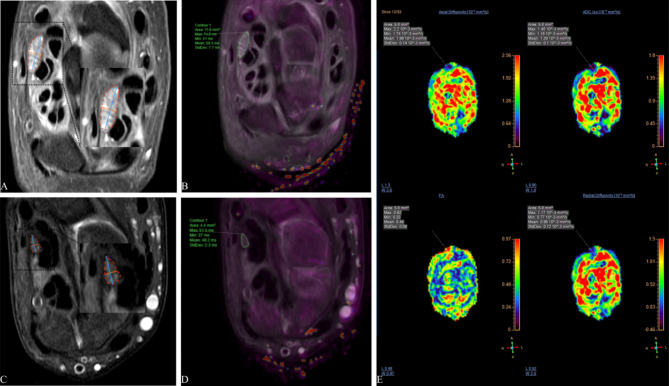
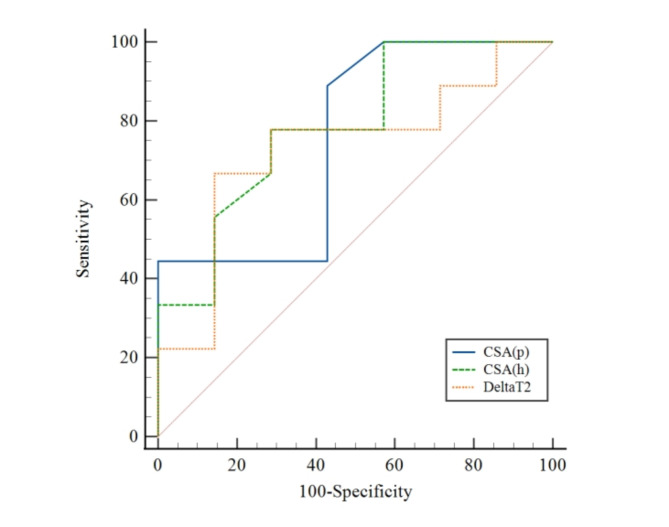
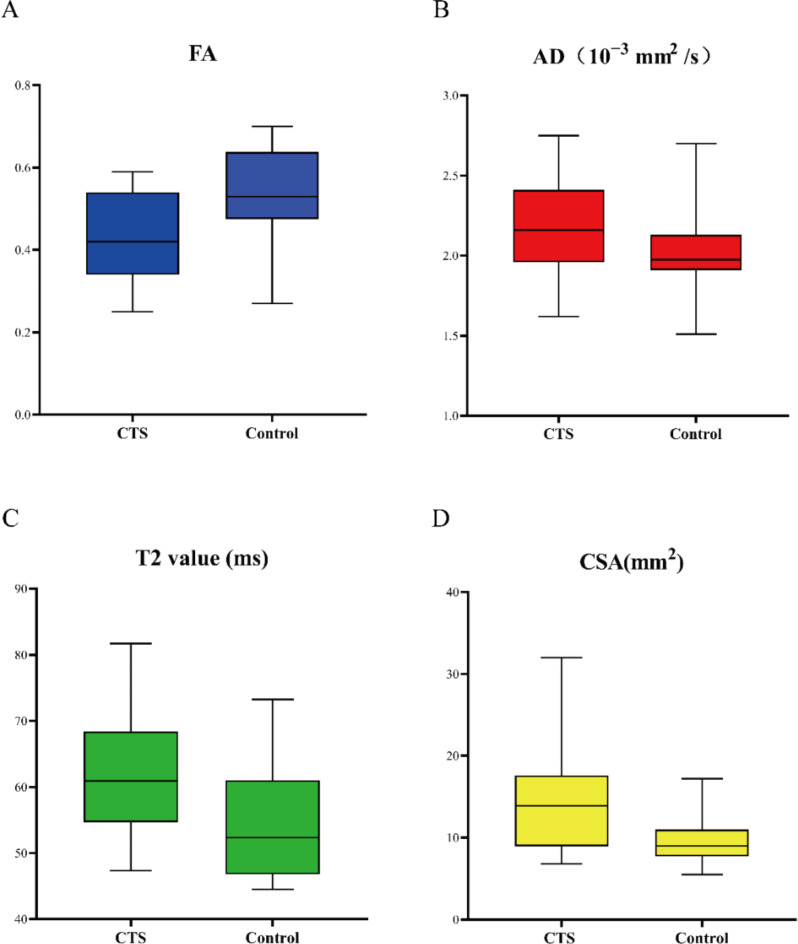
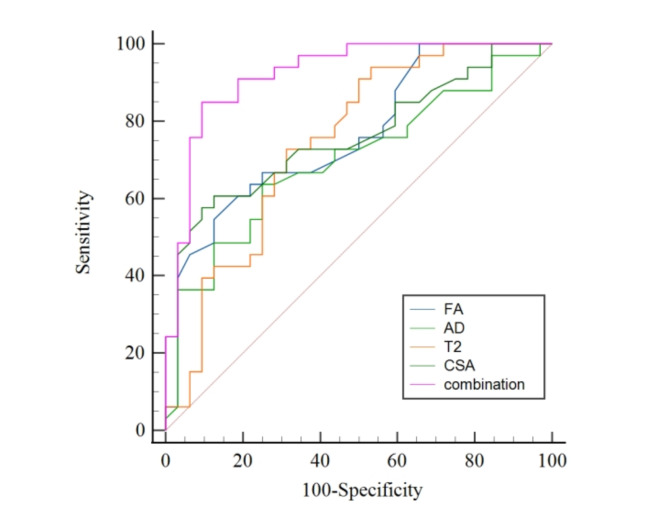
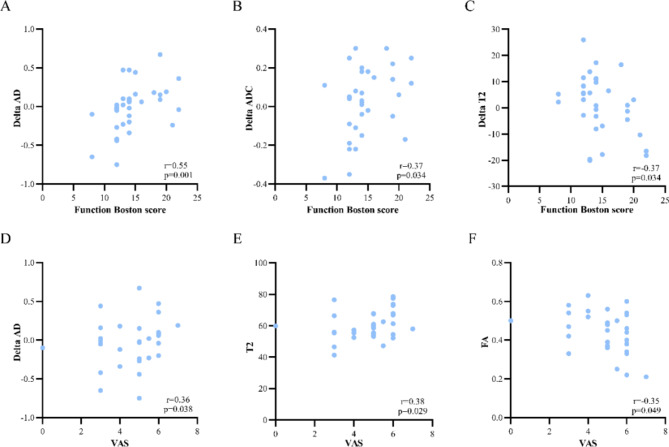
This study aimed to investigate the diagnostic and evaluative significance of combining median nerve (MN) morphological measurements with diffusion tensor imaging (DTI) and T2 mapping metrics for carpal tunnel syndrome (CTS). Morphological and multiparametric magnetic resonance neurography (MRN), along with clinical evaluation, were conducted on 33 CTS patients and 32 healthy controls. The MRN metrics included fractional anisotropy (FA), apparent diffusion coefficient (ADC), axial diffusivity (AD), radial diffusivity (RD), T2 value, cross-sectional area (CSA) and MN flattening ratio (MNFR) at both the pisiform bone and hamate bone levels. Differences in MRN metrics between the above two levels (Delta FA, Delta ADC, Delta AD, Delta RD and Delta T2) were calculated. T-tests, multivariable regression, and receiver operating characteristic (ROC) curve analyses were used to compare and classify patients with CTS and controls. The correlations between MRN metrics and clinical characteristics were analyzed. Comparisons were also made between MRN metrics in patients with and without significant symptom improvement after treatment. FA, AD, T2 value, and CSA at the pisiform bone level were identified as independent predictors of CTS. The combination of these metrics improved diagnostic performance (AUC 0.922, sensitivity 84.85% and specificity 90.62%). Delta ADC, Delta AD, and Delta T2 correlated with function Boston scores. The T2 value at hamate bone level, along with Delta AD and FA, correlated with visual analogue score (VAS). CSA and Delta T2 had higher AUCs for classifying patients with and without significant symptom improvement after treatment. These findings suggest that combining MN morphological and multiparametric MRN metrics can enhance the diagnostic performance of CTS and has the potential to provide an objective and quantitative basis for further study of the degree of entrapment and prognosis.
本研究旨在探讨正中神经(MN)形态学测量与扩散张量成像(DTI)及T2映射指标相结合对腕管综合征(CTS)的诊断和评估意义。对33例CTS患者和32例健康对照者进行了形态学和多参数磁共振神经成像(MRN)检查以及临床评估。MRN指标包括在豌豆骨和钩骨水平的分数各向异性(FA)、表观扩散系数(ADC)、轴向扩散率(AD)、径向扩散率(RD)、T2值、横截面积(CSA)和MN扁平率(MNFR)。计算上述两个水平之间MRN指标的差异(ΔFA、ΔADC、ΔAD、ΔRD和ΔT2)。采用t检验、多变量回归和受试者操作特征(ROC)曲线分析对CTS患者和对照者进行比较和分类。分析MRN指标与临床特征之间的相关性。还对治疗后症状有显著改善和无显著改善的患者的MRN指标进行了比较。豌豆骨水平的FA、AD、T2值和CSA被确定为CTS的独立预测指标。这些指标的组合提高了诊断性能(AUC为0.922,灵敏度为84.85%,特异性为90.62%)。ΔADC、ΔAD和ΔT2与波士顿功能评分相关。钩骨水平的T2值以及ΔAD和FA与视觉模拟评分(VAS)相关。CSA和ΔT2在对治疗后症状有显著改善和无显著改善的患者进行分类时具有更高的AUC。这些发现表明,将MN形态学和多参数MRN指标相结合可以提高CTS的诊断性能,并有可能为进一步研究卡压程度和预后提供客观和定量的依据。