Masturzo Luigi, Barca Patrizio, De Masi Luca, Marfisi Daniela, Traino Antonio, Cademartiri Filippo, Giannelli Marco
Unit of Medical Physics, Pisa University Hospital "Azienda Ospedaliero-Universitaria Pisana", Pisa, Italy.
Siemens Healthcare s.r.l., Milano, Italy.
Eur Radiol Exp. 2025 Jan 2;9(1):2. doi: 10.1186/s41747-024-00541-2.
Photon-counting detector (PCD) technology has the potential to reduce noise in computed tomography (CT). This study aimed to carry out a voxelwise noise characterization for a clinical PCD-CT scanner with a model-based iterative reconstruction algorithm (QIR).
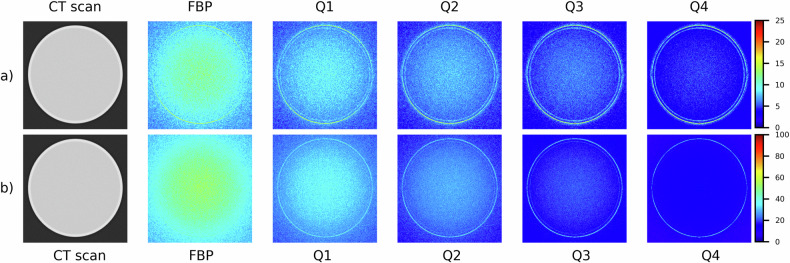
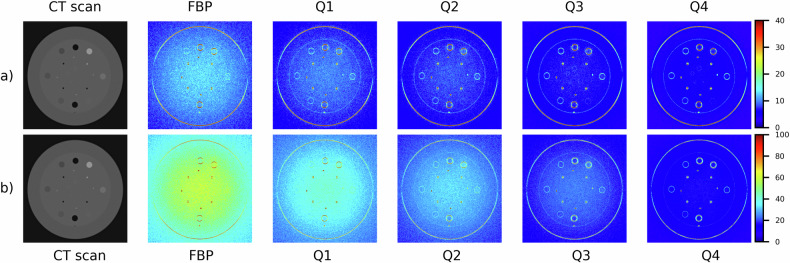
Forty repeated axial acquisitions (tube voltage 120 kV, tube load 200 mAs, slice thickness 0.4 mm) of a homogeneous water phantom and CTP404 module (Catphan-504) were performed. Water phantom acquisitions were also performed on a conventional energy-integrating detector (EID) scanner with a sinogram/image-based iterative reconstruction algorithm, using similar acquisition/reconstruction parameters. For smooth/sharp kernels, filtered back projection (FBP)- and iterative-reconstructed images were obtained. Noise maps, non-uniformity index (NUI) of noise maps, image noise histograms, and noise power spectrum (NPS) curves were computed.
For FBP-reconstructed images of water phantom, mean noise was (smooth/sharp kernel) 11.7 HU/51.1 HU and 18.3 HU/80.1 HU for PCD-scanner and EID-scanner, respectively, with NUI values for PCD-scanner less than half those for EID-scanner. Percentage noise reduction increased with increasing iterative power, up to (smooth/sharp kernel) 57.7%/72.5% and 56.3%/70.1% for PCD-scanner and EID-scanner, respectively. For PCD-scanner, FBP- and QIR-reconstructed images featured an almost Gaussian distribution of noise values, whose shape did not appreciably vary with iterative power. Noise maps of CTP404 module showed increased NUI values with increasing iterative power, up to (smooth/sharp kernel) 15.7%/9.2%. QIR-reconstructed images showed limited low-frequency shift of NPS peak frequency.
PCD-CT allowed appreciably reducing image noise while improving its spatial uniformity. QIR algorithm decreases image noise without modifying its histogram distribution shape, and partly preserving noise texture.
This phantom study corroborates the capability of photon-counting detector technology in appreciably reducing CT imaging noise and improving spatial uniformity of noise values, yielding a potential reduction of radiation exposure, though this needs to be assessed in more detail.
First voxelwise characterization of noise for a clinical CT scanner with photon-counting detector technology. Photon-counting detector technology has the capability to appreciably reduce CT imaging noise and improve spatial uniformity of noise values. In photon-counting CT, a model-based iterative reconstruction algorithm (QIR) allows decreasing effectively image noise. This is done without modifying noise histogram distribution shape, while limiting the low-frequency shift of noise power spectrum peak frequency.
光子计数探测器(PCD)技术有潜力降低计算机断层扫描(CT)中的噪声。本研究旨在使用基于模型的迭代重建算法(QIR)对临床PCD-CT扫描仪进行体素级噪声特征分析。
对均匀水模和CTP404模块(Catphan-504)进行40次重复轴向扫描(管电压120 kV,管负荷200 mAs,层厚0.4 mm)。还使用类似的采集/重建参数,在配备基于正弦图/图像的迭代重建算法的传统能量积分探测器(EID)扫描仪上对水模进行扫描。对于平滑/锐利内核,获得了滤波反投影(FBP)和迭代重建图像。计算了噪声图、噪声图的非均匀性指数(NUI)、图像噪声直方图和噪声功率谱(NPS)曲线。
对于水模的FBP重建图像,PCD扫描仪和平滑/锐利内核的平均噪声分别为11.7 HU/51.1 HU和18.3 HU/80.1 HU,EID扫描仪的平均噪声分别为18.3 HU/80.1 HU,PCD扫描仪的NUI值不到EID扫描仪的一半。噪声降低百分比随着迭代功率的增加而增加,PCD扫描仪和平滑/锐利内核分别高达57.7%/72.5%和56.3%/70.1%,EID扫描仪分别为56.3%/70.1%。对于PCD扫描仪,FBP和QIR重建图像的噪声值几乎呈高斯分布,其形状不会随着迭代功率而明显变化。CTP404模块的噪声图显示,随着迭代功率的增加,NUI值增加,平滑/锐利内核分别高达15.7%/9.2%。QIR重建图像显示NPS峰值频率的低频偏移有限。
PCD-CT在提高图像空间均匀性的同时,能显著降低图像噪声。QIR算法在不改变直方图分布形状的情况下降低图像噪声,并部分保留噪声纹理。
本体模研究证实了光子计数探测器技术在显著降低CT成像噪声和改善噪声值空间均匀性方面的能力,这可能会降低辐射剂量,不过这需要更详细的评估。
首次对采用光子计数探测器技术的临床CT扫描仪进行体素级噪声特征分析。光子计数探测器技术有能力显著降低CT成像噪声并改善噪声值的空间均匀性。在光子计数CT中,基于模型的迭代重建算法(QIR)能有效降低图像噪声。这是在不改变噪声直方图分布形状的情况下完成的,同时限制了噪声功率谱峰值频率的低频偏移。