Bagherinia Mansour, Rezaeian Shahab, Shakiba Ebrahim, Maleki Raheleh, Mohammad Karimi Mazhin Abbas, Darvishigilan Hadi, Janatolmakan Maryam, Karami Badriyeh
School of Health, Ilam University of Medical sciences, Ilam, Iran.
Infectious Diseases Research Center, Health Institute, Kermanshah University of Medical Sciences, Kermanshah, Iran.
Sci Rep. 2025 Jan 2;15(1):283. doi: 10.1038/s41598-024-79835-9.
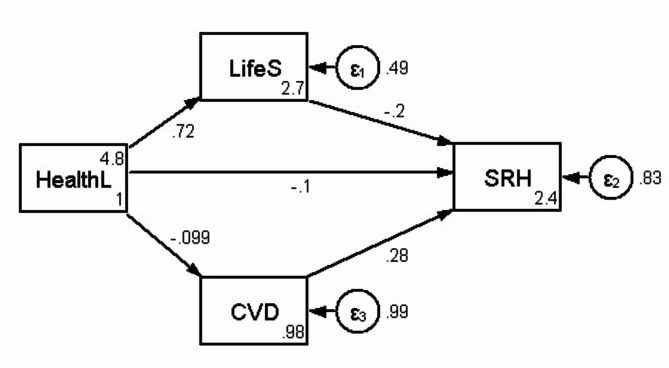
Self-rated health is related to the reduction of the burden of diseases and health outcomes. Various factors affect self-rated health. This study aimed to investigate the mediating role of life style in the relationship between health literacy and self-rated health. In 2023, 495 people aged 18-65 participated in this cross-sectional study. Montazeri et al.'s health literacy questionnaire, Eshaghi et al.'s healthy life style assessment questionnaire, and the self-rated health (SRH) questionnaire developed by the World Health Organization were used. The structural equation modeling (SEM) was used. Statistical analysis of data was performed using Stata version 14.2 software. Based on the results, a significant total effect of health literacy on self-rated health (β = - 0.27,p = 0.001), was identified. Life style (β = - 0.20) had a direct effect on self-rated health (p < 0.001). The result from SEM indicated that health literacy exhibited a direct effect on life style (β = 0.72). In addition, the principal hypothesis of this research posits the mediating function of lifestyle within the interrelationship between the two constructs of health literacy and self-rated health. Considering the mediating role of life style in the relationship between health literacy and self-rated health, to improve self-rated health, in addition to paying attention to the role of health literacy, it is necessary to take effective measures to positively change people's lifestyle.
自评健康与疾病负担减轻及健康结果相关。多种因素影响自评健康。本研究旨在探讨生活方式在健康素养与自评健康关系中的中介作用。2023年,495名18至65岁的人参与了这项横断面研究。使用了蒙塔泽里等人的健康素养问卷、埃沙吉等人的健康生活方式评估问卷以及世界卫生组织编制的自评健康(SRH)问卷。采用了结构方程模型(SEM)。使用Stata 14.2软件对数据进行统计分析。基于结果,确定了健康素养对自评健康有显著的总效应(β = - 0.27,p = 0.001)。生活方式(β = - 0.20)对自评健康有直接影响(p < 0.001)。结构方程模型的结果表明健康素养对生活方式有直接影响(β = 0.72)。此外,本研究的主要假设提出生活方式在健康素养和自评健康这两个构念的相互关系中起中介作用。考虑到生活方式在健康素养与自评健康关系中的中介作用,为了提高自评健康,除了关注健康素养的作用外,有必要采取有效措施积极改变人们的生活方式。